
2025 Dec 13th
Types of cooking knives: The essential guide for every
Types of Cooking Knives: The Essential Guide for Every Kitchen
Diving into the world of cooking knives can feel overwhelming, but it doesn't have to be. For over 90% of the jobs you'll tackle in the kitchen, you really only need three core tools. Think of it as your foundational toolkit: a versatile Chef's Knife, a precise Paring Knife, and a hardworking Serrated Knife.
Your Core Knife Toolkit: The Essential Trio
Walk into a professional kitchen supply store and you'll find a dazzling array of blades, each designed for a specific purpose. It's impressive, but building a functional collection starts with the basics. Just like a carpenter needs a hammer and saw before anything else, a cook needs a few indispensable knives to handle nearly every recipe that comes their way.
The goal isn't to own every knife under the sun. It's about mastering the few that do the heaviest lifting. By starting with the "big three," you build a powerful, efficient system that simplifies your prep work and lets you cook with confidence.
The Knives That Do It All
This core set is celebrated for its sheer utility. Together, these three can handle everything from rough chopping to the most delicate slicing.
- The Chef's Knife: This is the undisputed workhorse of any kitchen. Its broad, tapering blade is perfect for dicing onions, mincing herbs, and breaking down larger cuts of meat. You can explore some of the best with our professional-grade Chef's Knives.
- The Paring Knife: Your go-to for small, intricate tasks. This nimble little blade excels at peeling fruit, deveining shrimp, and any job where fine control is everything. Take a look at our collection of precision Paring Knives for home and commercial use.
- The Serrated Knife: Often called a bread knife, its saw-like edge slices through crusty loaves, delicate pastries, and soft-skinned produce like tomatoes without crushing them. Find the perfect one in our selection of durable Serrated Knives.
For anyone serious about cooking, having these three fundamental knives is non-negotiable. They are the bedrock of any good knife collection. To make it even clearer, here's a quick-glance table of your essential starter kit.
Your Essential Kitchen Knife Starter Kit
| Knife Type | Primary Use | Typical Blade Length |
|---|---|---|
| Chef's Knife | All-purpose chopping, dicing, mincing, and slicing | 8 to 10 inches |
| Paring Knife | Peeling, trimming, and detailed, in-hand work | 3 to 4 inches |
| Serrated Knife | Slicing bread, tomatoes, and delicate baked goods | 8 to 10 inches |
With just these three, you're equipped to handle almost any recipe with skill and efficiency.
The trend of home cooks equipping their kitchens with professional-quality tools is booming. The U.S. kitchen knife market alone was valued at around USD 430 million in 2024, largely driven by the popularity of cooking shows and a real desire for high-performance gear. You can read more about the growth of the kitchen knife market on fortunebusinessinsights.com.
By investing in these three high-quality knives, you are not just buying tools; you are setting yourself up for a more efficient, enjoyable, and skillful cooking experience. They are the true cornerstones of any functional kitchen.
Meet the Everyday Kitchen Workhorses
So you've got the foundational trio. Now, let's zoom in and see what makes each of these blades tick. These knives aren't just pieces of steel; they're specialized tools, each designed to make a specific set of kitchen tasks feel completely effortless. Getting a feel for their individual strengths is the secret to unlocking real efficiency and making your prep work genuinely enjoyable.
We'll start with the undisputed champion of the cutting board, the Chef's Knife, and see how it stacks up against its equally capable Japanese cousin, the Santoku. From there, we'll get into the fine details with the Paring Knife and finish with the often-underestimated power of a good Serrated Knife.
The All-Powerful Chef's Knife
If you could only have one knife for the rest of your life, the Chef's Knife would be it. Think of it as the versatile lead actor in your kitchen—it can handle just about any role you throw at it. The blade, usually eight to ten inches long, has a gentle curve that allows for a smooth rocking motion across the cutting board.
That classic rocking chop is perfect for making quick work of mincing herbs, dicing onions, or even breaking down a whole chicken. The broad, heavy heel of the blade can power through tough vegetables like squash, while the pointed tip gives you surprising precision for finer tasks. It's this do-it-all capability that makes it an absolute must-have.
For those ready to invest in a true kitchen cornerstone, our collection of high-performance Chef's Knives offers fantastic options for both bustling commercial kitchens and passionate home cooks.
The Precise Santoku Knife
The Santoku knife is the Japanese answer to the Western Chef's Knife. The name itself translates to "three virtues," which points to its mastery of slicing, dicing, and mincing. Unlike the curved belly of a Chef's Knife, the Santoku has a much straighter edge and a sheepsfoot tip that curves down sharply.
This unique shape encourages a more direct, downward chopping motion rather than a rock. You'll also notice many Santoku knives have hollow-ground indentations (called kullenschliff) along the blade. These create tiny air pockets that are brilliant for preventing starchy potatoes or thin slices of cucumber from sticking.
A Santoku truly shines when you need razor-thin, perfectly uniform slices. Its design gives you exceptional control, making it a favourite for prepping vegetables for a stir-fry or finely slicing fish.
To see how this unique design can change your prep work, browse our expertly crafted Santoku Knives, designed for precision and balance.
This visual breaks down the core jobs of the Chef's Knife, Paring Knife, and Serrated Knife, showing their primary roles in the kitchen.
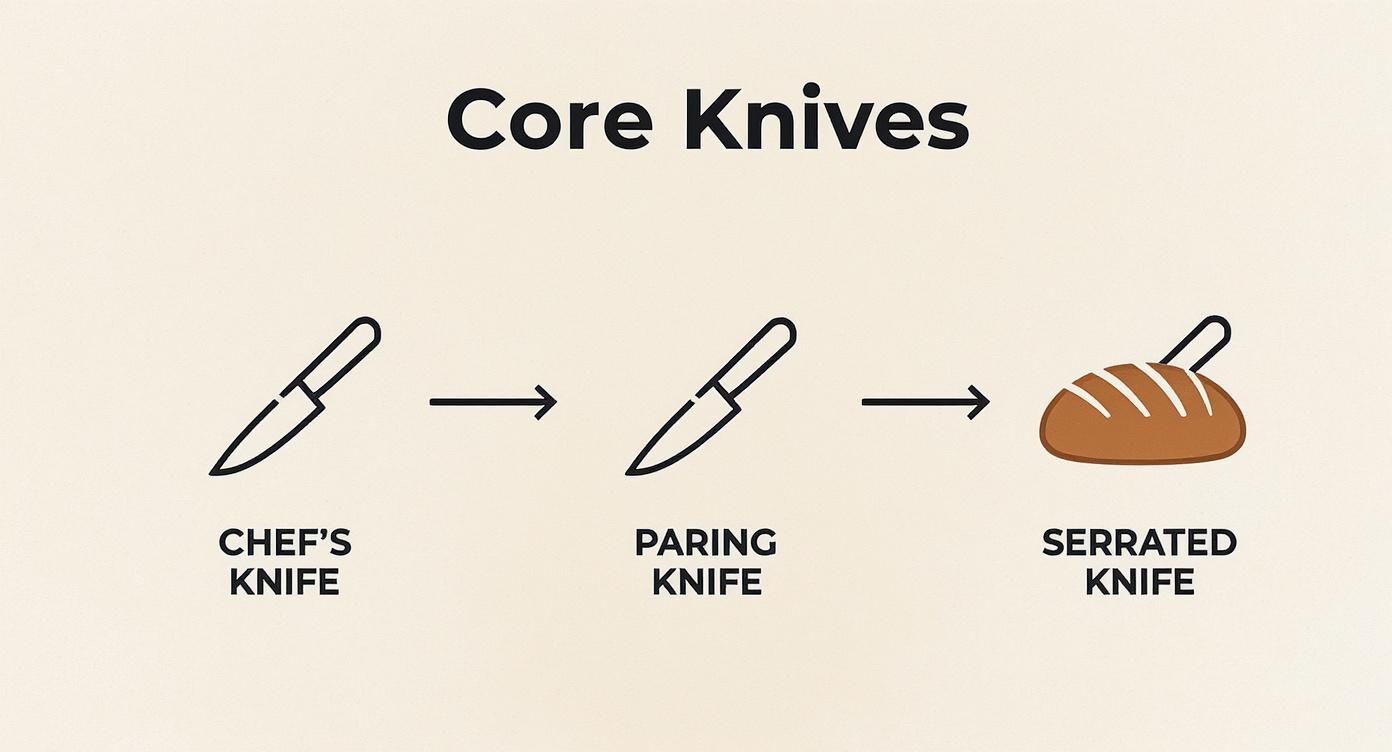
It's easy to see how these three distinct types of cooking knives cover the vast majority of kitchen tasks, from heavy chopping to delicate peeling and slicing.
The Nimble Paring Knife
While the Chef's Knife handles the big jobs, the Paring Knife is your go-to expert for anything small and detailed. With a blade that's typically just three to four inches long, it's basically a miniature Chef's Knife designed to feel like an extension of your hand.
This is the knife you'll grab when you're working off the cutting board. Think about tasks like peeling an apple in one long spiral, hulling strawberries, or deveining shrimp. Its small size offers unmatched control for intricate jobs that a larger blade would make clumsy and downright dangerous.
- Peeling: The short blade manoeuvres easily around the curved surfaces of fruits and vegetables.
- Coring: Its sharp, fine tip is perfect for popping the cores out of apples or digging the eyes out of potatoes.
- Trimming: Use it to trim the excess fat from a piece of meat or slice the ribs from a chilli pepper.
Every kitchen, from a five-star restaurant to a home galley, needs a reliable paring knife. You can find your perfect partner for detailed work in our selection of sharp and durable Paring Knives.
The Indispensable Serrated Knife
Often just called a "bread knife," the Serrated Knife is a specialist with a crucial talent. Its long, tooth-like edge acts like a tiny saw, letting it slice through foods that have a tough exterior and a soft interior without squashing everything.
The most obvious use is for a crusty loaf of sourdough, where a straight-edged knife would just slip or compress the delicate crumb inside. But its job doesn't stop there. This is, hands down, the best tool for slicing a ripe tomato, as the serrations gently pierce the skin instead of tearing it.
A serrated knife is also brilliant for levelling cakes, slicing through delicate pastries, and even cutting into tough-skinned citrus or melons. It bites into slippery surfaces where other knives fail, giving you clean, perfect cuts every time. Check out our robust collection of Serrated Knives to find the perfect length and edge for your needs. Together, these workhorses form a complete and powerful system, ready to tackle any recipe you can imagine.
Mastering Specific Tasks with Specialty Knives
Once you have your core knives sorted, you can start getting into the really fun stuff. Think of it like a mechanic's toolbox—you can handle most jobs with a good wrench and screwdriver, but the real magic happens when you have precisely the right tool for a specific task. This is where specialty knives come in, turning tricky jobs into smooth, satisfying work.
These aren't just extra knives; they're precision instruments. You wouldn't use a sledgehammer to hang a picture frame, and you shouldn't force a chef's knife to do jobs it wasn't built for. Matching the right blade to the job saves you time, gives you cleaner results, and frankly, makes you a much better cook.
Let's look at the knives the pros pull out to get those flawless, restaurant-quality results. These are the blades that handle the delicate, the tough, and the downright demanding jobs with serious grace and power.
The Agile Boning Knife
The Boning Knife is a butcher's secret weapon, built with a single purpose: to separate meat from bone as cleanly as possible. Its blade is usually thin and narrow with a sharp, pointed tip that lets you get right up against the bone.
What makes it so good at its job is its flexibility. A boning knife can be stiff or flexible, letting you curve and pivot around joints and along bones with incredible control. This agility means less wasted meat, whether you're breaking down a whole chicken, trimming a rack of lamb, or taking the silver skin off a pork tenderloin.
- Stiff Boning Knives: Your go-to for tough cuts like beef and pork. They give you the leverage to push through dense cartilage without bending.
- Flexible Boning Knives: Perfect for poultry and fish, where the blade needs to bend and glide around delicate bone structures.
For anyone who works with whole cuts of meat, our collection of professional-grade Boning Knives delivers the control and sharpness you need for clean, efficient work.
The Delicate Fillet Knife
At a glance, a Fillet Knife looks a lot like a boning knife, but it's a far more specialized tool. It's even thinner and significantly more flexible, making it the undisputed champion for handling delicate fish.
That incredible flexibility is the key—it allows the blade to move effortlessly along the backbone and just under the skin of a fish, lifting off perfect, bone-free fillets. Trying to do this with a chef's knife is clumsy and almost always tears the delicate flesh.
The true magic of a fillet knife is its ability to follow the contours of the fish, preserving the integrity of the flesh and yielding beautiful, clean cuts every time. It's an essential tool for any seafood enthusiast.
If you want to step up your fish game, check out our selection of ultra-flexible Fillet Knives, designed for maximum yield and precision.
The Mighty Meat Cleaver
While other knives rely on finesse, the Meat Cleaver is all about pure, brute-force power. This is the heavyweight champion of the kitchen, with a thick, heavy, rectangular blade built for the toughest jobs imaginable.
Its job is simple: chop through bone, dense cartilage, and tough connective tissue. The sheer weight of the cleaver does most of the work, letting you break down large cuts of meat or portion a whole chicken with a single, decisive chop. It's one of the most commanding types of cooking knives you can own.
This is not a tool for slicing tomatoes. It's for the kind of work that would chip, bend, or completely destroy a thinner, more delicate blade. A good cleaver is an investment in capability, opening up a world of butchery possibilities right in your own kitchen. For a tool that can handle anything you throw at it, check out our durable Meat Cleavers.
The Elegant Carving Knife
The Carving Knife is the star of the show at holiday feasts and Sunday dinners. With its long, thin blade and pointed tip, it's expertly designed to slice large roasts—like turkey, ham, or prime rib—into clean, uniform portions.
The length is what matters here. It lets you slice through a large roast in a single, smooth stroke, avoiding that back-and-forth sawing motion that tears meat fibres and ruins the texture. The result is a more tender and juicy slice on the plate. Often paired with a carving fork, this duo gives you the control you need to serve up beautiful, professional-looking portions.
The growing interest in home cooking has fuelled a significant demand for all types of high-quality knives. The U.S. knife market, which includes tools used in many Canadian households, generated around USD 698.8 million in 2021 and is projected to reach over USD 1.1 billion by 2030. This growth is partly supported by outdoor recreational activities popular among Canadians, where versatile knives are essential for food prep. You can discover more insights about the expanding U.S. knife market on grandviewresearch.com.
Elevate your next family dinner with a tool from our collection of elegant Carving Knives, designed for flawless presentation.
Understanding What Makes a Great Knife
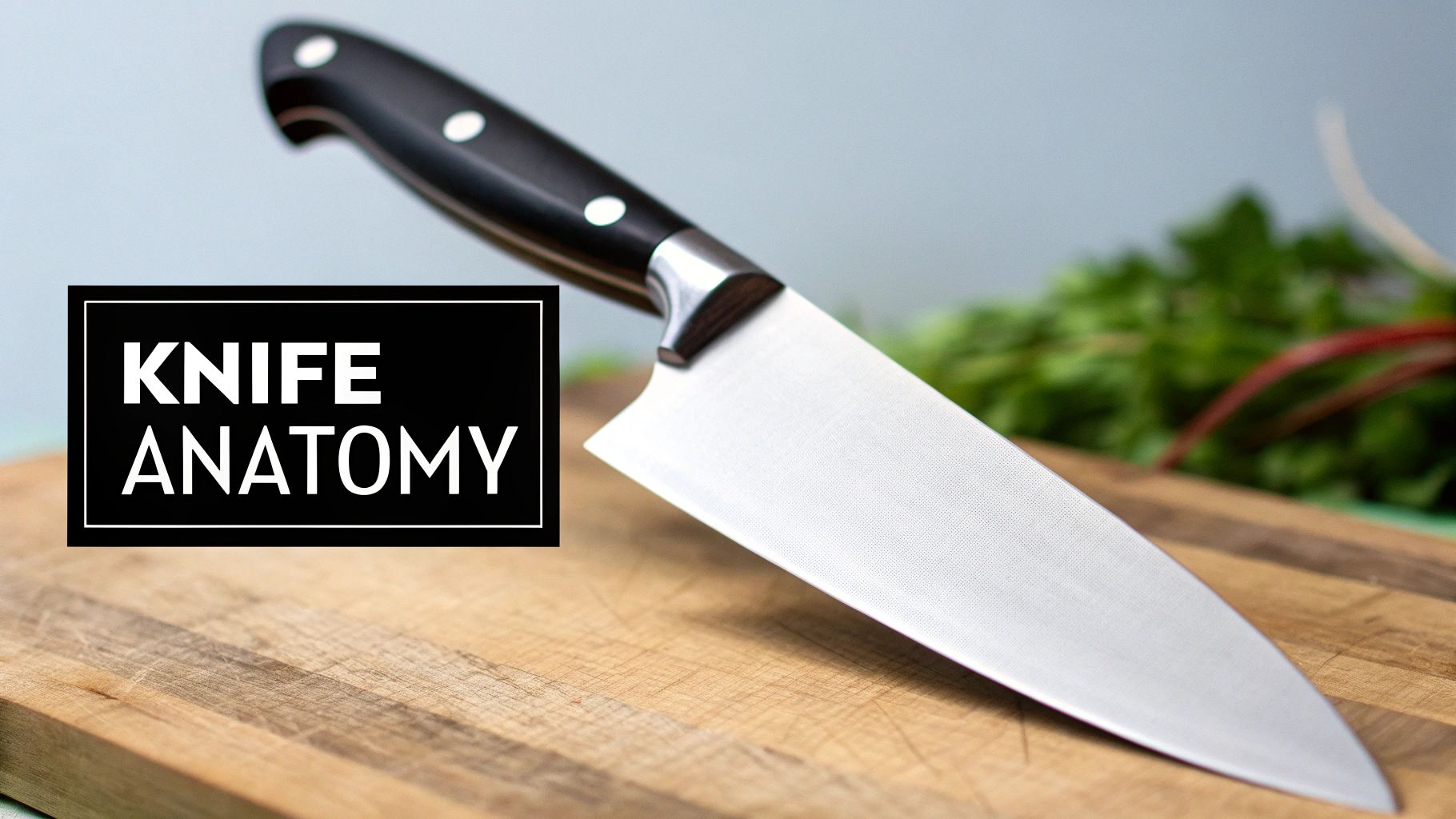
Ever wondered why some knives feel like a natural extension of your hand, while others are just plain awkward? It's not about the price tag. The secret is in the anatomy of the knife—how it's built and the materials used to craft it. Once you understand these core components, you can see past the marketing and spot what truly defines a knife's performance, balance, and longevity.
The journey starts with the knife's construction. Two words you'll hear a lot are tang and bolster. The tang is the part of the blade that extends down into the handle, and the bolster is that thick junction where the blade and handle meet. A full tang, where a single piece of steel runs the entire length of the handle, is the undisputed mark of a durable, well-balanced knife.
This solid construction does more than just prevent the blade from snapping off. It adds crucial weight that gives you a more controlled, stable feel in your hand. It's a small detail that makes a world of difference in both safety and performance.
The Soul of the Knife: Blade Materials
The blade material is the heart of the knife. It dictates everything from how sharp you can get the edge to how often you'll be pulling out the honing steel. Each material offers a unique trade-off, and the right choice really comes down to your priorities in the kitchen.
You'll find that knife makers are always pushing the envelope with new alloys and designs. This innovation is driven by what cooks want: ease of use and advanced performance. In fact, trends like assisted-opening mechanisms have exploded, accounting for 80% of knife sales in the last five years. You can discover more insights about knife industry statistics on kniferights.org.
When it comes to the blade itself, here's a quick comparison of the most common materials you'll encounter.
Comparing Blade Materials
| Material | Edge Retention | Corrosion Resistance | Maintenance Level | Best For |
|---|---|---|---|---|
| Stainless Steel | Moderate | High | Low | Everyday home and professional use; a great all-rounder. |
| High-Carbon Steel | Excellent | Low | High | Professional chefs who demand a razor edge and don't mind the upkeep. |
| Ceramic | Exceptional | Complete | Very Low | Slicing fruits and vegetables with precision; not for heavy-duty tasks. |
Let's break that down a bit more:
- Stainless Steel: This is the workhorse of the kitchen knife world for a reason. It's tough, low-maintenance, and highly resistant to rust and stains. While older stainless steels had a reputation for being softer, modern alloys hold a great edge and are a fantastic all-around choice. Our Chef's Knives collection is filled with reliable stainless steel options perfect for busy kitchens.
- High-Carbon Steel: A favourite among culinary purists and many professional chefs. Because it's harder than stainless steel, it can take and hold a wicked-sharp edge for much longer. The catch? It's more brittle and will rust if you don't meticulously clean and dry it after every single use.
- Ceramic: Made from zirconium dioxide, ceramic blades are incredibly hard and can stay sharp for what feels like forever. They're also lightweight and totally immune to rust. But that hardness is also their weakness—they are extremely brittle and can easily chip or shatter if dropped or used to pry or twist.
Ultimately, the choice of blade material is a personal one, balancing the desire for a perfect edge against the reality of daily maintenance.
A Handle on Comfort and Control
A knife's handle is just as critical as its blade. This is your connection to the tool, and it affects everything from comfort and grip to kitchen hygiene. The right handle feels secure in your hand, wet or dry, giving you the confidence you need for precise, delicate work.
The best handle is one you don't even notice. It should fit the curve of your palm so perfectly that it feels like a part of you, giving you total control over the blade's every move.
Different materials offer their own pros and cons, so think about how you cook when making a choice.
- Wood: Classic and beautiful, wood handles feel warm and comfortable in the hand. Their downside is that they are porous and can absorb moisture and bacteria if not cared for. They often require hand-washing and a bit of oiling now and then.
- Composite: Materials like Pakkawood or Micarta give you the best of both worlds. They're made by compressing layers of wood or fabric with resin, offering the handsome look of wood but with far better durability, water resistance, and hygiene.
- Metal: You can't beat stainless steel handles for durability and sanitation. They are incredibly tough and easy to clean, but they can get a bit slippery when wet. To fix this, they often feature a textured grip.
By understanding these elements—from the tang and bolster to the blade and handle—you're equipped to choose the best types of cooking knives not just for your budget, but for the way you actually cook. For those outfitting a professional kitchen, our curated selection of commercial-grade knives offers a variety of materials and designs built for performance.
How to Properly Care for Your Knives
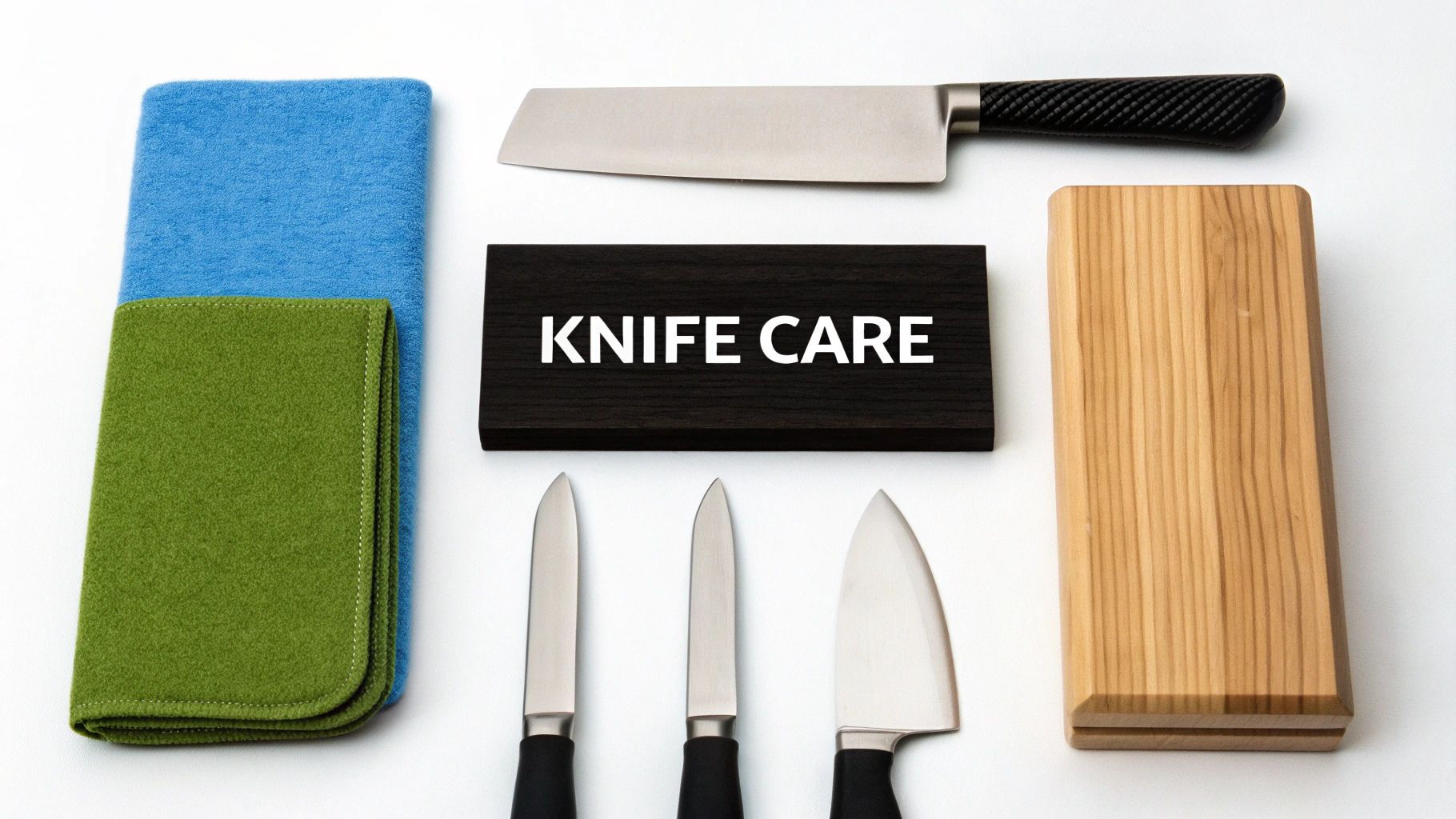
Buying a great set of knives is just the beginning. The real trick is protecting that investment so your blades stay sharp, safe, and dependable for years, maybe even a lifetime. It all boils down to a few simple habits for cleaning, maintenance, and storage.
Let's clear up the biggest point of confusion first: honing versus sharpening. Think of it like taking care of a car. Honing is the regular tune-up, while sharpening is when you finally need a brand-new set of tires.
Honing vs. Sharpening
Honing is all about realigning the microscopic teeth along the blade's edge. With everyday use, that edge gets knocked around and bent out of shape. Honing doesn't actually remove any steel; it just straightens everything back out, keeping your knife performing at its best between sharpenings.
Sharpening, on the other hand, grinds away a tiny amount of steel to create a completely new, razor-sharp edge. You only need to do this when honing just isn't cutting it anymore—literally.
To keep that perfect edge day-to-day, a honing steel is a must-have tool for any kitchen. Using one is easier than it looks. Just hold the steel vertically with the tip planted on a cutting board. Bring the heel of the blade to the top of the steel at about a 15 to 20-degree angle.
Now, just pull the knife down and toward you in a smooth sweep, running the blade from heel to tip. Do the same on the other side of the steel. A few quick strokes on each side before you start cooking is all it takes to keep your knives in top form.
The Golden Rules of Cleaning
Want to ruin a good knife in record time? Put it in the dishwasher. The intense heat, harsh detergents, and constant banging against other dishes will wreck the blade, warp the handle, and dull the edge faster than anything else.
The rule is simple and absolute: always wash your knives by hand. A bit of warm, soapy water and a soft sponge is all you need. The most crucial part? Dry them immediately and completely to stop rust in its tracks, especially if you have high-carbon steel blades.
This one simple habit is the single most important thing you can do for your knives.
Safe and Smart Knife Storage
How you store your knives is just as important as how you wash them. Tossing them into a drawer full of other utensils is a disaster waiting to happen. You'll end up with chipped blades and dulled edges, not to mention it's a serious hazard every time you reach in.
Good storage protects both your knives and your fingers. Here are a few solid options:
- Magnetic Strips: Mount one on the wall to keep your knives secure and out of the way. It also lets air circulate, which is great for preventing any moisture buildup.
- Wooden Knife Blocks: A classic for a reason. A good block gives each blade its own protected slot. Just make sure you keep the block clean and dry inside.
- In-Drawer Trays: If you have to use a drawer, get a dedicated knife tray. These have individual sheaths that stop the blades from banging into each other.
By combining routine maintenance with proper cleaning and storage, you can make sure every knife in your collection performs exactly like it's supposed to for years to come. Check out our lineup of essential knife care accessories to keep your blades in peak condition.
How to Choose the Right Knives for You
Alright, you've got the basics down on knife types, materials, and how to look after them. Now comes the fun part: picking the right tools for your own kitchen. There's no single "perfect" set for everyone; the best collection is deeply personal and built around how you cook.
If you're an everyday home cook, the most sensible place to start is with the "big three": a great chef's knife, a nimble paring knife, and a solid serrated knife. Honestly, that trio will handle over 90% of all your kitchen tasks, from chopping onions to slicing bread and peeling apples.
But if you're a passionate foodie looking to step up your game, you might find yourself adding a Santoku for razor-thin vegetable slices or a boning knife to break down your own cuts of meat.
Sets vs. Individual Knives
This is the classic debate: buy a pre-packaged knife set, or build your collection one piece at a time? While those big knife blocks look impressive on the counter, they're often stuffed with blades you'll barely touch.
- Knife Sets: These can be a fantastic, cost-effective way to get started. Our Complete Knife Sets are carefully curated to give you a balanced range for all-around use without any useless filler.
- Individual Knives: Building your collection piece-by-piece guarantees that every single tool is one you truly need and love. You can invest in a top-tier chef's knife now and add more specialized blades down the road as you need them.
My advice? Think about a hybrid approach. Start with an essential set to cover your bases, then expand with individual specialty knives from our collections—like a flexible Fillet Knife—as your skills and culinary interests grow.
For professional chefs and commercial kitchens, it's a different ball game entirely. Here, durability and sheer performance are everything. We specialize in outfitting high-volume businesses with tools built to withstand the punishing pace of a professional environment. Our team can put together personalized recommendations for bulk orders, ensuring your crew has exactly what they need to get the job done right.
Ready to build your toolkit? Take a look through our curated Kitchen Knife Collections. For professional inquiries or some one-on-one advice, just get in touch with our team today.
Common Questions About Cooking Knives
The following operator questions are answered with cited sources. Every FAQ links to Reddit, Quora, PAA, or a public regulator.
What knife types should a Canadian chef or cook buy first when building a kit?
Source: r/Cooking: What kitchen knife set would you recommend and why
How should a buyer compare a chef knife versus a santoku for a busy prep line?
Source: r/Cooking: Need help finding a good commercial knife set
Which commercial knife brands do experienced Canadian chefs actually keep on the line?
Source: r/chefknives: Knives used in professional kitchens vs retail knives
How can a buyer tell whether a commercial knife is worth the price versus a consumer-grade blade?
What knife storage and sanitation practices keep a commercial kitchen safe and efficient?
Source: r/chefknives: Professional chefs of Reddit what are your recommendations for chef knives
How should a small Canadian kitchen plan a complete knife set without overspending?
Source: r/Cooking: Looking for a gluten-free nut-free breadcrumb substitute
Which specialty knives are worth buying versus skipping for a small commercial kitchen?
How does a buyer maintain and sharpen commercial knives to keep them service-ready?
Source: r/KitchenConfidential: Always used peanut oil now boss wants us to do beef tallow
Regulatory reference: The FDA Food Code and Health Canada's food safety guidelines set the standards for commercial kitchen operations across North America.
Authoritative Sources
The following government and public-health sources informed the operator guidance above. Citations to Reddit, Quora, and operator forums appear in the FAQ block above.