
 US Dollar (USD)

2025 Dec 11th
How to Start catering business: A Quick Startup Guide
How to Start a Catering Business: A Quick Startup Guide
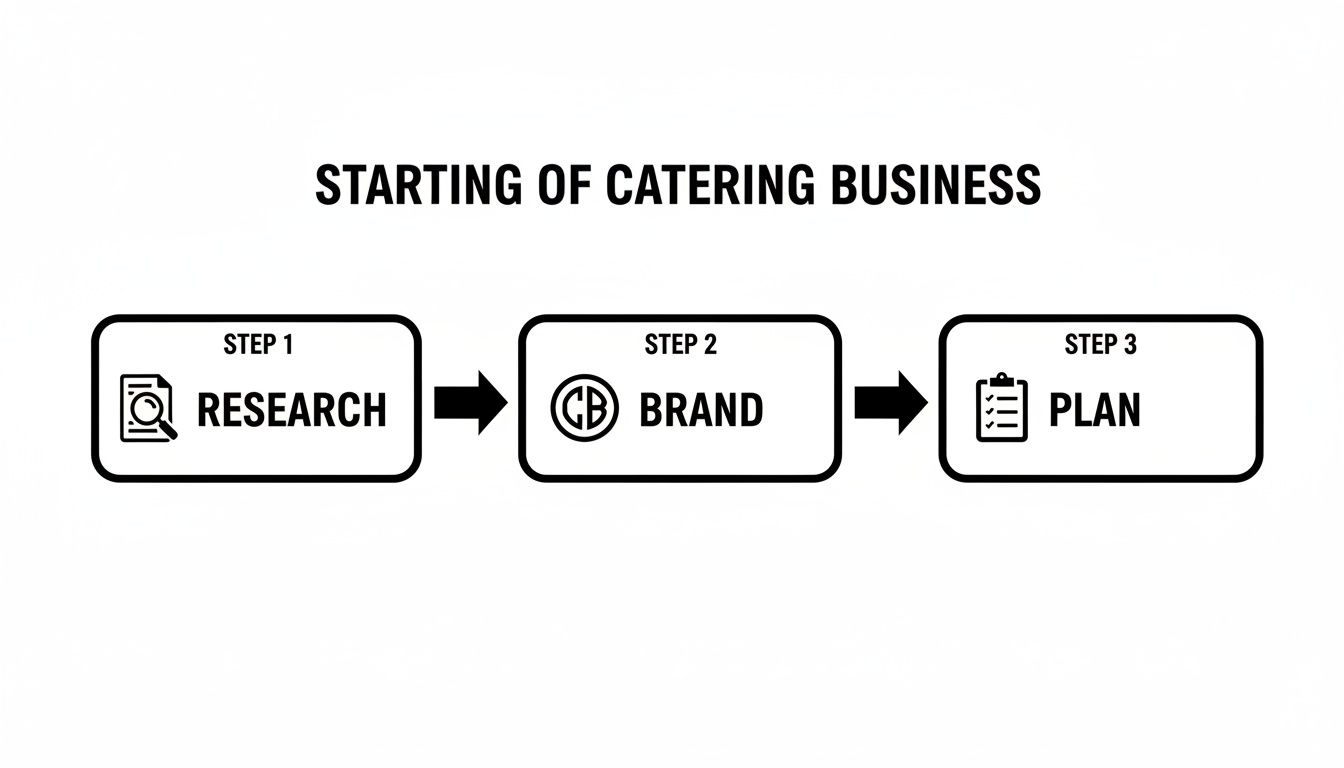
Before you even think about buying your first flat of strawberries, your most critical ingredient is a solid plan. Nailing down your foundation—market research, brand identity, and a killer business plan—is what separates the thriving caterers from the ones who fizzle out.
Let's move past the theory and get into the practical, actionable steps that will set you up for success.
Find Your Profitable Niche
The catering world can feel a little crowded. That's why trying to be everything to everyone is a recipe for disaster. Carving out a specific niche is your best bet to stand out, streamline your operations, and make your marketing dollars actually count.
So, where do you fit in? Think about what you're genuinely passionate about and what your local community is missing.
Corporate Catering: This is your bread and butter for repeat business. Think weekday office lunches, breakfast meetings, and company parties. The schedules are often predictable, which is a huge plus.
Weddings and Social Events: Definitely a high-margin game, but it demands meticulous planning, more staff, and a willingness to work weekends. If you thrive on logistics and creating memorable experiences, this could be for you.
Specialized Diets: The demand for vegan, gluten-free, or farm-to-table menus is exploding. If you can master a specific dietary need, you'll become the go-to expert.
Fusion Cuisine: Love blending different culinary traditions? This is a fantastic way to create a unique menu that competitors can't easily copy.
Once you've got a niche in mind, it's time to build a brand that tells that story.
Develop a Strong Brand Identity
Your brand is so much more than a cool logo. It's the entire vibe—the story you tell, the feeling a client gets when they see your menu, the professionalism of your staff. It's what makes you you. A great brand connects with your ideal customer before they've even tasted a bite.
Your business name should be memorable and give a little hint about your style. Everything from your menu design and website to your staff uniforms should feel consistent. This is how you build recognition and, more importantly, trust.
A well-defined brand acts as your silent salesperson. It communicates your value, professionalism, and unique culinary perspective before a potential client even tastes your food. This is your chance to showcase what your catering business is all about.
Think about it: a caterer specializing in rustic, farm-to-table weddings will look and sound completely different from one focused on sleek, modern corporate events. Let your brand be the guide for every decision you make.
Create a Comprehensive Business Plan
This is your roadmap, your blueprint for success. A business plan forces you to think through every detail and is absolutely non-negotiable if you plan on seeking funding from a bank or investors.
Make sure your plan covers these key areas:
Executive Summary: A quick, punchy overview of your entire business concept.
Company Description: Get into the details of your niche, your mission, and your legal structure.
Market Analysis: Show you've done your homework on your target audience and what the competition is up to.
Financial Projections: This is where the rubber meets the road. Map out your startup costs, revenue forecasts, and when you expect to be profitable. Don't forget to budget for everything from initial inventory like bulk spices to essential light equipment.
Starting a catering business in California, for example, means dealing with a unique set of economic factors. As of 2025, the state's food and drugs sector, which includes catering, contributes around 4.5% of total sales tax revenue. While some related sectors have struggled, catering has seen growth thanks to specific demands, with projected sector growth of about 2.1% in FY 25-26 and 3.4% in FY 26-27.
But it's not all smooth sailing. Caterers there have to plan for rising menu prices, new labour laws, and higher packaging costs due to state sustainability mandates. These are real-world expenses that need to be in your budget from day one. You can learn more about these factors in the California Consensus Forecast Q2 2025 data from hdlcompanies.com.
Navigating Canadian Legal and Health Requirements
Getting your legal and health requirements sorted isn't just a box to tick—it's the bedrock of a trustworthy and sustainable catering business. This is the stuff that separates the pros from the hobbyists and protects you, your clients, and your brand from day one.
In Canada, this means navigating a mix of federal, provincial, and municipal regulations. It might sound daunting, but with a clear plan, it's entirely manageable.

Honestly, this is what builds immediate credibility. Before you serve a single canapé, you need to ensure every part of your operation is compliant. Corporate clients and event planners expect this level of professionalism, and getting it right shows them you're serious.
Essential Licenses and Certifications
Fair warning: getting properly licensed can be the longest part of the setup process, so it's smart to get the ball rolling early. The specific permits you'll need can vary a bit by province and city, but a few key documents are universal across Canada for anyone figuring out how to start a catering business legally.
Here are the non-negotiables to get on your radar:
Business Registration: First things first, you need to register your business name and choose a legal structure (sole proprietorship, partnership, or incorporation). This is a foundational step that lets you open a business bank account and operate officially.
Food Handler Certification: In Canada, at least one person with a valid food handler certificate (like FoodSafe or an equivalent provincial program) must be present during food preparation and service. My advice? Get yourself and all key staff certified. It's best practice.
Municipal Business License: Your city or town will require you to have a license to operate a catering business within its jurisdiction. This usually involves an application and a fee, and it may need to be renewed annually.
Liquor License: Planning to serve alcohol? You'll need a specific liquor license. These are provincially regulated and come with strict rules, like requiring servers to have Smart Serve certification in Ontario. This is a separate, detailed process, so look into it early.
Passing Your Public Health Inspection
Think of your local public health unit as a partner in food safety, not an adversary. Their inspections are designed to prevent foodborne illness and make sure you're following established best practices.
An inspector will visit your commercial kitchen (or home kitchen, if permitted by local cottage food laws) to check that it meets all health and safety standards.
An A-grade on a health inspection is more than a requirement; it's a powerful marketing tool. It tells clients that you take their well-being seriously and operate with the highest standards of cleanliness and professionalism.
To get ready, dial in on these critical areas:
- Proper Food Storage: This means maintaining correct temperatures for fridges and freezers, using proper shelving to keep food off the floor, and having a clear first-in, first-out (FIFO) system for inventory.
- Sanitation and Cleaning Procedures: Inspectors want to see rigorous cleaning schedules for all surfaces and equipment. Make sure you have a three-compartment sink for washing, rinsing, and sanitizing, and use commercial-grade sanitation supplies that are approved for foodservice environments.
- Cross-Contamination Prevention: This is huge. It means using separate cutting boards and utensils for raw and cooked foods, especially when you're handling common allergens.
- Personal Hygiene: This covers everything from proper hand-washing stations to making sure staff wear clean uniforms and hairnets.
Protecting Your Business with Insurance
Insurance is your financial safety net. A single accident at an event—whether it's a guest slipping or a case of food poisoning—could be financially devastating without the right coverage. Don't even think about operating without it.
The most critical policy is Commercial General Liability (CGL) insurance. This protects you against claims of bodily injury or property damage that might happen during your operations.
Most venues will actually require you to provide proof of CGL insurance with a minimum coverage amount—often $2 million—before they'll even let you cater on their premises. This is standard industry practice and a clear sign that you run a professional, responsible business. Securing the right insurance is a crucial final step in legally launching your catering company.
Budgeting Costs and Sourcing Your Equipment
Let's talk about the money. A detailed financial plan is the absolute backbone of a successful catering business. Before you start dreaming up menus and marketing campaigns, you need a realistic grip on your startup costs and a solid budget to guide every dollar you spend. This is the moment your culinary passion gets real and transforms into a viable business.
Figuring out the financial side of a catering business means accounting for absolutely everything, from the big-ticket equipment down to the very first box of salt. Without a clear financial roadmap, it's frighteningly easy to overspend and put your business in jeopardy before you've even served your first client.
Breaking Down Your Startup Costs
Startup costs can swing wildly depending on your business model. A home-based operation focusing on small, drop-off lunch orders will have a much lower barrier to entry than a full-scale wedding caterer. Still, some expense categories are universal.
Your initial budget needs to cover these key areas:
Licensing and Insurance: Get all your legal ducks in a row. This means business registration, food handler certifications, and that non-negotiable commercial general liability insurance.
Kitchen Access: This is a big one. Whether you're renting a commercial kitchen by the hour or (where permitted) upgrading your home setup to meet code, this will be a significant line item.
Initial Inventory: Think about all the non-perishable food items, spices, and pantry staples you'll need for your first few gigs. Stocking up on bulk items here can save you a bundle down the road.
Packaging and Disposables: This stuff adds up fast. We're talking take-out containers, aluminum trays, plastic wrap, napkins, and disposable cutlery.
Marketing Materials: A basic website, some professional-looking business cards, and a small budget for initial online promotion are essential for landing those crucial first clients.
The single most common mistake I see new caterers make is underestimating their ongoing operational costs. Your budget isn't just a one-time startup expense; it needs to project your monthly costs for at least the first six months. This ensures you have enough cash flow to stay afloat while you build momentum.
Sourcing Your Essential Equipment
Your equipment is your arsenal. The right tools mean you can execute your menu flawlessly, keep food safe, and look professional doing it. The big question for every new caterer is whether to buy new, buy used, or lease. Each path has real pros and cons that will directly impact your startup budget.
Making the right call here comes down to your capital, the scale of your business, and how you want to manage long-term value.
To Buy New, Used, or Lease
The global catering market is growing, with a forecasted Compound Annual Growth Rate (CAGR) of 6.2% between 2026 and 2035, expecting to reach an estimated USD 140.85 billion. This growth is being pushed by trends like sustainability and new tech, which can influence what equipment you choose. While that big number is promising, what really matters is your local market. For example, California's incredibly vibrant foodservice scene, with its 83,501 eating establishments generating USD 135.8 billion in sales in 2022, shows just how much regional economies shape the industry. New caterers in competitive markets like that often need top-tier equipment just to meet high consumer expectations. You can explore more about these market dynamics to see how they affect business strategies nationwide and learn more about the US catering market growth on expertmarketresearch.com.
This growth makes smart equipment decisions even more critical. You need to be efficient and reliable from day one.
When you're sourcing your gear, you're essentially choosing between spending money now (buying new), spending time and taking on some risk (buying used), or spreading out the cost (leasing). Here's how it breaks down.
Equipment Sourcing Options for Catering Startups
| Sourcing Option | Upfront Cost | Long-Term Value | Maintenance & Reliability | Best For |
|---|---|---|---|---|
| Buying New | High | Excellent. Full warranty and you own the asset. | Highest. No prior wear and tear. | Well-funded startups planning for immediate, high-volume operations. |
| Buying Used | Low to Medium | Good. Depreciates slower than new. | Varies. No warranty; requires a thorough inspection before you buy. | Bootstrapped caterers who can inspect equipment and handle potential repairs. |
| Leasing | Lowest | None. You don't build any equity. | Typically included. Repairs and maintenance are often covered. | Startups with limited capital who need high-end equipment right away. |
Each option has its place, and many successful caterers use a hybrid approach—leasing a big-ticket item like a convection oven while buying used prep tables and new smallwares.
When you're just starting out, focus on the items that are absolutely critical for food safety and transport. High-quality food transport solutions are non-negotiable. You can always prep food a bit slower, but you can't fix food that arrives at an unsafe temperature. In the same vein, investing in durable serving ware presents a professional image from your very first event. These foundational pieces are where your budget should be prioritized.
Figuring Out Your Menu and Nailing Your Pricing
Your menu is the heart and soul of your catering business. It's your signature, your brand identity served up on a plate. But an incredible menu without a smart pricing strategy is just an expensive hobby. You have to master both the art of menu creation and the science of pricing to turn your passion into a profitable, long-term business.
This is where your culinary vision becomes a real, marketable service. It's about more than just delicious food; it's about crafting dishes that not only wow your clients but also make solid financial sense for your bottom line. Getting this right from day one is one of the most important steps in building a catering business that actually lasts.
Designing a Menu That's Both Profitable and Practical
Before you start listing every amazing dish you've ever made, press pause. A killer catering menu is a careful balancing act between creativity, practicality, and profitability. Your niche—the one you figured out earlier—should be your North Star here.
For example, a menu for corporate lunches needs to be efficient and easy to serve buffet-style, and the food has to hold its temperature well. A wedding menu, on the other hand, gives you more room to play with complex, plated dishes that create that once-in-a-lifetime, high-end experience.
As you build your initial offerings, keep these factors front and centre:
Scalability: Can you make this dish for 100 people just as perfectly as you can for 10? Stick to recipes that scale up without the quality scaling down.
Transportability: How well does the food travel? Delicate sauces, crispy textures, and perfectly cooked proteins can turn into a soggy, disappointing mess if they aren't designed for the road.
Ingredient Sourcing: Build your menu around ingredients that are consistently and readily available from your suppliers. Relying on rare or highly seasonal items is a recipe for sourcing nightmares and wildly unpredictable costs.
Dietary Flexibility: Design your dishes with modifications in mind from the get-go. Can a dish be easily adapted to be gluten-free, vegan, or nut-free? Offering these options isn't a bonus anymore; it's a basic client expectation.
Your menu should tell a story about who you are. It needs to be focused and intentional, showing off what you do best instead of trying to be everything to everyone. A smaller, perfected menu is always, always more impressive than a huge, mediocre one.
The Science of Costing Every Single Recipe
Guesswork has absolutely no place in your pricing. If you want to be profitable, you have to cost out every single recipe on your menu, right down to the last gram of spice. This process is called recipe costing, and it's the only way to know the true, hard cost of producing each dish.
Start by creating a detailed spreadsheet for every item you plan to offer. List every single ingredient and its exact quantity. Next, figure out the cost for each of those ingredients. For instance, if you buy a 5 kg bag of flour for $10, and your recipe calls for 500 g, the flour cost for that specific recipe is $1.00.
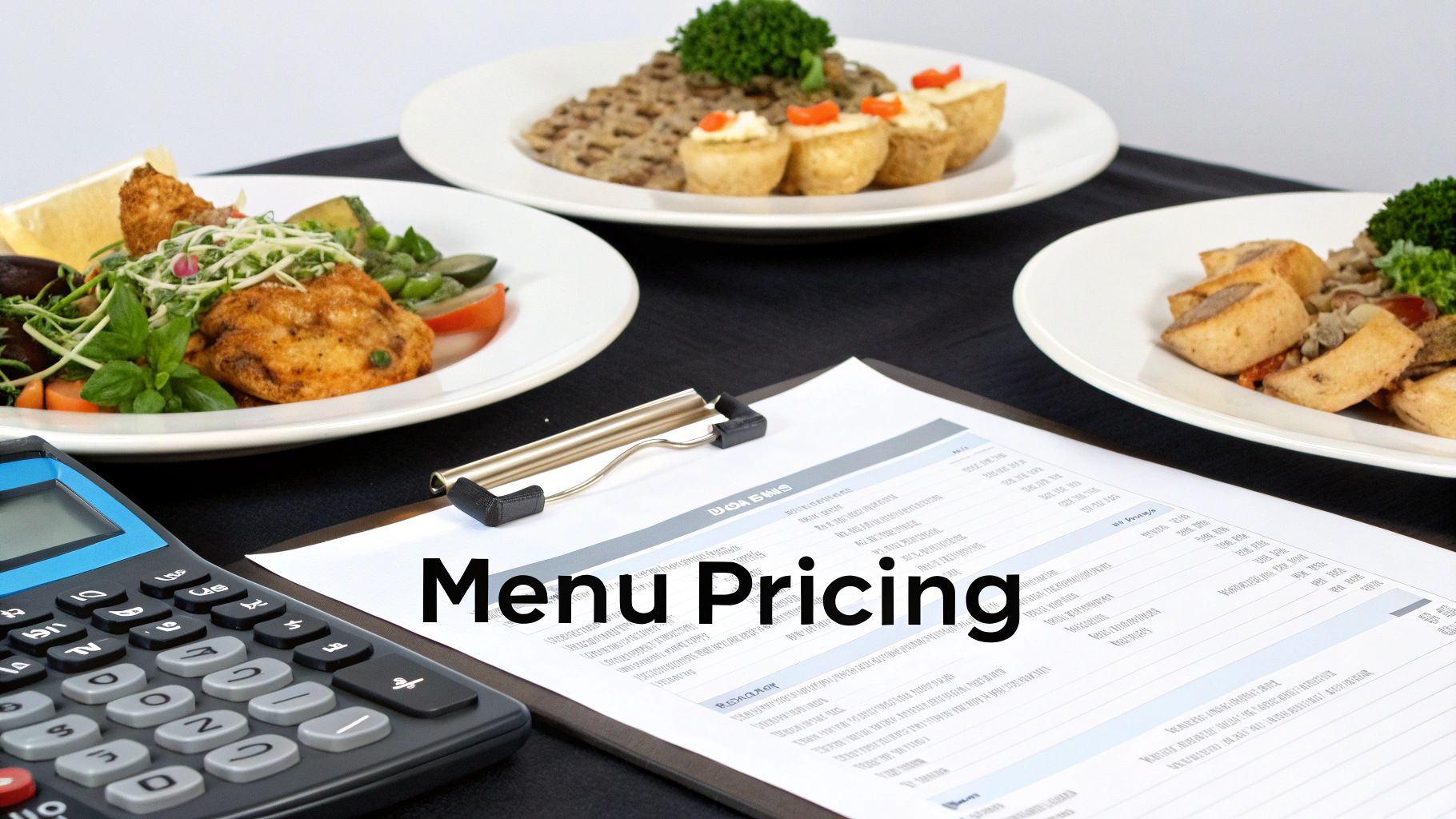
Do this for every single component, including the cooking oil, the spices, and even the parsley garnish. The sum of all those costs is your total food cost for that recipe. A solid industry benchmark to aim for is keeping your food costs between 28-35% of your final menu price. This buffer leaves room for labour, overhead, and—most importantly—your profit.
Structuring Your Prices for Success
Once you have your food costs dialled in, you can start building your pricing structure. The simplest and most common method to get started is the 3x multiplier rule.
Food Cost x 3 = Your Base Menu Price
This formula is a fantastic starting point because it roughly covers your three main expense buckets:
- Cost of Goods Sold (COGS): The ingredients themselves (about 33%).
- Labour Costs: Your time and your staff's time for shopping, prepping, cooking, and serving (about 33%).
- Overhead & Profit: Things like kitchen rental, insurance, marketing, and your actual profit margin (about 33%).
This base price is your foundation. For a client who just wants a simple food drop-off, the base price might be all you need. But for an event that requires a full buffet setup, serving staff, and cleanup, you have to add those extra labour costs on top. A full-service, multi-course plated dinner will have the highest labour costs and should be priced as your premium offering.
A great way to present this to clients is by offering tiered packages:
Bronze Tier: A basic drop-off package with high-quality disposable serving ware.
Silver Tier: Includes buffet setup with chafing dishes and real serving utensils, plus one staff member to manage the buffet.
Gold Tier: A full-service experience with multiple staff, plated courses, and complete post-event cleanup.
This approach makes your pricing crystal clear, helps clients find a service level that fits their budget, and empowers you to create accurate, professional quotes for any kind of event that comes your way.
Building Your Team and Managing Operations
Great food is just one piece of the puzzle. The real secret to creating loyal, repeat clients in the catering business? Seamless execution. This is where your operations—your team, your systems, and your logistics—come into play, turning a good meal into an unforgettable event.
Managing operations is what allows your business to run like a well-oiled machine. It's about more than just cooking; it's about orchestrating every tiny detail behind the scenes to deliver a flawless client experience, every single time.
Assembling Your Event Staff
When you're starting out, you'll probably handle most of the work yourself. But you can't be in two places at once. As you start booking larger or more complex events, you'll need a reliable team of part-time staff you can call on.
The roles you need will depend entirely on the type of event. A simple drop-off corporate lunch might just need a delivery driver, while a full-service wedding will require a whole team of prep cooks, servers, and maybe a bartender.
Here are the key roles you'll want to consider hiring for:
Prep Cooks: These are the engines of your kitchen. They handle all the chopping, mixing, and pre-cooking that has to happen before the event, freeing you up to focus on the final execution and plating.
Servers: They're the face of your business on-site. For a buffet-style service, a good rule of thumb is one server per 25-30 guests. For a more formal plated dinner, you'll need to tighten that up to one server for every 10-15 guests.
Event Captain or Lead: As soon as you're managing more than one or two other people, you need a designated lead on-site. This person directs the team and acts as the main point of contact for the client, so you aren't pulled in a million directions.
When you're hiring, look for hospitality experience, but prioritize reliability and a positive attitude above all else. A server who shows up on time with a great work ethic is far more valuable than a seasoned pro who is consistently late.
Mastering Your Operational Logistics
Flawless execution is all about having solid systems. That means managing your inventory, building strong relationships with your suppliers, and absolutely nailing your food transport logistics.
Think of your suppliers as partners in your business. Find vendors who are not just reliable but also provide consistently high-quality ingredients. A good relationship can get you better pricing, a heads-up on seasonal specials, and even some last-minute help when you find yourself in a pinch.
Food transport is where many new caterers stumble. Your food has to arrive at its destination looking great and, more importantly, at a safe temperature. Investing in high-quality insulated food carriers isn't just a suggestion—it's non-negotiable. This is foundational equipment that protects your food, your clients, and your hard-earned reputation.
The foodservice employment landscape presents both opportunities and challenges. As of September 2025, national employment in eating and drinking establishments exceeded pre-pandemic levels by nearly 144,000 jobs, a 1.2% increase. This signals a dynamic labour market, but also fierce competition for skilled workers. Catering businesses that model themselves after limited-service or fast-casual formats might find it easier to attract staff, as that segment's job growth is 2.4% above pre-pandemic levels, while full-service restaurant employment remains about 3.7% below. You can discover more insights about restaurant industry jobs on restaurant.org to understand the evolving hospitality employment climate.
Your Pre-Event and Post-Event Checklists
Consistency comes from process. A detailed checklist for every single event ensures no detail gets overlooked, no matter how busy you get. This simple tool is your secret weapon for looking like a seasoned pro from day one.
Break your checklist into two key phases.
Pre-Event Preparation Checklist:
- Confirm Final Guest Count: Get the final number from the client 72 hours before the event. No exceptions.
- Create Prep & Cooking Schedule: Work backward from the event start time to map out every single task.
- Pull & Pack All Equipment: Check off every item as it goes into a box, from serving spoons to chafing fuel.
- Print Event Details Sheet: This should have the client's contact info, venue address, schedule, and the final menu.
- Charge All Devices: Make sure your phone and any payment processors are at 100%.
Post-Event Breakdown Checklist:
- Pack All Leftover Food Safely: Have containers ready for the client or for proper disposal.
- Clean the Event Space: The golden rule: leave the venue cleaner than you found it.
- Conduct a Final Equipment Sweep: Do a walk-through to make sure you haven't left a single serving platter behind.
- Check Out with the Client: Before you leave, confirm they are happy with everything.
- Clean & Store Equipment: Unpack and properly sanitize everything as soon as you get back to your kitchen.
These checklists do more than just keep you organized. They reduce stress and ensure every job runs like clockwork, leaving your clients impressed and ready to book you for their next event.
Getting the Word Out: How to Market Your Catering Business and Find Clients
Let's be honest. You can have the most incredible food and five-star service, but if nobody knows you exist, you've just got a very expensive hobby. Marketing is what turns your passion into a pipeline of paying clients. It's the engine that keeps your catering business running, booking events, and actually making money.
This isn't about dropping a fortune on fancy ads. It's about being smart, consistent, and strategic. You need to focus on a few practical tactics that get those first critical clients in the door and build the momentum you need to grow.
Your Digital Shop Window
These days, your online presence is your storefront. Before anyone picks up the phone, they're going to do a quick search online. What they find—or don't find—will make or break their decision to contact you. Your goal is to look professional, credible, and absolutely delicious from the very first click.
Get these two things sorted out before you do anything else:
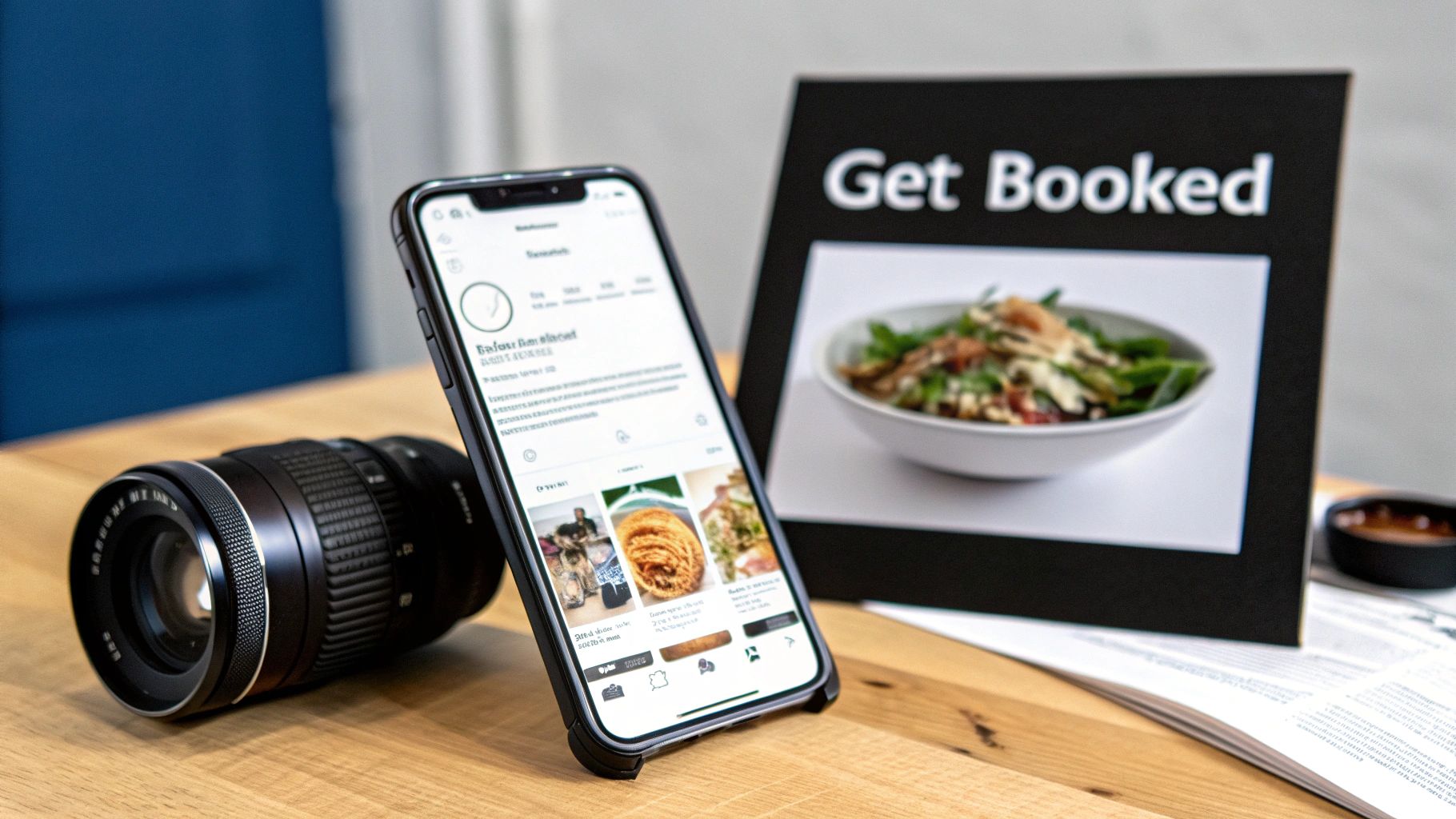
A Simple, Professional Website: Think of it as your online brochure. It doesn't need to be complicated, but it absolutely must have the essentials: your menu (even with just pricing ranges), a gallery of high-quality food photos, glowing client testimonials, and an obvious contact form.
A Google Business Profile: This is non-negotiable for getting found locally. Claim your free profile to make sure you pop up when someone searches "caterers near me." Fill it out completely with your service area, hours, and lots of photos. Critically, you need to encourage every single client to leave a review here. Social proof is everything.
Make Them Hungry with Social Media and Photos
Visual platforms like Instagram are your secret weapon. This is where you make people's mouths water and show them exactly what it feels like to be at one of your events. The key to this whole game? Incredible food photography. You don't need a pro for every single post, but you do need to learn the basics of good lighting and styling. Natural light is your best friend.
Your social media feed is a living, breathing portfolio. It should tell the story of your brand—from the behind-the-scenes prep to the final, stunning buffet spread. Let your passion and professionalism shine through in every photo.
Show off your finished dishes, feature photos of happy clients (always with their permission, of course!), and post action shots from events. This kind of visual proof builds trust and excitement way more effectively than just words on a page.
Forge Strategic Local Partnerships
Some of your best, most profitable clients will come from referrals. Building a solid network of local partners who serve the same type of clientele is one of the most powerful marketing moves you can make. These relationships become your unofficial sales team, sending business your way from clients who already trust their judgment.
Start making connections with:
Event Venues: So many venues keep a list of preferred caterers they hand out to everyone who books their space. Your mission is to get on that list. Offer the venue manager a complimentary tasting—it's a small investment that can pay off a hundred times over.
Wedding and Event Planners: Planners are always looking for reliable, professional vendors who make their job easier. Prove you're dependable and that you deliver amazing results, and they will bring you a steady stream of business.
Corporate Office Managers: Landing a few regular corporate lunch contracts can be the financial bedrock of your business. This is the predictable, recurring revenue that smooths out the peaks and valleys of event-based work.
Turning a "Maybe" into a "Yes"
Once your marketing starts working, the inquiries will start coming in. The final piece of the puzzle is turning those leads into confirmed, paid bookings. You do this with proposals and packages that make it incredibly easy for the client to say yes.
When a potential client reaches out, they're looking for a solution. They need to feed a group of people and want the stress taken off their plate. Your proposal needs to be more than a price list; it has to show you understand their vision and can deliver the experience they're dreaming of.
Present your offerings in clear, tiered packages—think Bronze, Silver, and Gold—that speak to different budgets and service levels. Make sure you spell out everything that's included, from the food itself to the disposable serving ware and staffing costs, so there are zero surprises. That transparency builds instant trust and makes signing on the dotted line a no-brainer.
Got Questions? We've Got Answers
Jumping into a new business always brings up a ton of questions. Let's tackle some of the most common ones we hear from aspiring caterers. We'll give you clear, straightforward answers to help you navigate these early days with a bit more confidence.
How Much Can I Realistically Make in My First Year?
Honestly, this can vary wildly depending on your market and how much you hustle.
If you're starting part-time from home and focusing on smaller local gigs, a realistic target is somewhere between $30,000 to $50,000. That's assuming you're booking a couple of events each week, with an average order size of $300-$500.
Ready to go all-in? If you commit full-time and maybe bring on some part-time help, aiming for $75,000 to $150,000 is a solid goal. This, of course, means booking more events—think five to eight a week—and landing some larger contracts. Once you subtract all your expenses, a healthy profit margin should land between 7% and 15%, provided your pricing is on point.
What Is the Easiest Type of Catering to Start With?
Without a doubt, corporate drop-off catering is the most accessible way to get your foot in the door. We're talking about weekday office lunches, which is great because it usually leaves your weekends free. The model is simple: you prep the food, deliver it, set up a buffet, and you're done.
This approach has some huge perks for a startup:
Predictable Revenue: Offices often book recurring weekly or bi-weekly lunches.
Lower Staffing Needs: You can often handle these jobs yourself or with just one helper.
Minimal On-Site Gear: No need for a huge inventory of fancy serving platters or formal place settings.
It's the perfect way to nail down your recipes, smooth out your delivery process, and build a client list with less initial investment and fewer operational headaches.
How Do I Handle Dietary Restrictions and Allergies?
Managing dietary needs isn't just a good idea—it's a non-negotiable part of the job today. The key is to have a rock-solid system from day one. When a client reaches out, make it standard practice to ask about allergies and restrictions like vegan, gluten-free, or dairy-free.
Treat every single dietary request with the seriousness it deserves. A mistake can have severe health consequences for a guest and do irreparable damage to your reputation. Clear communication and meticulous prep are your best friends here.
To manage this like a pro, you need to:
- Label Everything: Clearly label every dish on the buffet so guests know exactly what they're eating. No exceptions.
- Prevent Cross-Contamination: This is critical. Use separate cutting boards, utensils, and prep areas for common allergens like nuts, gluten, and shellfish.
- Offer Built-In Options: Design your menu with flexibility. A grain bowl where the protein and dressing can be easily swapped is a perfect example of smart, adaptable menu planning.
Stocking your pantry with versatile staples makes life so much easier. Keeping a good supply of gluten-free grains or vegan-friendly sauces from a reliable supplier means you're always prepared and not scrambling at the last minute.
Do I Need to Use a Commercial Kitchen?
The short answer is: it depends. Your local public health regulations and provincial food laws will have the final say. While many regions across Canada have cottage food laws that allow for home-based food businesses, catering often falls into a higher-risk category that requires more stringent oversight.
Starting from your home kitchen can be a great way to test your concept with minimal overhead. But as you grow and start tackling bigger, more complex events, moving into a shared or dedicated commercial kitchen becomes almost inevitable.
These facilities are built for volume and efficiency, giving you access to the commercial-grade tools you'll eventually need. More importantly, they provide the storage space and professional environment to scale your operations safely and legally—a must for long-term success.
Ready to stock your new catering kitchen with high-quality, reliable supplies? At Chicken Pieces, we provide everything you need to get started, from bulk pantry staples to professional serving ware and light equipment. Explore our extensive catalogue and let us be your trusted partner in building your successful catering business.