

Pot and Pan Detergent: How Many Sink Turns a Case Actually

2026 Jul 21st

Pot and Pan Detergent: How Many Sink Turns a Case Actually

Canadian-Owned No MOQ Ships Canada-Wide Calgary Warehouse Food Safe Certified NSF Certified Product
Quick Answer

Turns per case = (ounces per jug x jugs per case) ÷ (ounces per gallon at label dilution x gallons per bay). On a 20 gallon wash bay at half an ounce per gallon, a four by 3.78 L case of Array Pot and Pan or Ecolab Pantastic yields about 51 sink turns, a two by 2.5 L SUMA J-Fill case yields about 17, and a single 2.5 L SUMA Optifil cartridge yields about 8. Run your own invoice through that same divide: the ratio between two products is usually much wider than the ratio between their case prices.

Wash Compartment Unit Economics
A

Amani

ChickenPieces.com · Calgary, AB · We ship Canada-wide

Pot and Pan Detergent: How Many Sink Turns a Case Actually Washes

The dilution maths every distributor blog skips, converted into sink turns per case, a relative cost index, and the dish pit hours behind your water changes.

8 – 51
Sink turns per case across four manual pot and pan packs
7.3x
Spread between the best and worst cost per turn in this set
6 – 8 min
Paid labour to drain, wipe, refill and re-dose one bay
At a Glance

Key Takeaways

Six numbers to hold before your next quote lands.

You buy yield, not jugs

A case price means nothing until you divide it by turns per case. Two products close on the invoice can sit multiples apart per turn.

Bay volume is the hidden multiplier

A 20 gallon bay at half an ounce per gallon burns 10 fl oz per turn. A 30 gallon bay burns 15.

Pack format decides the spread

Bulk four by 3.78 L cases yield around 51 turns. Single cartridges yield around 8. Convenience is priced per turn.

Over-dosing is invisible on an invoice

Free-pouring at double the label ratio halves turns per case and shows up as a consumption jump nobody can trace.

Water changes are a labour line

Seven minutes per changeover, three a day, is close to ten paid hours a month before anyone scrubs a pan.

Calgary warehouse, no minimum

Order one case to test the yield claim before you commit a pallet. We ship Canada-wide with no MOQ.

The Formula

How many sink turns does a case actually wash?

Three numbers you half-know, converted into the one you buy on.

Every page competing for this question teaches wash, rinse, sanitize and then hands you back to the bottle. The top-ranked guide in the category runs past two thousand words and answers the dosing question with a single instruction to check the product label. That is a referral to a sticker, not an answer.

You need three inputs: ounces of concentrate in the case, ounces the label calls for per gallon, and gallons your wash bay actually holds. Multiply the last two to get ounces per turn, then divide the case into it.
Turns per case = (ounces per jug x jugs per case) ÷ (oz per gallon x gallons per bay)
Cost per turn = your invoice case price ÷ turns per case
Days per case = turns per case ÷ turns per day

Worked on a 20 gallon bay at half an ounce per gallon, that is 10 fl oz per turn. A four by 3.78 L case holds roughly 511 fl oz, so it clears about 51 turns. A two by 2.5 L dispenser case holds roughly 169 fl oz and clears about 17. A single 2.5 L cartridge clears about 8.

Twenty gallons is the assumption used throughout this post, typical for a mid-size compartment filled to working level rather than to the rim. If your bay holds 30, rerun the divide before you quote anyone a yield.
Comparison

Turns per case and relative cost index by product

Four manual packs on a 20 gallon bay at half an ounce per gallon. Cheapest per turn = 1.00x.

Product Pack Format Concentrate per Case Turns per Case Cost per Turn Index
Array Pot and Pan Manual Dish Detergent4 x 3.78 L jug~511 fl oz~511.00x
SUMA Pot & Pan Dish Detergent, J-Fill2 x 2.5 L dispenser pack~169 fl oz~172.9x
Ecolab Pantastic Pot Pan Manual Dish Detergent4 x 3.78 L jug~511 fl oz~514.8x
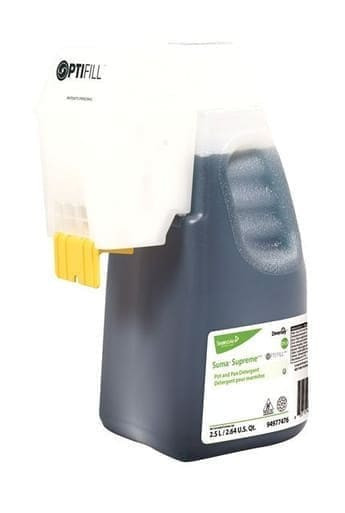
SUMA Pot & Pan Detergent, Optifil1 x 2.5 L cartridge~85 fl oz~87.3x
Same bay at heavy soil (1 oz/gal)any of the aboveunchangedhalvedindex unchanged
30 gallon bay instead of 20any of the aboveunchanged-33%index unchanged
Ecolab Ultra Klene Dish Detergent, Machine1 x 18.9 L~639 fl ozcosted per racknot comparable
Ecolab Solid Super Impactdish, Machine4 x 4.1 kg solidsolid blockcosted per racknot comparable
Read the index, not the case price. The two 3.78 L jug cases hold identical concentrate and clear identical turns, yet sit 4.8x apart per turn. That is the whole argument for running the divide before you renew.
Substitution

Is your chemical rep actually overcharging you?

The question operators ask by name, answered without guessing.

Operators do not search for detergent cost. They search for a substitute for a named brand, because that is how the frustration presents itself. One r/restaurateur thread puts it plainly: the soap is very expensive, and the dispenser occasionally malfunctions and eats through product. Nobody in that thread could verify the cheaper alternative being suggested, because nobody publishes yield.

A second thread on r/restaurantowners states the gap almost verbatim. An owner costing out a dish machine cannot locate annual cost information for detergent and chemicals anywhere. The best answer he received was a per-gallon figure with the honest caveat that consumption per rack varies by machine. He was handed an input and no method.

The method is the divide above. Work out turns per case at your own bay volume for your current product and for the candidate. If the candidate needs twice the ounces per gallon, its lower case price evaporates. If it doses the same and costs less, you have a defensible switch instead of a rumour.

The pattern we see fail: an operator switches on case price alone, the new product doses at double the ratio, consumption climbs, and the chemical line ends up higher than before the switch. The invoice never explains it because the invoice only shows cases.
Dosing Discipline

Why does "just use more detergent" wreck the numbers?

The folk fix that halves your yield and costs you a dish hand.

Ask any dish pit how to shift a greasy pan and someone will tell you to use more detergent. It is the most common advice in every thread on the subject and it is wrong in a specific, expensive way. Above the label ratio you do not get more soil removal. You get more foam, longer rinse time, and a film to chase off in the second compartment.

The consumption effect is direct. Double the dose and turns per case halves, so a case that should have cleared seventeen days of service clears eight. That shows up as a reorder that seems too soon, and because nobody measures ounces at the sink it gets blamed on volume, on theft, or on the supplier.

There is a labour cost too. Dish station staff report swollen and cracked hands after shifts on over-concentrated water, and a dish hand off the schedule costs far more than the chemical ever saved. Fit a dispenser or use a marked measuring cup.

The dish pit's own stated requirement, in their words, is detergent that is gentle on skin. Dosing to label is the cheapest way to deliver it.
Labour

What do your water changes cost in dish pit hours?

The half of the equation no competitor has ever costed.

A sink turn is not just chemical. It is a person draining a bay, wiping the walls, refilling to working level, waiting for temperature, and re-dosing. Budget six to eight minutes for that sequence on a 20 gallon compartment. Nobody schedules it, everybody pays for it.

Change the water when it stops holding suds, when grease films the surface, or when it drops below your minimum wash temperature, whichever comes first. Most operations settle at two to four turns per shift. Put a clock rule on it rather than leaving the call to whoever is tired at the end of service.

Three turns a day at seven minutes is 21 minutes daily, close to ten hours a month of paid time spent moving water. That figure is what makes a dish machine look sensible at higher covers, and it is also why a small operator running 40 covers a service is usually right to keep the sink and skip the capital, the rinse aid and the service contract.

Weekly water-change labour = turns per day x minutes per turn x days open
Worked example: 3 x 7 x 6 = 126 minutes a week, on water alone.
Canadian Compliance

How do Canadian rules change the consumption maths?

Compliance clauses that behave as cost inputs.

Ontario Reg. 493/17 s.21 makes manual warewashing in a three-compartment sink, or a commercial dish machine, mandatory wherever reusable dishware is served. The wash compartment is not a preference. Budget for it as fixed consumption.

Two further requirements bite directly on the numbers above. Toronto Public Health's manual utensil washing procedure and the Wellington-Dufferin-Guelph food handler manual both set a minimum tap temperature of 50C, that is 120F, and both require the sink to be large enough for the largest item you wash. Hotter water shortens the usable life of a fill, pushing turns per shift up. A bay sized for your biggest stock pot holds more gallons, pushing ounces per turn up. Two compliance clauses, two upward pressures on the chemical line.

The third compartment is a separate calculation with its own units and test procedure, handled in full in the companion post on quat sanitizer concentration for the three-compartment sink. Get the wash water right first.

Shop the Range

Dish pit chemicals we stock and ship from Calgary

Manual concentrates, pre-soak degreasers, and the machine lane you would compare against.

Array Pot and Pan Manual Dish Detergent 3.78 L
Array Pot and Pan Manual Dish Detergent
4 x 3.78 L · ~511 fl oz · ~51 turns
Ecolab Pantastic Pot Pan Manual Dish Detergent 3.78 L
Ecolab Pantastic Pot Pan Manual Dish Detergent
4 x 3.78 L · ~511 fl oz per case · premium manual tier
SUMA Pot and Pan Dish Detergent J-Fill 2.5 L
SUMA Pot & Pan Dish Detergent, J-Fill
2 x 2.5 L · ~169 fl oz per case · closed dispenser dosing
SUMA Pot and Pan Detergent Optifil 2.5 L
SUMA Pot & Pan Detergent, Optifil
1 x 2.5 L cartridge · ~85 fl oz · single-bay sites
Ecolab Greaselift Ready To Use Degreaser Cleaner 946 mL
Ecolab Greaselift Ready To Use Degreaser
6 x 946 mL · ready to use · pre-soak on baked-on soil
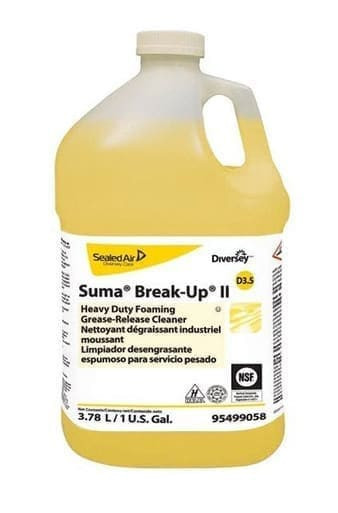
Diversey Break Up II Degreaser Cleaner 3.78 L
Diversey Degreaser Cleaner, Break Up II
4 x 3.78 L · heavy soil arm · protects wash water life
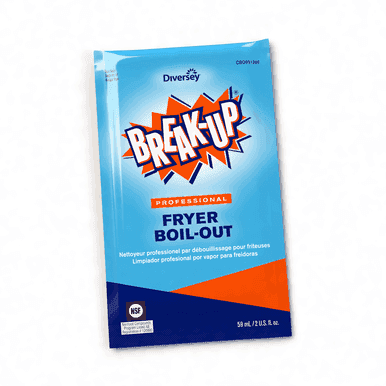
Diversey Liquid Fryer Degreaser Boil Out 59 mL
Diversey Liquid Fryer Degreaser, Boil Out
36 x 59 mL · pre-measured · keeps fryer soil out of the sink
Ecolab Ultra Klene Dish Detergent Machine 18.9 L
Ecolab Ultra Klene Dish Detergent, Machine
1 x 18.9 L · ~639 fl oz · costed per rack, not per turn
Ecolab Solid Super Impactdish Detergent Machine 4.1 kg
Ecolab Solid Super Impactdish Detergent, Machine
4 x 4.1 kg solid · machine lane · no free-pour drift
SUMA Quick Dry Dish Rinse Aid A6.6 Machine 3.78 L
SUMA Quick Dry Dish Rinse Aid, A6.6 Machine
4 x 3.78 L · machine-only consumable · absent on manual lines
Reviews

What Canadian operators say

Buyers who ran the turns-per-case divide against their own invoices.

★★★★★

"Quoted on case price for years, never once on yield. Running our bay volume through the divide showed our detergent was costing multiples per turn against the alternative. Switched to the Array case, ordered one to test first because there was no minimum."

M
Marcus D.
Owner-Operator, two-site cafe group — Ontario
★★★★★

"We put a dispenser on the SUMA J-Fill and stopped free-pouring. Consumption dropped immediately and the hand irritation complaints went with it. Calgary stock means a restock lands in two days."

J
Janelle R.
Kitchen Manager, banquet venue — British Columbia
★★★★★

"Costing the water changes was the part I had never done. Three turns a day at seven minutes was most of a shift a month I was paying for and not counting. We kept the sink and dropped the machine plan."

T
Tomasz K.
Food Services Lead, care residence — Manitoba
FAQ

Pot and Pan Detergent: Frequently Asked Questions

How much pot and pan detergent do I use per sink?

Read the label ratio, then multiply by bay volume. Most manual pot and pan concentrates run half an ounce per gallon on normal soil and a full ounce on heavy soil. A 20 gallon bay takes 10 fl oz normally, 20 fl oz on a heavy shift.

How many sink turns does a case of detergent wash?

Total ounces in the case divided by ounces used per turn. A four by 3.78 L case holds about 511 fl oz, so at 10 fl oz per turn it yields roughly 51 turns. A two by 2.5 L J-Fill case holds about 169 fl oz and yields roughly 17.

How do I work out my own cost per sink turn?

Take the case price on your own invoice and divide it by turns per case for that pack size, then run a rival through the same maths. The ratio between two candidates on the same bay volume matters far more than the absolute number.

Is a cheaper detergent actually cheaper per turn?

Only if the dilution ratio holds. A concentrate dosing at half an ounce per gallon beats a cheaper product needing two ounces per gallon, because you buy the yield, not the jug. Run both through the formula before switching.

How often should the wash water be changed?

When it stops holding suds, goes greasy on the surface, or drops below the minimum wash temperature, whichever comes first. Most operations land on two to four turns per shift. Set a clock-based rule rather than leaving the call to end-of-service judgement.

Does more detergent clean better?

No. Above the label ratio you get more foam, more rinse time and more skin irritation, without more soil removal. Over-dosing is the most common way a chemical line inflates, and it is invisible on an invoice.

Is manual washing cheaper than a dish machine?

They use different units, so compare labour rather than chemical alone. Manual detergent is costed per sink turn, machine detergent per rack. Below roughly 40 to 50 covers per service the sink usually wins on total cost: no capital, no rinse aid, no service contract.

What does a water change actually cost in labour?

Budget six to eight minutes per changeover to drain, wipe, refill and re-dose a 20 gallon bay. At three turns a day that is close to ten paid hours a month on water alone.

Do the Canadian rules change the consumption maths?

Yes, indirectly. Ontario Reg. 493/17 s.21 makes the wash compartment a legal requirement, and public health guidance sets a minimum tap temperature of 50C or 120F and requires the bay to fit the largest item. A larger bay means more gallons and more ounces per turn.

How do you calculate shipping on bulk orders?

We calculate shipping on live carrier rates at checkout, not on flat or subsidized tiers. Every order is priced against real LTL, parcel, or pallet-freight quotes from our Calgary warehouse to your dock. That means you never absorb hidden shipping costs into product margins, and for bulk and pallet orders this typically runs 15-25% lower than competitors who bake shipping into their unit prices.

Why operators buy dish chemicals from ChickenPieces

Four reasons buyers costing a dish pit keep the reorder here.

No minimum order

Buy one case, run it against your own bay volume, and prove the yield before you commit a pallet.

Canadian-owned, ships nationwide

Stock moves from our Calgary warehouse to any province on live carrier rates, with no border paperwork on your desk.

Both lanes in one order

Manual concentrates, degreasers, machine detergents and rinse aids on one purchase order.

Food-safe, NSF certified product selection
We publish the maths

Yield, dilution and turns per case up front, so procurement can audit the switch instead of taking a rep's word for it.

Get your dish pit costed per sink turn, not per case

Send us your bay volume and turns per shift, and we will come back with turns per case and a like-for-like comparison across the manual pot and pan range. Quotes include live freight from Calgary to your dock, no minimum order on any line.

Request a Quote
Sources

Sources & further reading