Thickened Liquids by IDDSI Level: Servings Per Case for

2026 Jul 21st

Thickened Liquids by IDDSI Level: Servings Per Case for

Canadian-Owned No MOQ Ships Canada-Wide Calgary Warehouse Health Canada Listed CFIA Compliant
Quick Answer

IDDSI measures drinks on Levels 0 through 4. Level 2 is Mildly Thick, the old nectar; Level 3 is Moderately Thick, the old honey. To convert a prescribed level into a purchase order, divide the fluid a case contains by your standard pour: a 48-count case of 118 mL cups yields 48 fixed servings, while a twelve-litre case yields about 100 servings at 120 mL and about 50 at 240 mL. We ship both formats and both levels from Calgary with no minimum order.

Dysphagia Purchasing Reference
A

Amani

ChickenPieces.com · Calgary, AB · We ship Canada-wide

Thickened Liquids by IDDSI Level: Servings Per Case for Powder vs Pre-Thickened

How a dietary manager turns a prescribed IDDSI Level 2 or Level 3 drink order into servings per case and a defensible cost-per-resident-day comparison.

0 – 4
IDDSI levels covering drinks
48 or 100
Servings per case by format
No MOQ
One case or one pallet
At a Glance

Key Takeaways

Six things to settle before signing the purchase order.

Level 2 is nectar, Level 3 is honey

Thin is Level 0, nectar is Level 2, honey is Level 3, pudding is Level 4. Learn the bridge and transfer orders stop causing arguments.

Portion cups yield a fixed number

A 48-count case of 118 mL cups yields 48 servings. No pour variance to model, which makes cups the easiest line to budget.

One-litre cases yield by pour size

Twelve litres yields roughly 100 servings at a 120 mL pour and about 50 at 240 mL. Set the pour before comparing products.

Powder yield lives on the label

Scoops per serving change between Level 2 and Level 3. Read the manufacturer's stated yield, never a tub-weight estimate.

The level is a clinical decision

Speech-language pathology sets the level and schedules the review. Nothing here is a reason to change one.

Calgary warehouse, no minimum

Both formats at both levels ship Canada-wide from Calgary with no MOQ, so one home can trial a case first.

The Framework

What do IDDSI Levels 0 to 4 actually mean on a drink order?

Five drink levels and one testing method that decides all of them.

The official names are the ones that belong on your purchasing standard and your tray cards. Level 0 is Thin. Level 1 is Slightly Thick. Level 2 is Mildly Thick. Level 3 is Moderately Thick. Level 4 is Extremely Thick. Those names are what an auditor expects to see, and mixing them up by one position is the most common documentation error during a transition.

Level is verified by flow test rather than by opinion: a measured volume is released through a syringe for a fixed interval, and what remains decides the level. That is why a pre-thickened case can carry a level claim, while a drink thickened by hand on a tray line has been tested by nobody unless your team runs the syringe.

Level 0 Thin flows like water. Level 1 Slightly Thick is used far more in paediatrics than in long-term care. Level 2 Mildly Thick pulls through a straw with visible effort. Level 3 Moderately Thick goes by cup or spoon, and a straw usually defeats the resident. Level 4 Extremely Thick is spoon only and does not pour cleanly.

Legacy Terms

Why does the order say nectar when the chart says Level 2?

The floor still speaks the old scale.

The mapping is stable and worth pinning above the diet office desk: thin is Level 0, nectar is Level 2, honey is Level 3, pudding is Level 4. Canada's former drink scale used those same names and maps the same way, which suits operators running one standard across both countries. Nothing maps to Level 1, which is part of why Level 1 shows up so rarely in adult long-term care.

One legacy term was retired for a safety reason rather than a tidiness reason. Honey thick was judged inappropriate for paediatric populations because of infant botulism risk under twelve months of age. A texture name that reads as a food instruction is a hazard, which is the argument for retiring the old words entirely.

Practical rule: print both vocabularies on the tray card during a transition, and only one of them on the purchase order. Ordering against the legacy word is how a facility ends up with two products at the same level under different names.

The Math

How do you turn a prescribed level into servings per case?

Two numbers close a purchase order: case yield and daily servings.

Every guide on this topic teaches the ladder and stops. The buying question is narrower: how many servings at the prescribed level does one case produce, and what does that make the daily cost for one resident. Once those two numbers exist, powder and pre-thickened can be compared honestly instead of by reputation.

Pre-thickened yield is arithmetic you can do at the desk. Portion cups are fixed: a 48-count case of 118 mL cups is 48 servings and roughly 5.7 litres, and no pour policy changes that. Litre formats are where facilities lose track. A twelve-litre case gives about 100 servings at a 120 mL pour, about 66 at 180 mL, and about 50 at 240 mL. Same case, half the servings, purely because somebody chose a bigger cup.

Powder yield has to come off the label, and this is the honest limit of a supplier's arithmetic. Scoops per serving differ between Level 2 and Level 3 on the same tub, and the quantity shifts again between water, juice and a nutritional supplement. Dividing a tub by a guessed scoop weight produces a number that looks precise and is not.

The four-step worksheet. One, fix the standard pour in millilitres. Two, find true servings per case: units per case for cups, litres divided by pour for litre formats, label yield for powder. Three, divide landed case cost by servings per case. Four, multiply by thickened servings per resident per day. Add the preparation minute for powder if your costing includes labour.

Format Choice

Powder or pre-thickened: what actually decides it at the same level?

Ingredient cost is one input. Consistency risk and staff time are the others.

Powder wins on ingredient cost per serving and on flexibility. A tub thickens whatever the resident wants, including a nutritional supplement. That is the exact problem facilities hit when a pre-thickened supplement line goes out of stock and the home has to thicken by hand and hope.

The hoping is the cost nobody prices. The recurring complaint from RDs is not that powder is difficult, it is that the result is inconsistent across shifts and can thin back out before it reaches the resident. Starch-based thickeners are the usual culprit, which is why gum-based clear thickeners such as Nestle ThickenUp Clear exist and why some policies allow only one thickener class in supplements.

Pre-thickened wins on verification. The case carries a tested level claim and nobody on the floor has to be trained to hit it, which matters in a building with agency staffing or high turnover. The counter-argument is real too: a facility that standardises on one flavour of one pre-thickened product has built a single point of failure into a clinical diet.

Where this goes wrong: a home standardises on pre-thickened Level 2 juice, drops powder from the formulary, then takes a supply interruption and has no compliant way to thicken anything.

Clinical Caution

Why the cost math must never push a level upward

Thicker is not safer, and this is not clinical advice.

This needs stating plainly because the arithmetic above can be read the wrong way. Thickened-liquid diets carried long term without scheduled clinical reassessment are associated with reduced fluid intake, dehydration and malnutrition. The level is prescribed by a speech-language pathologist against a swallowing assessment, it carries a review date, and it belongs to the clinical team. We supply to the prescribed level. We do not advise on what that level should be, and nothing here is a reason to change one.

Care aides describe the intake problem best: thickened fluid is hard to draw through a straw, residents get written off as people who do not drink much, and the practical fix is to offer it by spoon rather than record a low intake and move on. A resident who cannot operate the delivery method is not refusing fluid.

It also explains why thickened water belongs on a formulary rather than juice alone. Variety in a thickened formulary is a hydration measure, not a hospitality flourish.

Non-negotiable: a lower cost per resident-day is never a reason to hold or raise a level. Level is set clinically and reviewed on a schedule. Purchasing follows the order; it does not influence it.

Formulary

What should a mixed Level 2 and Level 3 census actually stock?

Most homes buy for two levels at once, and each stocks differently.

Level 2 carries the volume in most adult long-term care buildings, so that is where format efficiency matters most. Litre cases give the lowest handling burden per litre of finished drink. Portion cups suit tray line and medication pass, and they remove pour variance from your yield calculation entirely.

Level 3 is usually a smaller population, so keep fewer flavours in play. Thickened water at Level 3 earns its shelf space because a resident can return to it all day.

Keep a labelled thickener on the shelf regardless: it covers the beverage nobody sells ready-to-drink and the supply interruption that eventually arrives. A bulk tub suits a central kitchen; single canisters suit a satellite unit.

Product Comparison

IDDSI level by format by yield: what one case actually produces

Servings per case at a 120 mL standard pour, with powder rows pointing at label yield rather than a guessed figure.

Product Format Level (legacy) Case Pack Servings / Case
Thickened Apple Nectar, 118 mL cupsPre-thickened cupLevel 2 (nectar)48 cups48 fixed
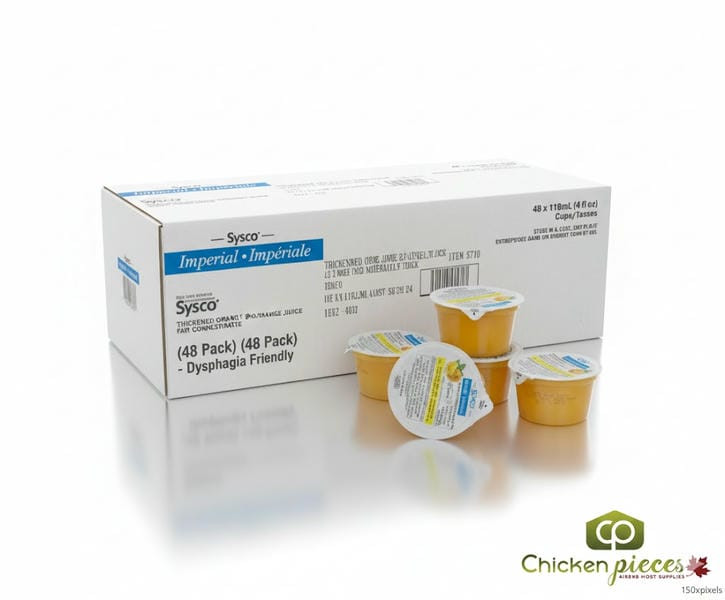
Sysco Imperial Thickened Orange Juice L3Pre-thickened cupLevel 3 (honey)48 cups48 fixed
Hydra+ Orange Juice Level 2Pre-thickened litreLevel 2 (nectar)12 × 1 L~100
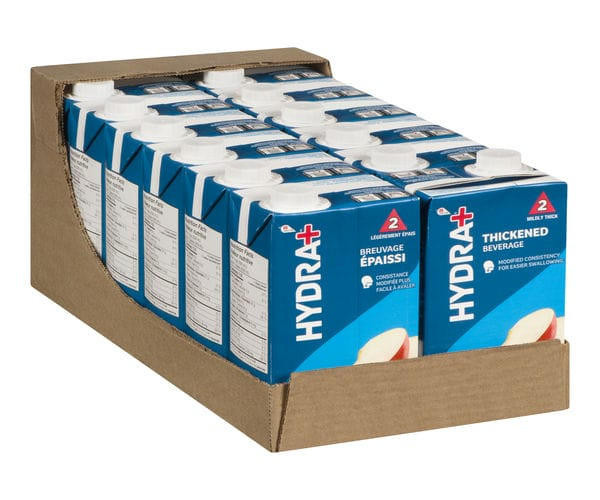
Hydra+ Thickened Apple Juice IDDSI 2Pre-thickened litreLevel 2 (nectar)12 × 1 L~100
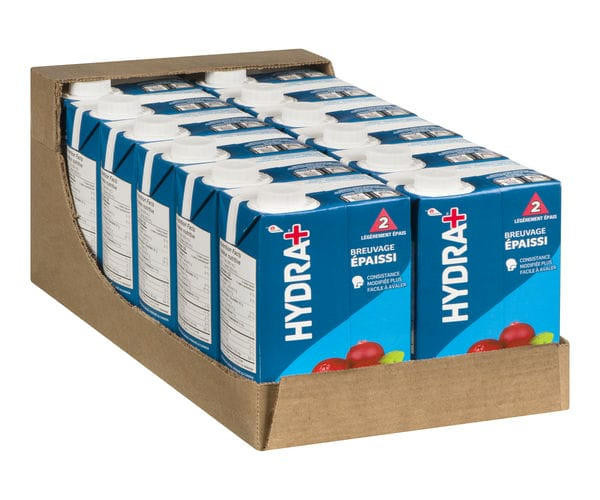
Hydra+ Thickened Cranberry Juice IDDSI 2Pre-thickened litreLevel 2 (nectar)12 × 1 L~100
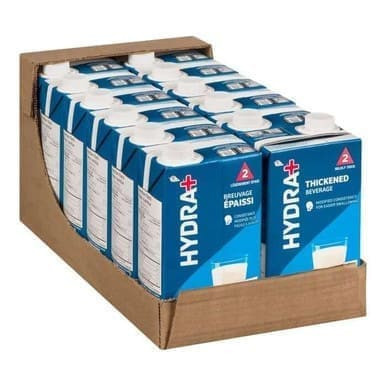
Hydra+ Milk L2 Thickened BeveragePre-thickened litreLevel 2 (nectar)12 × 1 L~100
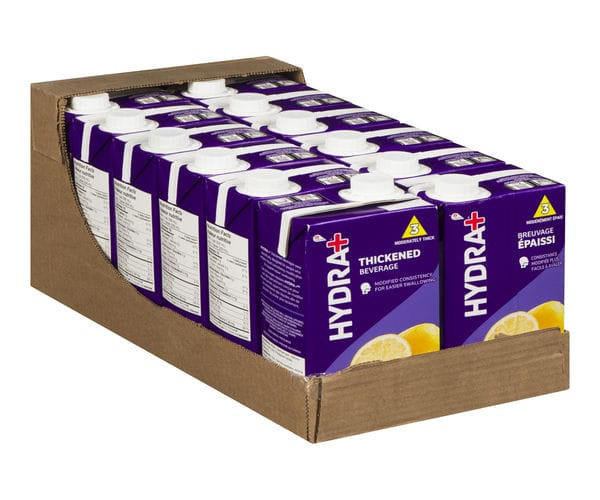
Hydra+ Thick Lemon Water IDDSI 3Pre-thickened litreLevel 3 (honey)12 × 1 L~100
Hormel Thick & Easy Thickener, 2 kg tubPowder, bulkPrepared to L2 or L31 tubPer label yield
Nestle ThickenUp Clear, 5 kg tubPowder, gum-basedPrepared to L2 or L31 tubPer label yield
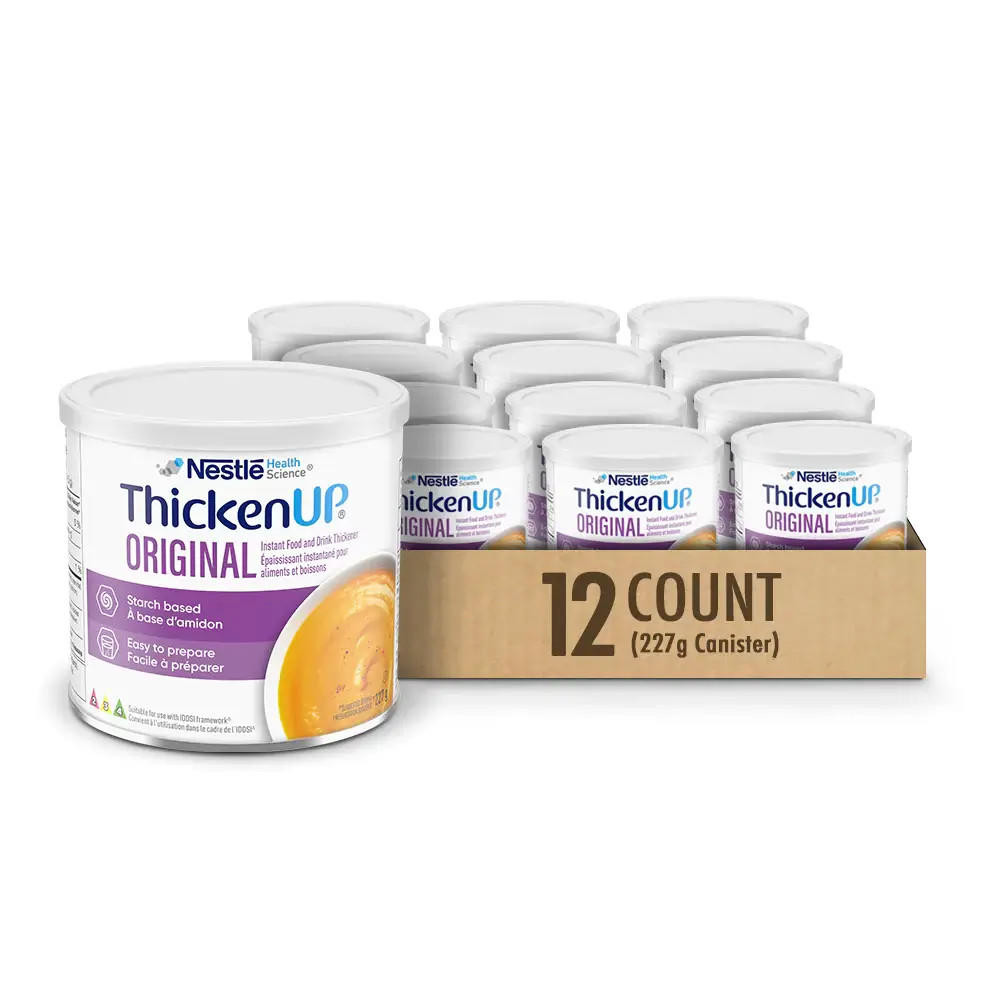
Nestle ThickenUp Original, 227 g canistersPowder, canisterPrepared to L2 or L312 canistersPer label yield

Litre-format servings scale inversely with pour: about 100 at 120 mL, about 66 at 180 mL, about 50 at 240 mL. Powder rows are deliberately not estimated, because scoop counts differ by level and by beverage.

Shop the Range

Thickened beverages and labelled thickeners we stock

Both formats at both levels, shipping from Calgary.

Juice Thickened Apple Nectar IDDSI Level 2 118 mL cups case of 48
Juice Thickened Apple Nectar — IDDSI Level 2 (Mildly Thick), 118 mL Cups
Level 2 nectar · 118 mL cups · 48 per case
Sysco Imperial Thickened Orange Juice IDDSI Level 3 4 oz 48 pack
Sysco Imperial Thickened Orange Juice L3, 4 oz (48 Pack)
Level 3 honey · 118 mL cups · 48 per case
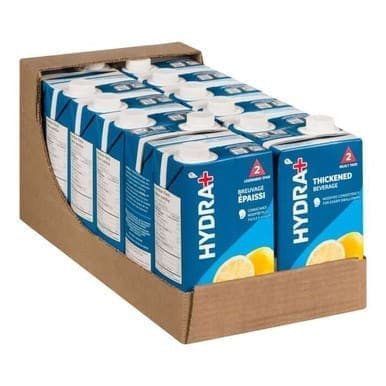
Hydra Plus Orange Juice Level 2 Thickened Beverage 1 litre
Hydra+ Orange Juice, Level 2 Thickened, 1 L
Level 2 nectar · 1 L · 12 per case · ~100 servings
Hydra Plus Thickened Apple Juice 1 Litre IDDSI Level 2
Hydra+ Thickened Apple Juice, 1 L, IDDSI 2
Level 2 nectar · 1 L · 12 per case
Hydra Plus Thickened Cranberry Juice IDDSI Level 2
Hydra+ Thickened Cranberry Juice, IDDSI 2
Level 2 nectar · 1 L · 12 per case · flavour variety
Hydra Plus Milk Level 2 IDDSI 2 Thickened Beverage 1 litre
Hydra+ Milk L2 (IDDSI 2) Thickened Beverage, 1 L
Level 2 nectar · dairy · 1 L · 12 per case
Hydra Plus Thick Lemon Water 1 Litre IDDSI Level 3
Hydra+ Thick Lemon Water, 1 L, IDDSI 3
Level 3 honey · thickened water · 1 L · 12 per case
Hormel Thick and Easy Food and Beverage Thickener bulk 2 kg
Hormel Thick & Easy Food and Beverage Thickener, Bulk 2 kg
Powder · 2 kg tub · L2 or L3 per label
Nestle ThickenUp Clear food thickener 5 kg bulk tub
Nestle ThickenUp Clear Food Thickener, 5 kg Bulk Tub
Gum-based clear powder · 5 kg tub · answers thin-back
Nestle ThickenUp Original instant food and drink thickener 227 g 12 case
Nestle ThickenUp Original Instant Thickener, 227 g (12/Case)
Powder · 227 g canisters · 12 per case
People Also Ask

People Also Ask

Real questions buyers search before they order — answered straight.

What does "thickened liquids" actually mean?

Thickened liquids are ordinary drinks — water, juice, milk, tea — that have had a thickening agent added so they flow more slowly. Slowing the flow gives people with swallowing difficulties more control, lowering the risk of liquid going the wrong way. The IDDSI framework sets exact levels, so slightly, mildly, moderately, and extremely thick each mean something measurable.

Why are thickened liquids easier to swallow?

A thin liquid moves fast and can slip toward the airway before the swallow is ready, while a thicker liquid travels more slowly and predictably. That extra moment of control helps a weakened or delayed swallow direct the drink safely. It is why a speech-language pathologist may prescribe a specific thickness rather than leaving it to guesswork.

How do thickened liquids help prevent aspiration?

Aspiration is when a drink enters the airway instead of the food pipe, and thin liquids are a common cause because they move so quickly. Thickening slows the flow so the swallow has time to close off the airway. The correct level, tested and served consistently, is what keeps that protection reliable.

What are the three types of thickened liquids?

Older wording described three tiers — nectar, honey, and pudding — based on how the drink pours. The IDDSI framework has replaced those names with numbered levels (mildly, moderately, and extremely thick) that can be checked with a simple flow test. If you still see nectar or honey on packaging, match it to the IDDSI level rather than relying on the old label.

Can you drink thickened liquids through a straw?

It depends on the level and the person's assessment — mildly thick drinks may still work through a wide straw, while thicker levels are usually taken from a cup. A straw can change how fast the drink arrives, so follow the guidance in each resident's swallowing plan. When in doubt, check with the speech-language pathologist before offering one.

Why do older adults often need thickened liquids?

Swallowing can weaken with age, stroke, dementia, or other conditions, making thin drinks harder to manage safely. Thickened liquids give a slower, more controlled flow that lowers the risk of choking and chest infections. Not every older person needs them, though — they are prescribed after a swallowing assessment, not by default.

Reviews

What Canadian care operators say

Dietary leads on format choice, yield and delivery.

★★★★★

"We moved the Level 2 population onto the Hydra+ litre cartons and finally had a servings-per-case number we could defend in budget review. The no-minimum policy let us trial one case first."

D
Dana R.
Dietary Services Manager — Ontario
★★★★★

"The 118 mL cups solved our tray line. Fixed serving, level printed on the case, nothing for an agency aide to get wrong at night. We keep ThickenUp Clear on the shelf as backup."

M
Marcelle T.
Consultant Dietitian — Alberta
★★★★★

"Thick lemon water at Level 3 changed our hydration numbers more than any policy did. Ordering both levels from one supplier cut a lot of chasing out of my week."

S
Suzanne L.
Nutrition Services Lead — Nova Scotia
FAQ

Thickened liquids and IDDSI levels: frequently asked questions

The following operator questions are answered with cited sources. Every FAQ links to Health Canada, CFIA, Canada.ca, or another authoritative regulator.

Which works best for everyday use: powder thickener or pre-thickened drinks?
Personal reports suggest there is no single winner. Pre-thickened drinks are easiest when consistency and staff time matter because they arrive ready to serve at a stated level. Powder is more flexible and can cost less per serving, but staff must follow the label, allow the specified standing time, and verify the prescribed IDDSI level. Compare landed cost plus preparation labour at the same pour size and level.

Products referenced:

  • Hydra+ ready-to-drink thickened beverages
  • Nestle ThickenUp Clear
  • Hormel Thick & Easy

Source: Best pre thickened drinks : r/dysphagia - Reddit

Is a gum-based clear thickener worth the extra cost compared with starch powder?
It can be worth trialling when taste, appearance, lumps, or thickness drift are reducing intake. In the discussion, an SLP recommends xanthan-gum Nestle Resource ThickenUp Clear for home use and reports better flavour than cornstarch, while noting that preference varies and whisking helps prevent lumps. Cost the products by label yield at the prescribed level rather than by tub weight alone.

Products referenced:

  • Nestle ThickenUp Clear
  • Nestle ThickenUp Original
  • Hormel Thick & Easy

Source: Best pre thickened drinks : r/dysphagia - Reddit

What thickener works best for juice or protein drinks when ThickenUp Clear does not?
Buyers report that a thickener that works in water may perform differently in acidic juice or dense nutrition drinks such as Nepro or Novasource. Do not compensate with an improvised scoop count: use the beverage-specific manufacturer directions, wait the stated development time, and run the IDDSI test. For a facility, trial each high-volume beverage before choosing one powder for the whole formulary; a ready-to-drink option can remove this variable where available.

Products referenced:

  • Nestle ThickenUp Clear
  • Nepro
  • Novasource
  • pre-thickened nutritional beverages

Source: Best thickener? : r/dysphagia - Reddit

Anyone tried pre-thickened drinks—which flavours are actually palatable?
In one clinician's taste test, ready-to-drink apple and cranberry juices were described as decent, while orange and lemon water were less successful. That is a useful buying signal, not a universal ranking: taste is individual. Use the no-MOQ option to trial one case across several residents before committing to a flavour, and include actual consumption and waste in the value comparison.

Products referenced:

  • Hydra+ Thickened Apple Juice IDDSI 2
  • Hydra+ Thickened Cranberry Juice IDDSI 2
  • Hydra+ Orange Juice Level 2
  • Hydra+ Thick Lemon Water IDDSI 3

Source: Best pre thickened drinks : r/dysphagia - Reddit

What do caregivers use when thickening powder leaves a bad taste and the person stops drinking?
Caregiver discussions repeatedly favour changing the beverage or thickener rather than accepting low intake. Practical options include trialling a clear gum-based thickener, offering several preferred flavours, or buying pre-thickened drinks for the beverages residents reject when mixed from powder. Keep the prescribed IDDSI level unchanged, track intake, and involve the speech-language pathologist or dietitian when acceptance remains poor.

Products referenced:

  • Nestle ThickenUp Clear
  • Hydra+ ready-to-drink thickened beverages
  • thickened apple juice
  • thickened cranberry juice

Source: My grandpa doesn't like the taste that thickening powder leaves so won't drink much

Has anyone used Thick & Easy, and is it practical for home or care-facility use?
Caregivers report using Thick & Easy for relatives with dysphagia and describe adjusting drinks according to need. For safe purchasing and preparation, however, do not rely on informal trial-and-error: buy the labelled food-and-beverage thickener, mix exactly for the prescribed IDDSI level, and verify with the IDDSI test. A bulk 2 kg tub suits a trained central kitchen; smaller canisters may reduce handling risk on satellite units.

Products referenced:

  • Hormel Thick & Easy Food and Beverage Thickener 2 kg
  • Nestle ThickenUp Original 227 g canisters

Source: Has anyone used thickeners for liquids, my husband is being released from skilled nursing?

What mixing method works best for thickened tea without ruining its taste?
A dementia-care forum contributor recommends making the tea normally, placing the prescribed scoops in a second mug, then slowly adding the tea. This may preserve familiar taste and appearance better than altering the recipe first. Facilities should still use the product's hot-liquid directions, observe its standing time, and verify the required IDDSI level before serving.

Products referenced:

  • Nestle ThickenUp Clear
  • Hormel Thick & Easy
  • labelled beverage thickener

Source: Do you use thickener in liquids? - Dementia Support Forum

Are portion cups worth it, or are one-litre cartons the better value?
Choose by workflow and consumed serving cost, not package price. A 48-count case of 118 mL cups gives 48 fixed portions with little measuring or open-carton waste. A 12 x 1 L case gives about 100 portions at 120 mL, 66 at 180 mL, or 50 at 240 mL and usually reduces packaging per litre, but actual value falls if pours are oversized or opened cartons are discarded. Cups often suit tray lines; litre cartons suit predictable high-volume service.

Products referenced:

  • Thickened Apple Nectar IDDSI Level 2 118 mL cups
  • Sysco Imperial Thickened Orange Juice L3 4 oz cups
  • Hydra+ 1 L thickened beverages

Source: About Food and Beverage Thickening Agents

Should a facility keep powder if it mainly buys pre-thickened beverages?
Yes, a backup labelled thickener is usually sensible. Pre-thickened beverages simplify routine service, but they cannot cover every favourite drink or nutrition supplement and a supply interruption can leave a formulary gap. Keep a powder that staff are trained to use, document recipes by beverage and prescribed level, rotate stock, and verify prepared drinks. This preserves flexibility without making hand mixing the default.

Products referenced:

  • Nestle ThickenUp Clear 5 kg
  • Hormel Thick & Easy 2 kg
  • Hydra+ ready-to-drink thickened beverages

Source: Do you have difficulty eating or drinking? - ALS News Today Forums

What is the safest way to confirm a powder-thickened drink matches the ordered IDDSI level?
Follow the thickener label for that exact beverage, temperature, volume, and prescribed level; allow the specified standing time; then perform the IDDSI Flow Test with the correct 10 mL slip-tip syringe. Do not use visual judgement or legacy words alone. Purchasing should compare products only after confirming they can repeatedly reach the clinician-prescribed level in the facility's real preparation conditions.

Products referenced:

  • Nestle ThickenUp Clear
  • Hormel Thick & Easy
  • IDDSI 10 mL flow-test syringe

Source: IDDSI Testing Methods

Regulatory reference: IDDSI Testing Methods (U.S. FDA references IDDSI)

\n

Why care operators buy thickened liquids from ChickenPieces

Both formats, both levels, one supplier, no minimum.

No minimum order

Trial one case of a Level 3 line before committing it to a formulary.

Both levels in stock

Level 2 and Level 3 in cup and litre formats, plus labelled thickeners.

Health Canada listed supplier
Calgary warehouse, Canada-wide

Shipped from our Calgary warehouse on live carrier rates, pallet freight included.

Institutional selection

A catalogue built for long-term care and hospital dietary rather than retail.

CFIA-compliant product selection

Get a quote on both levels before your next formulary review

Send us your prescribed levels, standard pour and resident counts. We will come back with case options at both levels in both formats. No minimum order.

Request a Quote
Sources

Sources & further reading