

Patient Lift Buying Guide: Matching Capacity to the

2026 Jul 21st

Patient Lift Buying Guide: Matching Capacity to the

Canadian-Owned No MOQ Ships Canada-Wide Calgary Warehouse Health Canada Listed ISO 9001 Supplier
Quick Answer

Buy for the heaviest resident your unit will ever hold, then take the tier above it: 400 lb (181 kg) with the BestLift PL400HE, 500 lb (227 kg) with the ProCare BestLift PL500 or Drive Medical LEVANTAR, and 700 lb (318 kg) with the FGA-700 bariatric floor lift. Staff the transfer for two caregivers even when the device is rated for one operator, because facility policy and surveyors are what get reviewed after an incident.

Safe Patient Handling Equipment Guide
A

Amani

ChickenPieces.com · Calgary, AB · We ship Canada-wide

Patient Lift Buying Guide: Matching Capacity to the Resident and Staffing the Transfer Honestly

A capacity ladder from a resident's actual weight to a named model we stock, plus the caregiver-count answer most buying guides skip.

400 – 700 lb
Rated capacity span across our floor lift range
2 caregivers
What operators report their policy requires
No MOQ
One home unit or a full facility fleet
At a Glance

Key Takeaways

Six decisions that separate a lift that gets used from one that sits in a hallway.

Buy the tier above your heaviest resident

Rated capacity is a ceiling, not a target. A lift rated below the load it is given has already failed on a hospital floor.

Weight-bearing ability picks the device

A full-body floor lift needs none. A sit-to-stand needs partial weight-bearing plus the ability to follow a cue.

Staff for two, whatever the manual says

Care-home staff report that facility policy and state surveyors expect two people on a mechanical lift.

Inspect the sling as carefully as the lift

CCOHS is explicit that pre-use inspection covers the device and its accessories, slings and belts included.

Check the floor before you check the brochure

Castors that stall on residential carpet turn a completed lift into a stranded resident.

Calgary warehouse, no minimum order

We ship lifts to every province on live freight rates, and one home buyer gets the same terms as a multi-site operator.

The Trigger

When does a difficult transfer become a lift purchase?

The buying signal is time and back strain, not a diagnosis.

Families rarely decide to buy a lift on a clinical milestone. They decide on a clock. A caregiver on r/caregivers put it exactly right: transfers with a board were getting harder, and the real question was at what point you say enough — "When it takes 15 minutes to get her into the shower? Half an hour?"

Facilities hit the same wall from the other direction. A resident is classified as a one-person pivot on paper, the classification lags their actual condition, and an aide working alone absorbs the difference in their lumbar spine. One care aide described exactly that: alone with a supposed one-person pivot who was breaking her back, using the sit-to-stand parked in the hallway, and getting reprimanded for it.

Our position: if a transfer takes two attempts or leaves the caregiver sore, the assessment is finished. Buy the lift.
Device Choice

Floor lift or sit-to-stand: which one does the resident qualify for?

One question decides it, based on the resident's worst day.

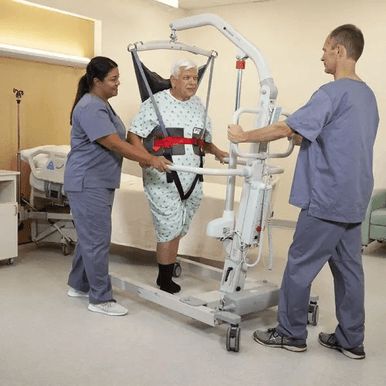
Weight-bearing ability is the entire decision. A full-body floor lift takes the resident's whole weight in a sling and asks nothing of them. A sit-to-stand asks for partial weight-bearing through the legs plus enough cognition to hold a bar and follow a cue. If either is unreliable on a bad afternoon, the floor lift is the right device on every afternoon.

Floor staff name a third answer constantly: the lift is all-or-nothing. Once a resident regains independence, it stops being the safest option and starts holding them back.

Merchandising note: our verified in-stock range is floor lifts. We compare sit-to-stand as a decision framework because you need it to choose correctly, not because we can fill a sit-to-stand fleet order.

Use when: the resident cannot bear weight, cannot follow a transfer cue, is being moved bed-to-chair, or is in the bariatric range. This is the category we stock — BestLift PL400HE through FGA-700.

Use when: the resident bears partial weight, can grip and pull, and is being moved short distances such as bed to commode. It preserves standing tolerance, which is why rehab units favour it.

Use when: the resident is regaining independence and the lift has become a ceiling rather than a floor. Reassess with the therapy team — standing tolerance is harder to rebuild than to preserve.

The Staffing Answer

How many caregivers does a mechanical lift actually need?

Three different authorities answer this, and they disagree.

Most buying guides duck this. The one competitor that answers states that most floor and sit-to-stand lifts are designed for one-caregiver operation. That is a statement about engineering, and as buying advice it is contradicted by nearly every care-home account we reviewed. Separate the three things.

What the device is engineered for. A powered floor lift is built so one trained operator can run the controls. What facility policy requires. Care aides with a decade on the floor describe never operating a lift without a spotter, under policy requiring two people every time. What a surveyor expects. Operators report that state surveyors treat mechanical lift transfers as a two-person task, and that solo transfers are what get written up.

The stakes are not abstract. A care aide has been indicted for negligent homicide after a resident fell from a Hoyer lift, and the community evidence is full of the failure that precedes it: one aide attempted a Hoyer alone and the resident slipped out of the sling.

Our position, stated plainly: buy and staff for two caregivers. We are not citing a federal regulation that mandates it — the picture on the ground is facility policy and survey practice, and mixed messages within the same building are exactly what staff describe. If your policy says one, put it in writing and train to it. If it says two, roster it.

Capacity

Why capacity headroom is the one spec you cannot negotiate

Rated capacity is a ceiling. Buying to the ceiling is how equipment fails.

Under-rating is a documented failure mode, not a caution-label hypothetical. Nursing staff describe a lift breaking loose with a resident of roughly 500 lb who hit the tile in a hallway — rated for less than the load it was given.

Buy against the heaviest resident the unit will ever admit, then take the next tier up. A floor admitting residents up to 450 lb should be equipped at 500 lb. Weight fluctuates and nobody re-weighs a resident before an emergency transfer at three in the morning.

Then check the floor. A home health team reported lifting a resident of close to 400 lb and being unable to move him — the castors were stuck in his living room carpet. The lift worked and the transfer still failed. Measure the doorway before the unit ships.

CCOHS states that any mechanical lifting device must be inspected before use, including any accessories such as slings, belts, or discs. Run this before the first transfer of every shift.

The lift: battery charge · emergency lowering tested · emergency stop tested · mast and boom free of cracks · castors turning freely and locks holding · base-width control through full travel · actuator movement smooth with no drift · capacity label legible.

The sling: label legible with size and rated load · every strap and loop checked for fraying or heat damage · seams intact · fabric free of tears or laundering damage · attachment points matched to the spreader bar · correct size for the resident and the transfer.

Fail one item and the lift is out of service. Tag it, pull it, use a spare.

Canadian Compliance

What Canadian operators need on file

The Canadian framework is a program requirement, not an equipment specification.

CCOHS frames safe patient handling as a program rather than a purchase. Its guidance calls for a joint program committee with management, worker, union and health-and-safety-committee input — the people doing the transfers help write the rules. If your lift arrives without a policy, training record and inspection routine attached, you bought hardware and skipped the program.

The same page sets the inspection expectation quoted above — turning sling condition into a documented daily step instead of a maintenance afterthought.

Health Canada also publishes guidance on patient lifts and fall risk. We link it as the regulator reference and do not paraphrase its wording — read it at canada.ca patient lifts guidance, alongside the CCOHS safe patient handling program page.

Program, not purchase

Policy, training records and inspection logs travel with the equipment.

Workers on the committee

Joint input from management, workers, union and the health-and-safety committee.

Inspection before use

Device plus accessories, every shift. Slings and belts named explicitly.

Matched ratings

Follow the manufacturer instructions for your lift and sling pairing.

Product Comparison

Capacity ladder: from resident weight to a named model

Find the row covering your heaviest resident, then take the row below it as your margin.

Model Rated Capacity Type Best For Capacity Source
BestLift PL400HE400 lb / 181 kgFull-body electric floor liftSingle-resident home care, assisted livingStated in model name
Bestcare PL400EF400 lb / 181 kgFoldable electric floor liftHome care with storage limits, travelStated in model name
ProCare BestLift PL400Confirm on product pageFull-electric floor liftGeneral long-term care floor useVerify before purchase order
Invacare Reliant 450Confirm on product pageBattery-powered floor liftHigh-cycle units, 150–300 lifts per chargeVerify before purchase order
ProCare BestLift PL500500 lb / 227 kgFull-electric floor liftLong-term care floors admitting heavier residentsStated in model name
Drive Medical LEVANTAR500 lb / 227 kgHeavy-duty floor liftSkilled nursing, mixed-acuity unitsStated in model name
FGA-700 Bariatric700 lb / 318 kgBariatric mobile floor liftDedicated bariatric rooms and unitsStated in model name
Molift Smart 150Confirm on product pageLightweight portable liftHome health rounds, multi-site caregiversVerify before purchase order

Where a capacity is not printed in the model name, we say so rather than estimating it. Confirm on the product page before the order goes out.

Shop the Range

Patient lifts we stock and ship from Calgary

Ten floor lifts spanning home care, long-term care and bariatric use.

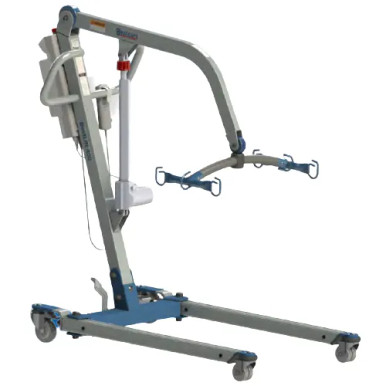
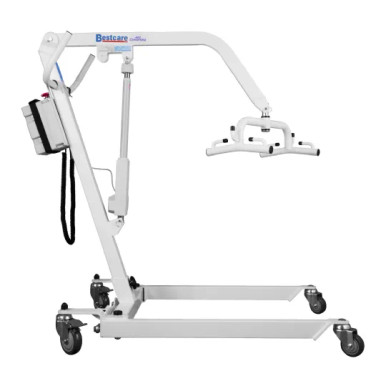
BestLift PL400HE Full Body Electric Mobile Patient Lift
400 lb / 181 kg · full-body sling lift · electric
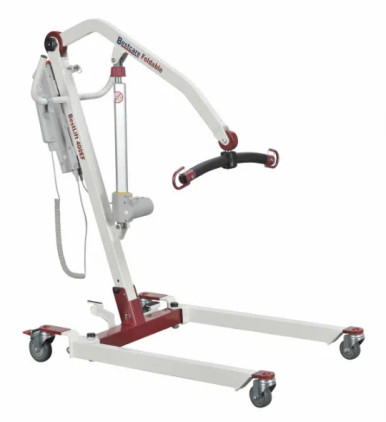
Bestcare PL400EF Electric Patient Lift Foldable and Portable
Bestcare PL400EF Electric Patient Lift, Foldable
400 lb / 181 kg · folds for storage · portable
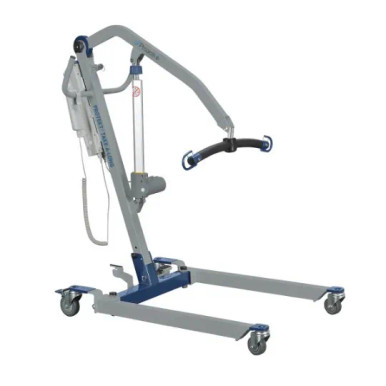
ProCare BestLift PL400 Patient Lift by BestCare
Full-electric floor lift · confirm capacity on page
Invacare Reliant 450 Battery-Powered Patient Lift
Battery powered · 150–300 lifts per charge
ProCare BestLift PL500 Patient Lift by BestCare 500 lb capacity
ProCare BestLift PL500 Patient Lift by BestCare
500 lb / 227 kg · full-electric · long-term care
Drive Medical LEVANTAR Heavy-Duty Floor Patient Lift 500 lb capacity
Drive Medical LEVANTAR Heavy-Duty Floor Patient Lift
500 lb / 227 kg · heavy-duty · skilled nursing
FGA-700 Bariatric Mobile Floor Lift 700 lb capacity
FGA-700 Bariatric Mobile Floor Lift
700 lb / 318 kg · bariatric mobile base
BestLift Full Body Patient Lift compact design for bariatric lifts
BestLift Full Body Patient Lift, Compact Design
Compact footprint · bariatric-capable · confirm capacity on page
Protekt Take-A-Long Folding Power Patient Lift
Folding power lift · transport-friendly · confirm capacity on page
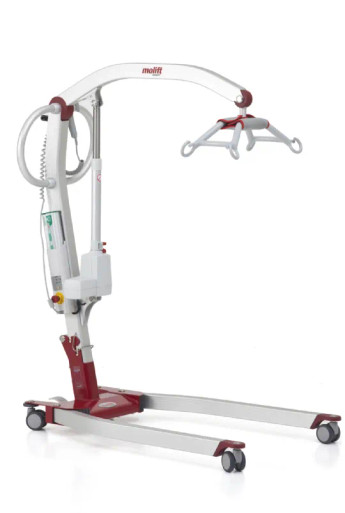
Molift Smart 150 lightweight portable patient lift
Molift Smart 150 Lightweight Portable Patient Lift
Lightweight portable · home health rounds · confirm capacity on page
Reviews

What Canadian care operators say

Buyers running lifts across long-term care, home health and rehab.

★★★★★

"We replaced two aging floor lifts with the PL500 after an admission pushed us past our old rated ceiling. Ordering two units without a fleet minimum was the part that mattered."

M
Marc D.
Director of Care, long-term care home — Quebec
★★★★★

"The FGA-700 went into our bariatric room and gave our aides the headroom they had been asking for. What sold me was being told plainly which capacities were printed on the model and which needed confirming."

S
Sandra K.
Clinical Procurement Lead — Ontario
★★★★★

"The Molift Smart 150 goes in the vehicle for rounds and the BestLift PL400HE stays with our heaviest client. Rural delivery was handled without the usual freight runaround."

J
Janelle R.
Home Health Agency Owner — Manitoba
FAQ

Patient Lifts: Frequently Asked Questions

How do I choose the right patient lift capacity?

Start from the heaviest resident the unit will ever hold, not the average, then buy the tier above that number. Our catalog ladders at 400 lb (181 kg) with the BestLift PL400HE, 500 lb (227 kg) with the ProCare BestLift PL500 and Drive Medical LEVANTAR, and 700 lb (318 kg) with the FGA-700. Any capacity not printed in the model name should be confirmed on the product page first.

Are patient lifts a one-caregiver or two-caregiver job?

The device and the workplace answer this differently. Many powered floor lifts are engineered so one trained operator can run the controls, but long-term care operators report that facility policy and state surveyors treat a mechanical lift transfer as a two-person task. Staff for the policy.

What is the difference between a floor lift and a sit-to-stand lift?

A full-body floor lift takes the resident's entire weight in a sling and requires no weight-bearing ability. A sit-to-stand lift assists a resident who can bear partial weight and follow a cue to pull up. If a resident cannot reliably bear weight on a bad day, the floor lift is the correct device on every day.

What should be inspected before every patient lift transfer?

CCOHS states that any mechanical lifting device must be inspected before use, including accessories such as slings, belts or discs. That means the mast, boom, castors, battery charge, emergency lowering control, and every sling strap, loop, label and seam.

Do the lift and the sling need matching weight ratings?

The working load of the system is set by its weakest rated component, so a sling rated below the lift caps the whole assembly. Follow the manufacturer instructions supplied with your specific lift and sling. Treat this as manufacturer guidance, not a regulatory citation.

Why does a patient lift get stuck on carpet?

Small castors and a heavy load are a bad combination on residential carpet, and a home health team reported lifting a resident of roughly 400 lb only to find the lift would not roll. Check castor size and base clearance against the actual floor surface before ordering.

Do you sell patient lift slings separately?

Our range is built around lifts, and many units ship with a sling included. We stock only a small number of standalone slings, so contact our team with your lift model and resident measurements. The sling has to match the lift, not just the person.

Can a home caregiver buy a single patient lift?

Yes. ChickenPieces.com has no minimum order, so a family buying one BestLift PL400HE orders on the same terms as a long-term care group buying a fleet. Size for the resident's worst day and your doorway width.

Do you ship patient lifts across Canada?

Yes. Patient lifts ship Canada-wide from our Calgary warehouse to every province, on live carrier freight. Free shipping applies on qualifying orders, and lifts move as freight rather than parcel because of their size and weight.

How do you calculate shipping on bulk orders?

We calculate shipping on live carrier rates at checkout, not on flat or subsidized tiers. Every order is priced against real LTL, parcel, or pallet-freight quotes from our Calgary warehouse to your dock. That means you never absorb hidden shipping costs into product margins, and for bulk and pallet orders this typically runs 15-25% lower than competitors who bake shipping into their unit prices.

Why care operators buy patient lifts from ChickenPieces

Four reasons Canadian care buyers keep the reorder here.

No minimum order

Buy one unit or equip a whole floor. A family caregiver and a multi-site operator get the same terms.

Canadian-owned, ships nationwide

Lifts move from our Calgary warehouse to every province on live freight rates, with no border paperwork.

Straight answers on specifications

Where a rated capacity is not printed on the model, we say so instead of estimating. Your procurement file gets facts.

Health Canada listed supplier
Institutional supply experience

We supply long-term care, home health and rehab accounts, so the sizing advice comes from units running this equipment daily.

Get a patient lift quote sized to your heaviest resident

Send us your heaviest admitted weight, floor surfaces and doorway widths, and we will come back with the models that clear all three with margin to spare. Quotes include live freight from Calgary, no minimum order.

Request a Quote
Sources

Sources & further reading