
 US Dollar


2026 May 1st
The Guide to IDDSI-Compliant Beverages for Canadian
My name is Amani, and at ChickenPieces.com, we spend our days talking to operators like you. We see the purchase orders, we hear the feedback from kitchen managers, and we understand the pressure you're under. One of the most consistent challenges in any Canadian long-term care home is managing hydration and nutrition for residents with dysphagia. It's not a niche problem; it's a core operational reality. Statistics show that anywhere from 40% to 60% of residents in long-term care have some degree of difficulty swallowing. That's a huge portion of your census.
Key Takeaways
- IDDSI is mandatory in Canadian long-term care — Level 0-4 for liquids, tested with fork-drip or syringe.
- Powder thickeners are flexible but risk inconsistency and require staff time for proper mixing and testing.
- Ready-to-drink (RTD) beverages guarantee perfect consistency every time and reduce labour costs significantly.
- Best strategy: Use RTD for high-volume med passes, keep powder for ad-hoc needs like tea or soup.
Getting this right isn't just about resident satisfaction. It's about safety, compliance, and managing your budget effectively. Since the nationwide adoption of the IDDSI framework in 2019, the standards are clearer than ever, but the day-to-day execution remains complex. This post is a no-nonsense guide for Canadian operators. We'll break down the products, the processes, and the purchasing strategies you need to manage thickened beverages and texture-modified foods efficiently .
What is IDDSI and Why It's Non-Negotiable in Canada
IDDSI is the global standard for texture-modified foods and thickened liquids, adopted across Canadian healthcare since 2019. Every thickened beverage your facility serves must meet a specific IDDSI level prescribed by a speech-language pathologist or dietitian — it's not optional, it's the standard of care.
First, let's get on the same page. The International Dysphagia Diet Standardisation Initiative (IDDSI) is a global framework providing common terminology and definitions for texture-modified foods and thickened liquids. It's a scale from 0 to 7. For the purpose of this guide, we're mostly concerned with the liquid levels:
- Level 0 - Thin (like regular water)
- Level 1 - Slightly Thick
- Level 2 - Mildly Thick (often called "nectar-thick")
- Level 3 - Moderately Thick (often called "honey-thick")
- Level 4 - Extremely Thick (often called "pudding-thick")
Levels 3 and 4 also apply to foods, which continue up to Level 7 (Regular foods).
Before IDDSI, every facility, region, and sometimes even every staff member had a different definition for "nectar" or "honey" thick. This created dangerous inconsistencies. A resident could move from a hospital to your long-term care home and receive a liquid with a completely different, and potentially unsafe, consistency, even if it had the same name on the chart.
In Canada, healthcare authorities and organisations have mandated IDDSI compliance. This isn't a suggestion; it's the standard of care. For your facility, this means that every single thickened drink you serve must be tested and confirmed to meet the precise IDDSI level prescribed for that resident by a clinician, like a speech-language pathologist (SLP) or dietitian. Adherence is a matter of resident safety and regulatory compliance.
The Core Challenge: Powder Thickeners vs. Ready-to-Drink (RTD)
Powder thickeners offer flexibility and lower per-serving cost but risk dangerous consistency errors. Ready-to-drink (RTD) beverages guarantee perfect thickness every time and eliminate staff mixing time. Most long-term care homes use a combination strategy for best results.
This is the main operational decision your kitchen and clinical team will make. Do you thicken beverages to order using a powder, or do you purchase pre-thickened, ready-to-drink products? Each has significant pros and cons, and the right answer for your facility is likely a combination of both.
Powder Thickeners
These are the large tubs of starch- or gum-based powders that you mix into liquids. We stock the industry standards that you're familiar with, like Hormel Thick and Easy Food and Beverage Thickener and Nestle ThickenUp Clear 5 kg.
Pros:
- Flexibility: You can thicken almost any liquid--juice, milk, coffee, tea, soup, or nutritional supplements. This is their biggest advantage.
- Lower Invoice Cost: On a per-serving basis, the raw cost of powder is generally lower than a pre-packaged drink.
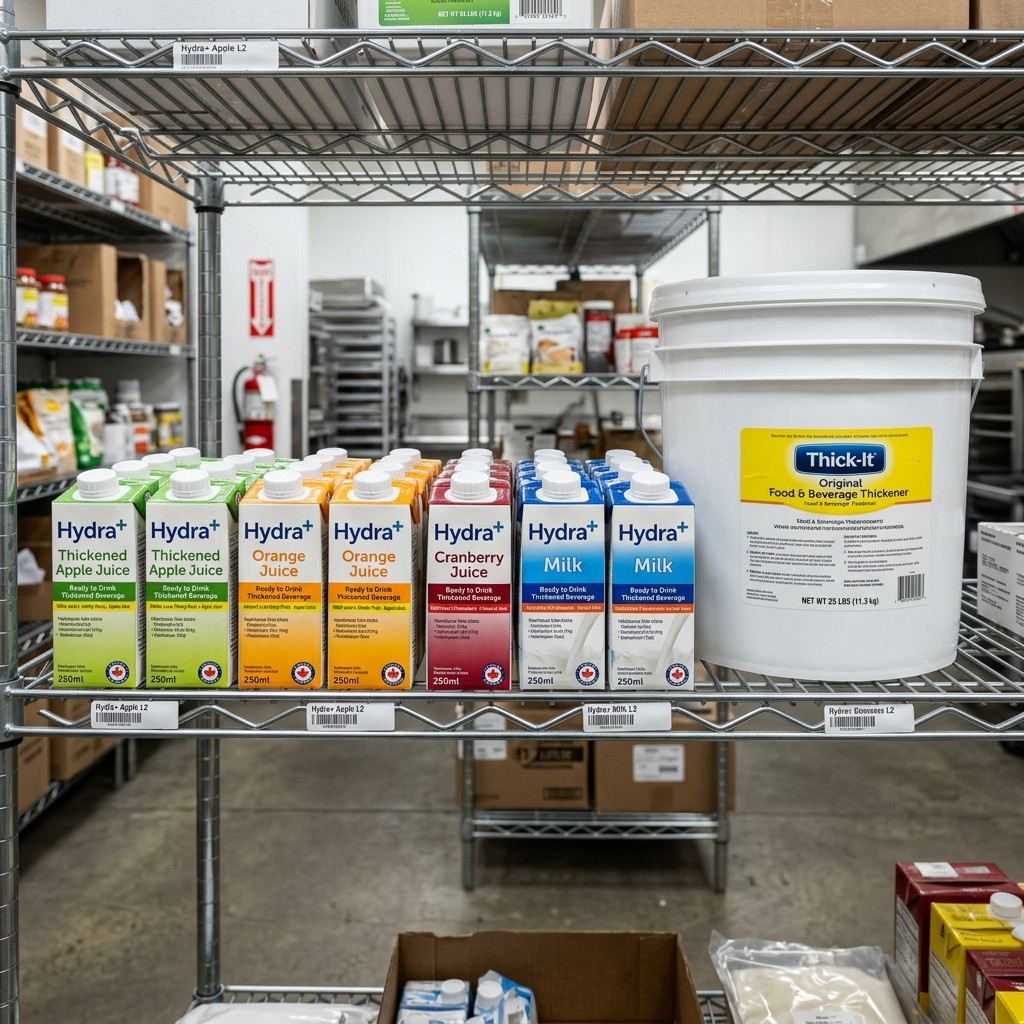
- Storage Efficiency: A 25-pound box of Thick It powder takes up far less storeroom space than the equivalent volume of prepared drinks.
Cons:
- Inconsistency: This is the single biggest risk. Is your new casual kitchen aide mixing it the same way as the 10-year veteran? Is the liquid at the right temperature? Is the mixing technique correct? Small variations can result in a drink that is too thin (choking risk) or too thick (dehydration risk, poor palatability).
- Labour Intensive: It takes staff time. Time to get the liquid, measure the powder, mix for the specified duration, wait for it to set, and then test it with a fork or syringe to confirm the level. This time adds up across dozens of residents, three times a day.
- Taste and Texture: Let's be honest. Powders, especially older starch-based ones, can add a starchy taste, a gritty mouthfeel, or a cloudy appearance to liquids. This can significantly reduce a resident's desire to drink.
Ready-to-Drink (RTD) Thickened Beverages
These are pre-packaged, pre-thickened drinks that are guaranteed to be at the correct IDDSI level right out of the carton. Our most popular line is Hydra+ Thickened Beverage, which come in IDDSI Level 2 and Level 3.
Pros:
- Perfect Consistency: Every single time. There is no guesswork and virtually no room for human error. This is the ultimate in safety and quality assurance.
- Labour Savings: The only staff time involved is opening the package and pouring it into a cup. This frees up your team for other critical tasks.
- Improved Palatability: Products like Hydra+ are formulated to have a smooth texture and clean taste. They come in familiar flavours like Apple, Orange, Cranberry, Milk, and Lemon Water, which encourages consumption.
Cons:
- Higher Unit Cost: A single-serve carton of RTD juice will cost more on an invoice than the equivalent amount of juice and powder.
- Storage Space: Cases of RTD beverages take up considerable room in your storeroom. You need to plan your inventory and storage layout accordingly.
- Limited Variety: While core flavours are covered, you can't get an RTD version of every single beverage your residents might request.
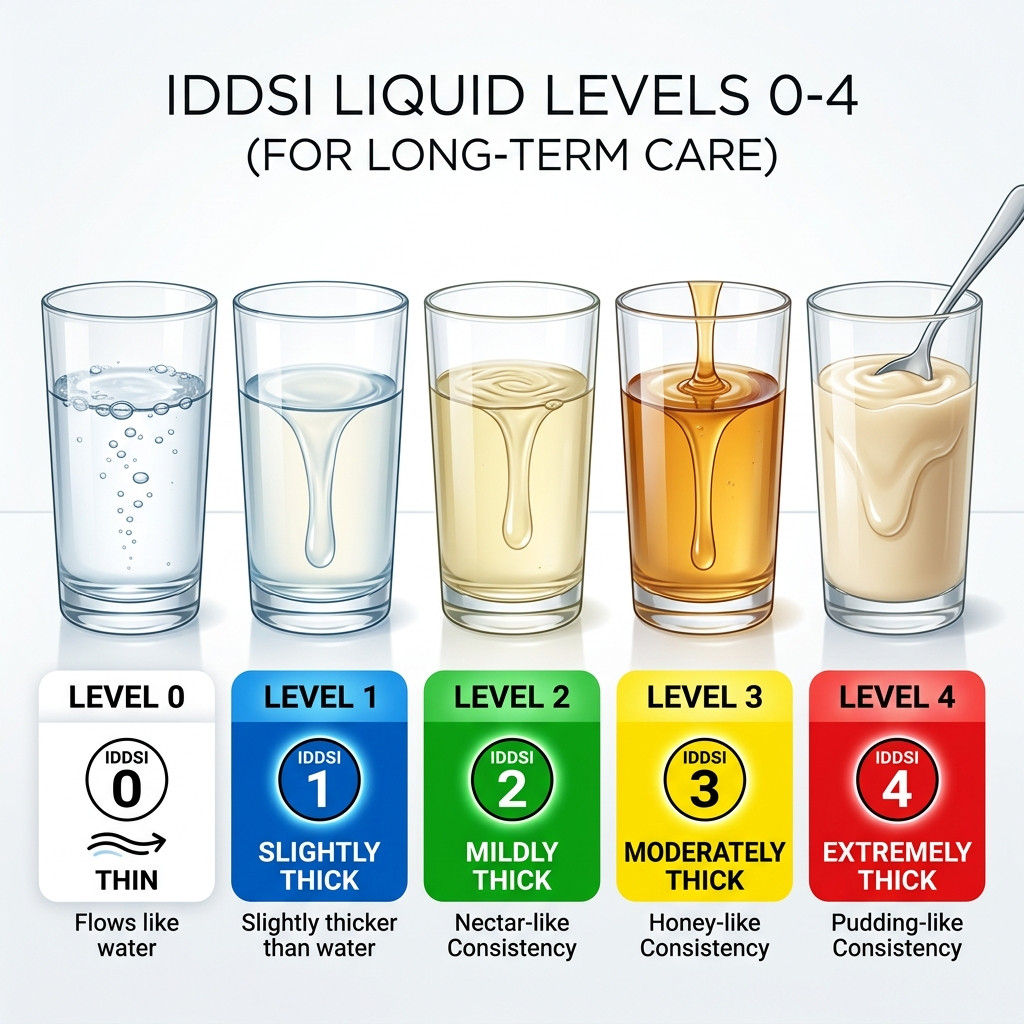
A Closer Look: IDDSI Level 2 vs. Level 3
IDDSI Level 2 (mildly thick, formerly nectar) flows slowly off a fork in small dollops. Level 3 (moderately thick, formerly honey) sits on top of a fork and requires a spoon. Your team must know the difference and test every serving.
Understanding the practical difference between the two most common thickened liquid levels is crucial for your staff. This shouldn't be a mystery; it's a measurable standard.
IDDSI Level 2 - Mildly Thick:
- Commonly Called: Nectar-thick.
- Description: Noticeably thick, flows off a spoon but slower than a thin liquid. It can be sipped from a cup.
- The IDDSI Test (Fork Drip Test): When you lift a fork from the liquid, it should drip slowly in small dollops through the prongs. A small amount may remain on top of the fork.
- Products: Hydra+ Level 2 drinks, or liquids thickened to spec with powders like Hormel Thick and Easy.
IDDSI Level 3 - Moderately Thick:
- Commonly Called: Honey-thick.
- Description: The liquid is difficult to drink from a standard cup and is best taken with a spoon. It has a smooth texture with no lumps.
- The IDDSI Test (Fork Drip Test): The liquid should dollop off the fork and not flow continuously. It will not drip through the prongs easily; it will sit on top.
- Products: Hydra+ Level 3 drinks, or liquids thickened to spec.
Your staff must be trained to perform these simple tests. Posting IDDSI flow test charts in the kitchen, servery, and nursing stations is a best practice. The decision on which level a resident needs is made by a clinician based on their swallowing assessment. Your job is to deliver that exact level, without fail.
The Real Cost: A Practical Breakdown
The true cost of a thickened beverage includes labour, waste from incorrect mixing, and the risk of adverse events. RTDs narrow the cost gap significantly when you factor in consistency and safety, making them a strong value proposition for Canadian long-term care homes.
Managers get stuck on invoice price. Look at the total landed cost of serving a safe beverage.
Cost of a Powder-Thickened Drink =
Cost of Juice/Milk + Cost of Powder + (Staff Time to Retrieve, Measure, Mix, Wait, Test, and Serve) + Cost of Waste (incorrectly mixed batches) + Cost of Risk (an adverse event like choking or aspiration pneumonia from an incorrect consistency).
Cost of an RTD Thickened Drink =
Cost of the RTD unit + (Staff Time to Open and Pour).
When you factor in labour, especially in a unionized environment, the cost gap narrows significantly. When you consider the near-elimination of consistency errors, the value proposition of RTDs becomes very strong. A single choking incident or aspiration event can have devastating consequences for the resident and significant operational and legal repercussions for your facility. The consistency of an RTD product is a powerful form of risk management.
| Cost Factor | Powder Thickener | RTD Beverage |
|---|---|---|
| Product cost per serving | Lower | Higher |
| Staff labour per serving | 3-5 minutes | <30 seconds |
| Consistency risk | High (human error) | None (factory sealed) |
| Waste from incorrect mixing | 5-15% of batches | 0% |
| Training requirement | Ongoing (every new hire) | Minimal |
| Total landed cost | Higher than invoice suggests | Lower than invoice suggests |
Operator's Tip
Many facilities use RTD thickened drinks for med passes (speed + accuracy) and single-serve powder packets for odd requests like tea or soup. It's about using the right tool for each job.
Building Your Bulk Buying Strategy
items, powder for flexibility.A smart bulk buying strategy for IDDSI products starts with knowing your resident census numbers, applying the 80/20 rule for core RTD products, and maintaining powder thickeners for ad-hoc beverage requests.
A smart purchasing strategy is proactive, not reactive. Running out of thickener or a specific RTD flavour is not an option. Here's how to structure your ordering.
1. Know Your Numbers: Work with your dietitian or clinical lead. You need to know exactly how many residents are on Level 2 and Level 3 liquids. This is the single most important piece of data for forecasting your needs.
2. Apply the 80/20 Rule: You'll likely find that 80% of your thickened beverage needs are for a few core products: apple juice, orange juice, cranberry juice, water, and milk. These are your workhorses. It makes the most sense to stock these high-volume items in a reliable RTD format.
3. Create a Core Stock List: Stock Hydra+ Level 2 and 3 in Apple, Orange, Cranberry, and Milk. Keep Nestle ThickenUp Clear 5 kg for ad-hoc needs and single-serve packets for nursing stations, and Trepuree Salmon with Peas & Pasta Puree for complete dysphagia care.
Products Mentioned
Frequently Asked Questions
The following operator questions are answered with cited sources. Every FAQ links to Health Canada, CFIA, Canada.ca, or another authoritative regulator.
What are IDDSI-compliant beverages?
What IDDSI levels are available for thickened beverages in Canada?
Where can I buy IDDSI-compliant thickened beverages in Canada?
What is the difference between thickened beverage powders and pre-thickened ready-to-drink beverages?
Source: Thickened Beverages vs Powders - McKin Health Canada
Does Canada require healthcare facilities to use IDDSI standards?
Source: IDDSI in Canada - Canadian Society of Nutrition Management
How do I test whether my beverage is IDDSI-compliant?
Source: How to Thicken Beverages to IDDSI Levels 1-4 - SeniorDeli
What are the common challenges with thickened beverages for dysphagia patients?
Can I thicken coffee, tea, or juice to IDDSI levels?
How much do IDDSI-compliant pre-thickened beverages cost in Canada?
What is the Frazier Free Water Protocol for dysphagia patients?
Authoritative Sources
The following government and public-health sources informed the operator guidance above. Citations to Reddit, Quora, and operator forums appear in the FAQ block above.