
2026 Jul 25th
Certified Eco-Friendly Janitorial Chemicals for Canadian
Eco-friendly janitorial certifications in Canada include EcoLogo, Green Seal, and Health Canada DIN registration. These verify biodegradability, low toxicity, and reduced environmental impact. Concentrated formulas cut plastic use and transport emissions.
Certified Eco-Friendly Janitorial Chemicals for Canadian Facilities
Facility operators and property managers across Canada need cleaning chemistry that meets strict environmental standards without sacrificing performance.
Key Takeaways
Here is what Canadian buyers should know before stocking eco-friendly cleaning chemistry.
Certification labels differ
EcoLogo and Green Seal measure full product lifecycle. DIN numbers from Health Canada confirm disinfectant safety and efficacy. Both matter, for different reasons.
Concentrates reduce footprint
Closed-loop systems and bulk concentrates slash plastic, water shipping weight, and storage space. Most ratios mix at 1:256 or similar.
Biodegradable does not mean weak
Hydrogen peroxide-based disinfectants like Oxivir break down to water and oxygen. They kill pathogens without quaternary ammonium residue.
Read the SDS sheet
The safety data sheet lists active ingredients, pH, and disposal guidance. It is your fastest way to verify claims against actual chemistry.
Closed-loop prevents spills
Sealed concentrate containers dock into dispensers. Staff cannot over-pour or under-dilute. This controls cost and keeps mixing consistent.
Provincial rules vary
Alberta and Ontario have their own workplace chemical handling rules. Federal certifications satisfy baseline standards, but check local add-ons.
What Canadian Eco-Labels Actually Verify
Third-party certifications test chemistry, not just marketing claims.
EcoLogo, now part of UL, tests products against standards for human health, environmental impact, and performance. A product with this mark has survived independent audit of its full lifecycle: raw material extraction, manufacturing, use, and disposal. For janitorial chemicals, this means the formula biodegrades within set timeframes and avoids bioaccumulative ingredients.
Green Seal follows a similar rigour but adds requirements for packaging recyclability and manufacturing transparency. Neither certification is mandatory in Canada. They are voluntary standards that facilities adopt to meet internal sustainability targets or to satisfy client requests, especially in government and institutional contracts.
Health Canada's Drug Identification Number, or DIN, serves a different purpose. It confirms a disinfectant has been reviewed for safety and efficacy against specific organisms. A DIN does not measure environmental impact. However, pairing DIN-registered disinfectants with EcoLogo or Green Seal certification gives buyers both performance assurance and environmental accountability.
Why Concentrates Cut Facility Waste
Shipping water across provinces makes little sense.
Concentrated janitorial chemicals contain active ingredients at high strength, diluted at point of use. The environmental math is direct: less plastic packaging, lighter freight loads, and smaller storage footprints. A facility in Calgary ordering from a national distributor reduces transport emissions simply by receiving concentrate instead of pre-diluted product.
Closed-loop dispensing systems lock the concentrate container onto a wall-mounted unit. Staff press a button or fill a bottle to a marked line. This removes guesswork, prevents the over-concentration that wastes chemistry and leaves residue, and limits skin contact with raw product. The sealed design also reduces spill risk in busy mop closets.
The trade-off is upfront equipment cost and staff training. Dispensers pay back through reduced product use and eliminated theft of ready-to-use bottles. Most facility managers see break-even within two reorder cycles. The environmental benefit is immediate and measurable in kilograms of plastic avoided.
How Oxivir Breaks Down Safely
Some disinfectants leave persistent chemical residue.
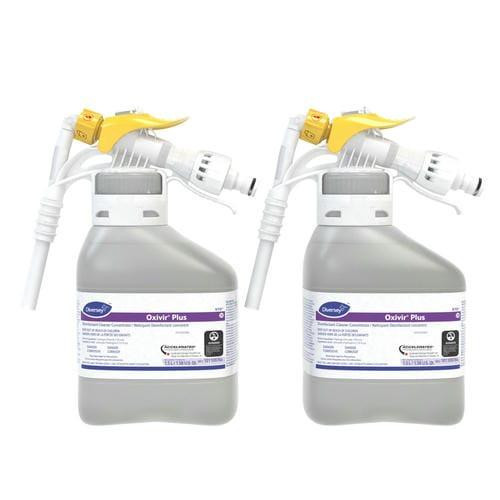
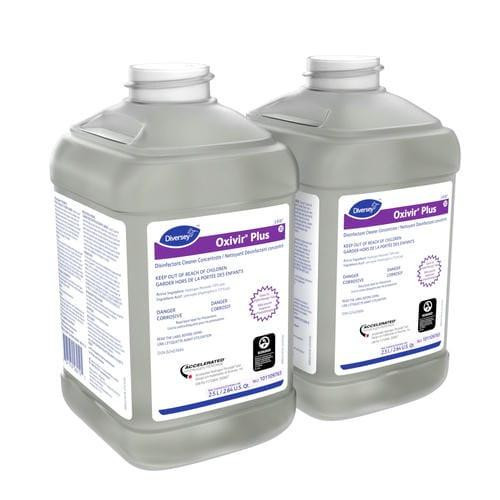
Diversey Oxivir Plus uses accelerated hydrogen peroxide, or AHP, as its active disinfectant. The chemistry is straightforward: hydrogen peroxide oxidizes cell walls of bacteria, viruses, and fungi, then breaks down into water and oxygen. No quaternary ammonium compounds remain on surfaces. No synthetic fragrance masks chemical odour.
This breakdown matters for facilities with sensitive populations. Schools, senior residences, and short-term rentals see high turnover of occupants with unknown allergies or respiratory conditions. AHP-based products carry shorter required contact times than many alternatives, and they do not contribute to indoor air pollutants that linger for hours after cleaning.
The concentrate format ships in 1.5L and 2.5L containers, both designed for closed-loop systems. Dilution ratios vary by application: higher concentration for bathroom disinfecting, lower for general surface cleaning. Staff training focuses on matching the ratio to the task, not on handling hazardous concentrate.
All-Purpose Cleaners for Varied Spaces
Airbnb units and managed properties need flexible chemistry.
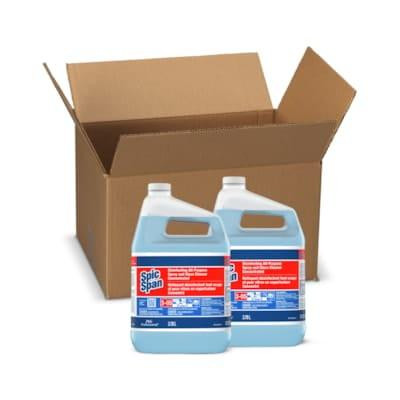
Procter & Gamble's Spic and Span All-Purpose Disinfectant Cleaner concentrates into closed-loop dispensers for high-frequency cleaning environments. The formula targets the mixed soils found in residential and hospitality settings: cooking residue, soap scum, and tracked-in particulate. One diluted solution serves multiple surface types, reducing the bottle inventory cluttering supply closets.
Property managers with scattered units across a city benefit from standardization. Staff carry one trigger bottle from kitchen to bathroom to living area. Training simplifies. Reorder logistics consolidate. The closed-loop concentrate container stays at a central location, with staff filling portable bottles as needed for each turnover or scheduled clean.
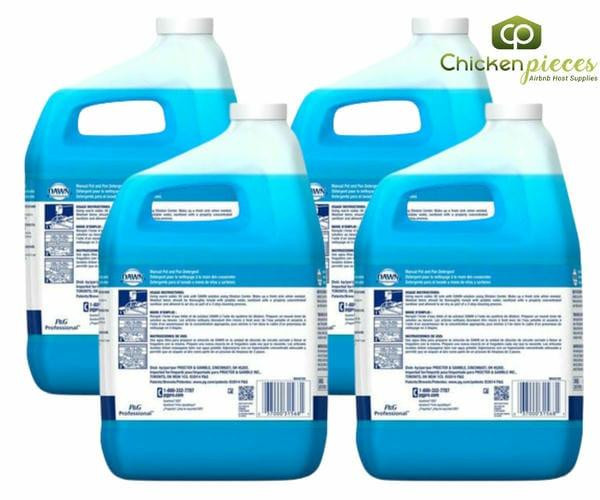
For food service areas, Dawn Professional Manual Pot & Pan Detergent handles grease removal without the aggressive alkalinity that etches aluminium cookware. The concentrate dilutes for manual sink use or spray application. Two packaging options, 1 gallon and 3.78L closed-loop, match different operation scales from boutique inns to institutional kitchens.
Extending Green Chemistry to Linens and Ware
Washing operations consume the bulk of water and energy in hospitality.
Clax Diversey Hypo Concentrate Destainer serves commercial laundry operations where linen life and rewash rates directly affect operating budgets. The 18.9L unit feeds automated dispensing systems that inject precise doses into wash cycles. Lower-temperature effectiveness matters: every degree of water heating requires energy, and Canadian utilities charge commercial gas rates that reward conservation.
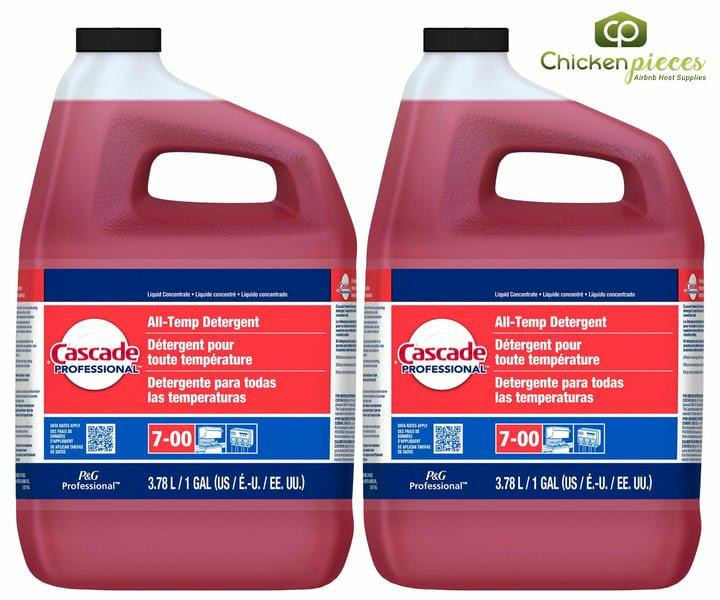
Cascade Professional All-Temp Detergent addresses the same efficiency target for automatic dishwashing. The concentrate closed-loop system doses into commercial machines without manual pouring. All-temp formulation means effective cleaning even when incoming water runs cold, as in northern properties with long pipe runs or seasonal supply variations.
Both products pair with rinse aids and drying agents in integrated chemical programs. The environmental gain comes from system design: precise dosing prevents the overuse that sends excess phosphate or surfactant into wastewater, and bulk packaging replaces the individual pods or tablets that generate disproportionate wrapper waste.
Detergent Sanitizers for Food Contact
Kitchens need products that clean and sanitize in one step.
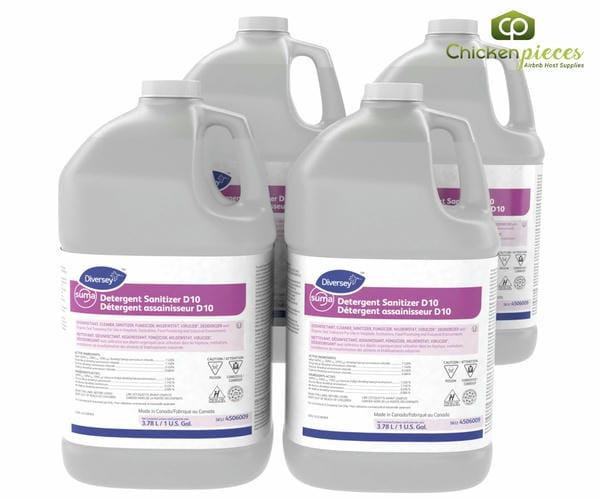
Diversey Suma Detergent Sanitizer concentrates into closed-loop dispensers for food preparation areas where speed and safety overlap. The formulation combines surfactant cleaning with quaternary ammonium sanitizing in a single step, applied to surfaces then allowed to air dry. This eliminates the separate rinse step that adds time and cross-contamination risk in busy kitchens.
Health Canada registration confirms efficacy against foodborne pathogens when used at labelled concentration and contact time. Provincial food safety inspectors look for documentation: product label, SDS on file, and verification that staff dilute correctly. The closed-loop dispenser generates automatic compliance records if equipped with data logging, or manual checklists if not.
For facilities without dish machines, Dawn Professional and Suma pair to cover manual washing and surface sanitizing. The chemistry differs: Dawn lifts grease from cookware, while Suma leaves a sanitizing residue on counters and cutting boards. Staff training distinguishes the two applications, preventing the misuse of dish soap where sanitizing is required by regulation.
Eco-Friendly Janitorial Chemical Comparison
Match product type to your facility's primary cleaning task and preferred dispensing system.
| Product | Primary Use | Active Chemistry | Dispensing |
|---|---|---|---|
| Oxivir Plus 1.5L | Disinfecting high-touch surfaces | Hydrogen peroxide (AHP) | Closed-loop concentrate |
| Oxivir Plus 2.5L | Disinfecting high-touch surfaces | Hydrogen peroxide (AHP) | Closed-loop concentrate |
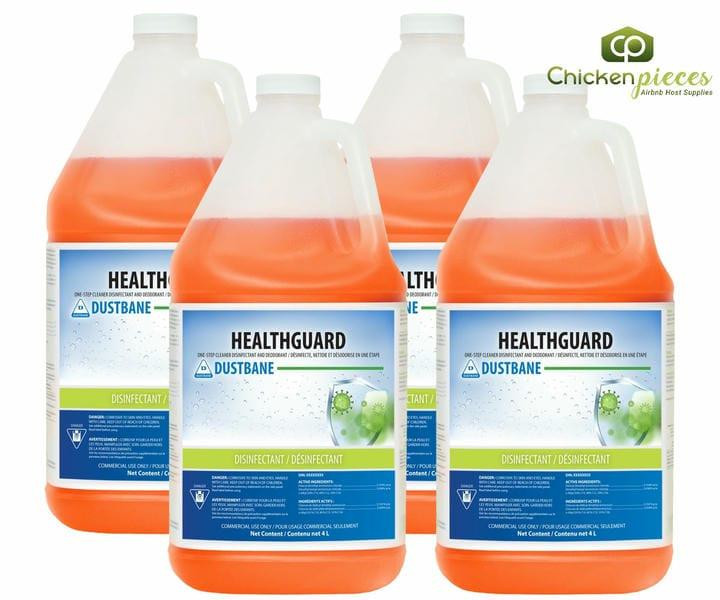
| Dustbane HealthGuard | General disinfecting and deodorizing | Quaternary ammonium | Concentrate dilution |
| Spic and Span | All-purpose cleaning and disinfecting | Broad-spectrum surfactants | Closed-loop concentrate |
| Cascade All-Temp | Automatic dishwashing | Proprietary enzyme blend | Closed-loop concentrate |
| Clax Hypo Destainer | Commercial laundry destaining | Oxygen-based bleach | Bulk automated feed |
| Dawn Professional | Manual pot, pan, and dish washing | Anionic surfactants | Concentrate or closed-loop |
Concentrated Cleaning Chemistry
Browse closed-loop concentrates and bulk detergents with verified environmental certifications for Canadian facilities.


People Also Ask
Real questions buyers search before they order — answered straight.
What actually makes a cleaning product eco-friendly?
An eco-friendly cleaner usually combines readily biodegradable ingredients, lower toxicity to people and aquatic life, and reduced or recyclable packaging. Many are also concentrated, so less product is shipped and thrown away. No single feature makes something green — it is the whole recipe and packaging together, ideally backed by an independent certification.
Do eco-friendly cleaners actually work as well as conventional ones?
Modern green cleaners have improved a great deal and handle most everyday cleaning as well as conventional products, though a few very heavy-duty jobs may still need a specialist option. Matching the right cleaner to the task matters more than the label. For most surfaces, a well-chosen eco product cleans effectively while cutting harshness.
How do you choose an eco-friendly cleaning product for a commercial setting?
Look for a recognised environmental certification, a clear ingredient list, and a concentrate you can dilute to control both use and packaging waste. Check it is approved for your surfaces and, where needed, carries the right disinfectant claims. Choosing one certified multi-tasker instead of several single-use products often cuts clutter and waste at once.
Are eco-friendly cleaners safer and less toxic for staff?
Many green cleaners are formulated to reduce harsh fumes, skin irritation, and the ingredients people most want to avoid, which makes them gentler for staff who clean all day. "Non-toxic" is not a regulated term, though, so read the label and safety data sheet rather than trusting the wording alone. A certified product with a full ingredient list gives you the most reassurance.
Are eco-friendly cleaning products safe to use around pets?
Many plant-based, low-toxicity cleaners are a better choice around animals than harsh conventional products, especially on floors and surfaces pets touch. Even so, keep any concentrate stored away from animals and let treated surfaces dry before pets return. Checking the label for specific pet guidance is always worth a moment.
Why should a business switch to eco-friendly cleaning products?
Beyond the environmental gain, greener cleaners can mean gentler handling for staff, fewer strong odours in occupied spaces, and a story that customers increasingly value. Concentrated formats also cut packaging and delivery waste. For many businesses it is a change that improves both the workplace and the brand at the same time.
What Canadian facility operators say
Facility managers and property operators across Canada report measurable results after switching to certified concentrates.
We cut our mop-closet inventory by sixty percent after switching to closed-loop Oxivir. Staff no longer guess at dilution ratios, and our provincial inspection scores improved immediately.
HealthGuard replaced three separate products in our turnover cleans. One bottle, one procedure, and our Airbnb guests stopped complaining about chemical smells in the bathrooms.
The Clax laundry system dropped our hot water consumption enough that the maintenance team noticed the boiler running less. Linen replacement rates stayed flat.
Green certification standards: Frequently Asked Questions
The following operator questions are answered with cited sources. Every FAQ links to Health Canada, CFIA, Canada.ca, or another authoritative regulator.
What certifications actually matter when buying eco-friendly janitorial chemicals in Canada?
Products referenced:
- EcoLogo-certified all-purpose cleaner
- Green Seal GS-37 neutral cleaner
- DIN-registered quat disinfectant
Source: What eco certifications actually mean something? - r/CleaningTips
Is EcoLogo the same thing as Green Seal for cleaning products?
Products referenced:
- EcoLogo UL ECVP certified cleaner
- Green Seal GS-37 certified cleaner
- LEED-compliant neutral floor cleaner
Source: What is the difference between EcoLogo and Green Seal certifications?
Are biodegradable cleaning products actually safer to use around food prep areas?
Products referenced:
- biodegradable enzyme cleaner
- peroxide-based sanitizer
- food-contact CFIA-accepted detergent
Source: Biodegradable cleaners: food-prep safe or marketing? - r/KitchenConfidential
Do eco-friendly disinfectants actually kill the same pathogens as bleach?
Products referenced:
- hydrogen peroxide DIN disinfectant
- citric acid DIN sanitizer
- sodium hypochlorite bleach alternative
Source: Eco-friendly disinfectants vs bleach efficacy - r/CommercialCleaning
What's the cheapest way for a small facility to switch to certified green cleaning products?
Products referenced:
- Green Seal all-purpose cleaner
- EcoLogo glass cleaner
- certified green floor neutral
Source: Switching a small restaurant to green cleaning chemicals - eGullet Forums
How do eco-friendly cleaning products affect commercial cleaning staff training?
Products referenced:
- concentrated green all-purpose cleaner
- wall-mounted dilution dispenser
- WHMIS-compliant secondary label kit
Source: Eco-friendly cleaning products and staff training - ISSA Community
Will switching to certified green cleaning chemicals void any warranties on floors or equipment?
Products referenced:
- neutral pH floor cleaner
- acrylic floor finish compatible cleaner
- low-residue certified green cleaner
Source: Green cleaners and floor warranty compatibility - r/FacilitiesManagement
Are green cleaning certifications recognized in Canadian government procurement tenders?
Products referenced:
- EcoLogo UL ECVP cleaner
- Green Seal GS-37 cleaner
- Green Seal GS-53 floor care product
Source: Green cleaning procurement in Canadian government tenders - Practical Answers
What's the typical price premium for EcoLogo or Green Seal cleaners compared to conventional ones?
Products referenced:
- concentrated EcoLogo all-purpose cleaner
- Green Seal GS-37 neutral cleaner
- bulk green floor cleaner
Source: Cost per use: green vs conventional cleaning chemicals - r/CommercialCleaning
Related guides from ChickenPieces
Why Canadian Facilities Source from ChickenPieces
We stock concentrates with verified certifications, shipped from Calgary to operators nationwide.
Certification clarity
We list active certifications per product, not vague green claims. Cross-check our documentation against certifier databases with confidence.
Concentrate focus
Our catalogue emphasizes closed-loop and bulk concentrates. This aligns with how Canadian facilities actually reduce waste and control costs.
Alberta-based logistics
Calgary warehousing means competitive freight rates to Western Canada and reasonable transit to Ontario and British Columbia. No cross-border duty surprises.
Federal compliance support
We maintain Health Canada and CFIA compliance documentation for all regulated products. Your inspection readiness is backed by traceable records.
Sources & further reading
Request Your Facility's Quote
Tell us your square footage, staff count, and primary cleaning tasks. We will recommend concentrates and dispensing systems matched to your volume and certification requirements.
Request a Quote