
2026 Aug 16th
What Airbnb Turnovers Cost in Gloves, Bags and Cleaners by
Watch: which Airbnb amenities actually pay for themselves
Airbnb turnovers consume gloves by the hundred, microfiber cloths by the dozen, and disinfectants by the litre. Buying these in case quantities from a Calgary wholesaler locks your per-stay supply cost and eliminates mid-season stockouts during back-to-back bookings.
What Airbnb Turnovers Cost in Gloves, Bags and Cleaners by the Case
Property managers and Airbnb hosts in Calgary and across Canada need predictable supply costs to protect margins on every checkout.
Key Takeaways
Six practical points to control your turnover supply budget.
Count gloves per turnover
Each changeover uses multiple glove pairs for bathroom, kitchen, and common area tasks. Case packs of nitrile or polyethylene gloves prevent mid-week shortages.
Plan linen in threes
The three-par system means one set on the bed, one in laundry, one clean and stored. A two-bedroom unit needs six complete sheet sets minimum.
Match cloth colour to zone
Red for toilets, yellow for kitchens, blue for guest spaces, green for corridors. Cross-contamination drops when cloths never migrate between zones.
Check disinfectant contact time
Surfaces must stay visibly wet for the full label duration. Spraying and wiping immediately wastes chemical and misses pathogens.
Stock full-size amenities
Guests now expect hotel-grade toiletries, not travel packets. Refillable dispensers work if maintained; empty ones generate complaints.
Buy towels by guest count
Two bath towels per guest minimum, multiplied by three for the par system. A four-guest property holds twenty-four bath towels in rotation.
How many gloves one turnover burns through
Glove consumption multiplies fast across multi-room units.
Each turnover demands fresh gloves for distinct zones. Bathroom tasks require one pair. Kitchen wipe-downs need another. Common-area dusting and surface disinfection consume a third. Add a fourth pair for unexpected spills or guest-left debris. A standard one-bedroom suite easily burns four to six pairs per changeover.
Buying gloves in individual boxes leaves hosts scrambling during peak season. Case quantities—whether nitrile for durability or polyethylene for light tasks—create a buffer. The 511 Large Green Nitrile Gloves ship twelve units per case. Gordon Choice polyethylene gloves come in thousand-count units, ten to a case. Either format removes the weekly restocking decision.
Powder-free formulations matter for guest-facing spaces. Residue transfers to remote controls, light switches, and door handles. Guests notice. Staff notice. The specification is simple: non-powdered, sized for your typical cleaner, ordered by the case before busy season starts.
Why cloth colour matters in short-term rentals
Zone-coded cloths prevent cross-contamination between bathroom and kitchen.
Short-term rental cleaners move fast. Thirty minutes between checkout and next check-in is common. Speed creates shortcuts. The red-yellow-blue-green system exists to make the right choice automatic, not a decision. Red stays in bathrooms. Yellow handles kitchens. Blue covers living and dining spaces. Green sweeps hallways and back-of-house areas.
Microfiber structure matters as much as colour. The material physically traps particles rather than pushing them around. ISSA guidance notes that synthetic blends can bind certain disinfectants, reducing chemical efficacy. Cotton or quality microfiber cloths, paired with correct dwell times, outperform spray-and-wipe alone.
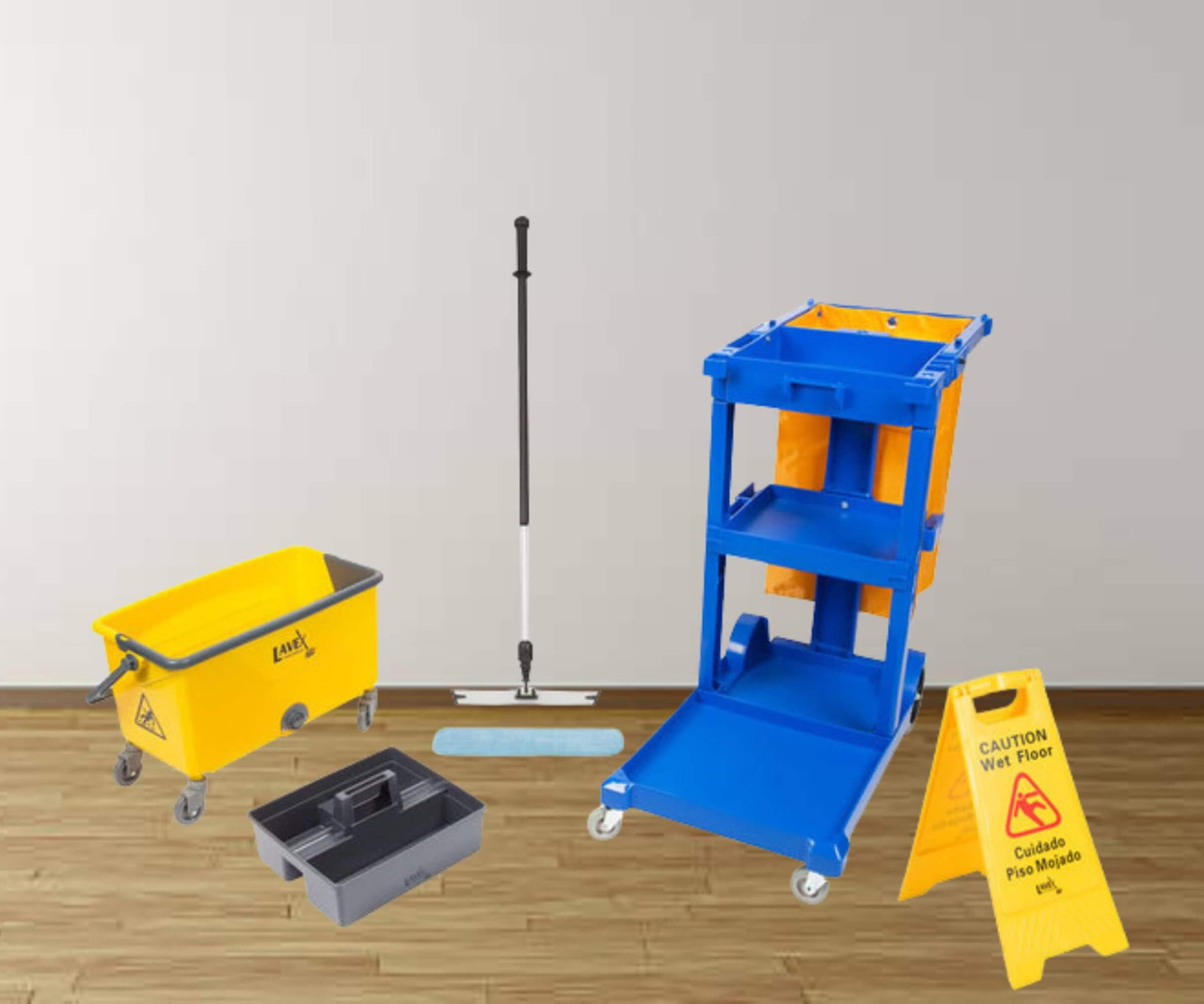
The CP Janitorial Blue Janitor Cart bundles storage and mobility. A cart with segregated compartments enforces the colour system better than a bucket of mixed rags. Staff grab the right cloth for the zone. Managers audit by colour, not by guessing which cloth went where.
Contact time and pre-cleaning requirements
Effective disinfection demands visible wetness and soil removal first.
The five-minute-or-less contact time standard exists because turnovers are time-bound. Longer dwell times risk premature wiping. Staff spray, wait, get distracted, wipe early. The surface looks clean. It is not. Selecting a one-step disinfectant with shorter labelled contact time reduces this failure mode.
Pre-cleaning is non-negotiable. Hair in the sink, toothpaste splatter, food crumbs—all reduce disinfectant effectiveness. The biocide needs direct surface contact. Organic matter creates a barrier. Training cleaners to remove debris before spraying, then maintain visible wetness for the full duration, is the protocol that passes white-glove inspections.
Paper towels handle initial debris removal. Array Paper Towel Rolls at eight inches by six hundred feet provide continuous stock for pre-clean stages. Natural colour indicates no added dyes that might transfer to light surfaces. Twelve rolls per case matches typical monthly consumption for a five-unit portfolio.
Three-par inventory for uninterrupted turnovers
Running out of clean sheets mid-season destroys your review average.
The three-par system is arithmetic, not theory. One set on the bed. One set in wash or dry. One set folded and ready. Two beds means six sets. Add pillowcases, duvet covers, and mattress protectors as separate counts. The system collapses when any par hits zero.
Towels multiply faster. Two bath towels per guest, two hand towels, two washcloths, one bath mat per bathroom. A four-guest property holds twenty-four bath towels in three-par rotation. Hand towels and washcloths scale similarly. The total linen footprint for a small two-bedroom can exceed fifty pieces.
On-site laundry supports three-par. Off-site service, with pickup and delivery windows, needs four-par. The extra par absorbs lag time. Property managers with centralized cleaning hubs often miss this distinction, stocking for ideal turnaround while operating in reality with forty-eight-hour laundry cycles.
Toiletries and consumables that protect ratings
Empty dispensers and missing toilet paper generate immediate negative reviews.
Hospitality standards have shifted. Travel-size packets now signal budget operation. Full-size shampoo, conditioner, and body wash are baseline expectations in competitive markets. The sustainable angle—refillable dispensers—works only with rigorous maintenance schedules. A guest discovering an empty dispenser at 10 PM has already formed their review opinion.
Toilet paper minimums are explicit: one full roll per guest at arrival. This sounds generous until you account for multi-night stays, stomach bugs, or overuse. Running out mid-stay means an emergency store run or a texted complaint. Neither protects your rating. Case quantities of household rolls, not individual packs, maintain the buffer.
Hair dryers, makeup remover wipes, and facial tissues round out the amenity set. These are not luxuries in well-reviewed properties. They are table stakes. Budgeting for replacement and repair—hair dryers fail frequently—keeps the guest experience consistent across hundreds of turnovers.
When wholesale quantities beat retail restocking
Per-unit costs drop and stockouts disappear with planned case orders.
The hidden cost of retail supply runs is time. Driving to a store, discovering stockouts, substituting brands, repeating weekly. Each run consumes an hour. For a manager overseeing fifteen units, that is fifteen hours weekly. Case ordering from a Calgary wholesaler consolidates procurement into a single monthly decision.
Consistency matters for cleaning outcomes. Switching glove brands mid-season means retraining on fit and durability. Substituting paper towel rolls changes sheet size and dispenser compatibility. Case commitments lock specifications for the contract period. Staff know the product. Inventory counts are predictable.
Storage is the objection. A case of nitrile gloves occupies less space than a case of paper towels. Most operators find that a dedicated supply closet, organized by turnover kit, handles monthly case volume. The alternative—last-minute retail runs at premium per-unit cost—consumes more vehicle space and more payroll hours.
Airbnb turnover supply comparison by category
Match your operation size to the case quantity and zone system that fits.
| Supply category | Case format | Zone or rotation | Best for |
|---|---|---|---|
| Nitrile gloves | 12 units per case, powder-free | All cleaning zones | Heavy-duty bathroom and kitchen tasks |
| Polyethylene gloves | 1000 per unit, 10 units per case | Light duty, frequent changes | High-turnover properties with daily cleans |
| Microfiber cloth kits | Colour-coded by zone | Red/yellow/blue/green segregation | Multi-unit operations with cross-contamination risk |
| Janitor cart with mop | Single unit, mobile storage | Enforces colour separation | Teams cleaning 5+ units per day |
| Paper towel rolls | 12 rolls per case, 600 ft each | Pre-clean and spill response | Properties with on-site laundry and kitchen resets |
| Sheet sets | 3-par or 4-par rotation | One in use, one in wash, one stored | All bed configurations; add fourth par for off-site laundry |
| Towel inventory | Guest count × 3 (or × 4) | Bath, hand, washcloth, mat per bathroom | Standard guest counts from two to six |
Turnover supplies by the case
Gloves, cloths, carts and consumables sized for Airbnb and short-term rental operations.




What Canadian Airbnb hosts say
What property managers say about buying turnover supplies in bulk.
Switching to case quantities for gloves and paper towels cut our mid-month stockouts to zero. My cleaner now grabs from a locked closet instead of texting me at 9 PM.
The colour-coded microfiber system stopped our bathroom-to-kitchen cross-contamination issue. Inspector noticed the difference on the first visit after we switched.
Four-par linen inventory saved us during July when our laundry service fell behind by three days. Every unit still turned over clean and on time.
Turnover supply planning: Frequently Asked Questions
The following operator questions are answered with cited sources. Every FAQ links to Health Canada, CFIA, Canada.ca, or another authoritative regulator.
How much do Airbnb cleaning supplies cost per turnover?
Products referenced:
- toilet paper
- paper towels
- trash bags
- concentrate cleaner
- toiletries
Should I buy cleaning supplies in bulk for my short-term rental?
Products referenced:
- bulk laundry detergent
- 5-gallon containers
- all-purpose cleaner concentrate
- glass cleaner
- dishwashing detergent
Source: Do your cleaners provide their own materials? — r/airbnb_hosts
What cleaning supplies should I stock for Airbnb turnovers?
Products referenced:
- microfiber cloths
- nitrile gloves
- trash bags
- paper towels
- all-purpose disinfectant
- glass cleaner
- laundry detergent
Source: Do your cleaners provide their own materials? — r/airbnb_hosts
How much do nitrile gloves and garbage bags cost for STR cleaning?
Products referenced:
- nitrile gloves
- disposable gloves
- 13-gallon trash bags
- drawstring trash bags
- paper towels
Source: I want to start doing my own cleaning — r/airbnb_hosts
What percentage of Airbnb revenue goes to cleaning supplies?
Products referenced:
- cleaning supplies
- linen
- laundry detergent
- consumables
Do Airbnb cleaners bring their own supplies or should I provide them?
Products referenced:
- granite cleaner
- furniture polish
- all-purpose cleaner
- glass cleaner
- microfiber cloths
Source: Do your cleaners provide their own materials? — r/airbnb_hosts
Where do Airbnb hosts buy cleaning supplies in bulk to save money?
Products referenced:
- concentrate cleaner
- toilet paper bulk
- paper towels bulk
- trash bags bulk
- commercial cleaning supplies
Source: What's typical of a turnover cleaning crew? — r/airbnb_hosts
How much do paper towels and microfiber cloths cost for Airbnb turnover cleaning?
Products referenced:
- paper towels
- microfiber cloths
- disposable cleaning wipes
- commercial paper towel rolls
Source: Cleaning Supplies May Be Costing You More Than You Think — ChefStore
Related guides from ChickenPieces
Why operators buy from ChickenPieces
Calgary-based wholesale supply with Canadian compliance and no retail markup.
Case quantities only
No individual-item pricing or retail packaging. Every product ships in case or bulk unit format for operational scale.
Alberta warehouse
Canadian distribution eliminates cross-border duty surprises and simplifies return handling for defective or incorrect shipments.
Named specifications
Product details list material, dimensions, and unit counts without invented certifications or misleading claims.
Regulatory alignment
Cleaning chemical handling and food-contact glove sourcing follow Health Canada and CFIA compliance frameworks for hospitality operations.
Sources & further reading
- Disinfection Best Practices — ISSA (The Association for Cleaning & Facility Solutions)
- Linen Inventory: How Many Sheets and Towels Do You Need to Run an Airbnb or Hospitality Property? — InnStyle (Hospitality & Short-Term Rental Blog)
- Color-Coded Microfiber Cleaning Protocols for Hospitality — Color-Coded Cleaning Systems (COSHH Training & Asset Services)
- Guest Expectations and Amenity Provision Standards for Short-Term Rentals — Airbnb Community & Hospitality Standards
Request your turnover supply quote
Tell us your unit count and turnover frequency. We will size case quantities for gloves, cloths, and consumables to match your operation. No minimum order pressure.
Request a QuoteReferences: Health Canada — PPE Standards FDA — Medical Glove Guidance.