
 US Dollar (USD)

2026 Mar 12th
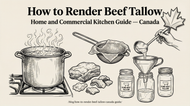
How to Render Beef Tallow
How to Render Beef Tallow: The Complete Guide for Home Cooks and Canadian Commercial Kitchens
Key Takeaways
- Rendering beef tallow is a straightforward process: heat beef fat (ideally leaf fat or suet) slowly until the fat melts and the protein solids separate, then strain and cool. The entire process takes 4–8 hours depending on quantity.
- Yield is approximately 70–80% of starting weight — 10 kg of raw beef fat will produce roughly 7–8 kg of rendered tallow, with the remainder being cracklings (crispy protein solids) and water.
- For commercial kitchens in Canada, rendering your own tallow requires compliance with CFIA regulations if the product will be sold or served to the public — rendered animal fats must be produced from inspected animals and meet food safety standards.
- Properly rendered and stored tallow is shelf-stable for up to 12 months at room temperature and 18–24 months refrigerated — significantly longer than most vegetable oils.
- For most Canadian food service operators, purchasing pre-rendered tallow from a reputable wholesale supplier is more practical than rendering in-house — but understanding the rendering process helps you evaluate product quality.
Table of Contents
- What Is Beef Tallow and What Makes a Good Fat for Rendering?
- How Do You Render Beef Tallow at Home?
- How Do You Render Beef Tallow at Commercial Scale in Canada?
- What Are the Yield Calculations for Rendering Beef Tallow?
- How Do You Store Rendered Beef Tallow and What Is Its Shelf Life?
- Frequently Asked Questions
Rendering beef tallow is one of those kitchen skills that was universal a century ago and nearly forgotten by the end of the 20th century. Every farm kitchen in Canada had a pot of tallow on the go at some point. Every butcher shop rendered the fat that came off the carcasses. It was practical, economical, and produced a cooking fat that was genuinely superior for many applications.
The skill is coming back, driven by the same forces that are bringing tallow back to restaurant menus: a growing appreciation for traditional cooking methods, a preference for natural over processed fats, and the simple fact that rendered beef fat is an excellent cooking medium. Home cooks are rendering small batches in slow cookers. Chefs are experimenting with in-house rendering to control quality and provenance. Farmers and butchers are rediscovering a revenue stream that was abandoned in the 1990s.
This guide covers the rendering process from start to finish — for home cooks working with a few kilograms of fat, and for commercial operators considering in-house rendering at scale. It also covers the regulatory requirements that apply to Canadian commercial operators, yield calculations, and storage guidance.
What Is Beef Tallow and What Makes a Good Fat for Rendering?
Beef tallow is rendered beef fat — specifically, the fat that has been heated to separate the pure fat (tallow) from the protein solids (cracklings) and water. The best fat for rendering is leaf fat (the fat surrounding the kidneys and loins), which produces a mild, clean-flavoured tallow. Back fat and other trimmings can also be rendered but produce a stronger-flavoured, slightly less pure product.
Not all beef fat is equal for rendering purposes. The type of fat you start with has a significant effect on the quality, flavour, and colour of the finished tallow.
Leaf fat (also called suet when raw) is the premium choice. It surrounds the kidneys and the loin area of the animal and has a very mild, clean flavour. Tallow rendered from leaf fat is white, firm, and has a neutral enough flavour for use in pastry and baking as well as frying. It is the preferred fat for high-quality rendered tallow.
Back fat and fat trimmings are the most commonly available type of beef fat from butchers and abattoirs. They produce a good quality tallow, but with a slightly stronger, more pronounced beefy flavour than leaf fat tallow. For frying applications, this is generally an advantage. For pastry and baking, it may be noticeable.
Grass-fed vs grain-fed is a secondary consideration. Grass-fed beef fat tends to be slightly yellower in colour (due to higher beta-carotene content) and has a slightly different fatty acid profile, with higher levels of omega-3 fatty acids and CLA. The difference in flavour is subtle but noticeable to experienced cooks. For most commercial applications, either works well.
How Do You Render Beef Tallow at Home?
Home rendering of beef tallow requires only a heavy-bottomed pot or slow cooker, a fine-mesh strainer or cheesecloth, and clean glass jars for storage. The process takes 4–8 hours on low heat. The key is patience — low and slow heat produces a clean, mild tallow; high heat produces a darker, stronger-flavoured product with more impurities.
Equipment You Need
A heavy-bottomed pot (Dutch oven or stockpot), a slow cooker, or an oven-safe roasting pan all work for home rendering. A fine-mesh strainer lined with cheesecloth or a coffee filter is essential for producing clean, clear tallow. Glass mason jars are the best storage containers — they are airtight, easy to sterilise, and allow you to see the colour and clarity of the finished product.
Step-by-Step Home Rendering Process
Step 1: Source and prepare your fat. Ask your butcher for beef leaf fat or suet — most butchers will sell it at a very reasonable cost, and some will give it away. Trim away any blood spots or meat attached to the fat. Cut or grind the fat into small pieces — roughly 2–3 cm cubes. Smaller pieces render more quickly and evenly.
Step 2: Add a small amount of water. Place the fat pieces in your pot and add approximately 60–120 mL (¼–½ cup) of water per kilogram of fat. The water prevents the fat from scorching before it begins to melt, and it evaporates during the rendering process.
Step 3: Render on low heat. Heat the fat over the lowest possible heat setting, or in a slow cooker on low. The fat will begin to melt slowly over the first hour. Stir occasionally to prevent sticking. Do not rush this step — high heat produces a darker, stronger-flavoured tallow with more impurities.
Step 4: Continue until the cracklings are golden. After 4–8 hours (depending on quantity and heat level), the fat will be fully melted and the protein solids (cracklings) will have sunk to the bottom and turned golden brown. The liquid fat should be clear and pale yellow.
Step 5: Strain and cool. Carefully ladle the liquid tallow through a fine-mesh strainer lined with cheesecloth into clean glass jars. Discard the cracklings (or season and eat them — they are delicious). Allow the tallow to cool at room temperature until it solidifies to a creamy white colour, then seal and store.
How Do You Render Beef Tallow at Commercial Scale in Canada?
Commercial-scale rendering in Canada requires equipment capable of handling large volumes of fat safely — typically a commercial steam kettle, tilting braising pan, or dedicated rendering vessel. For operations producing tallow for sale or for serving to the public, CFIA regulations require that the fat be sourced from federally inspected animals and that the rendering process meet food safety standards.
Equipment for Commercial Rendering
A 40–80 litre commercial steam kettle or tilting braising pan is the most practical equipment for in-house rendering at restaurant or small-production scale. These units provide precise temperature control, easy stirring, and a tilting mechanism that simplifies straining and transfer. For very large volumes, dedicated rendering vessels with built-in filtration are available from commercial kitchen equipment suppliers.
Commercial Rendering Process (20–50 kg batches)
Step 1: Source fat from a federally inspected facility. For commercial use, your beef fat must come from an animal that was slaughtered at a federally inspected facility. Your butcher or abattoir supplier should be able to confirm this. Keep records of your fat source for food safety documentation purposes.
Step 2: Grind or chop the fat. A commercial meat grinder set to a coarse plate (10–12 mm) is the most efficient way to reduce fat to a consistent size for commercial rendering. Uniformly sized pieces render more evenly and quickly than hand-cut chunks.
Step 3: Render in a steam kettle at 100–120°C. Add the ground fat to the steam kettle with a small amount of water (approximately 5% of fat weight). Set the temperature to 100–120°C and stir regularly. At this scale, rendering typically takes 3–5 hours.
Step 4: Separate and filter. Once the cracklings are golden and the fat is fully liquid, drain the tallow through a commercial filter press or a fine-mesh strainer lined with food-grade filter paper. For the cleanest product, a two-stage filtration (coarse filter followed by fine filter) produces a clearer, more stable tallow.
Step 5: Cool, label, and store. Pour the filtered tallow into food-grade containers. Allow to cool to room temperature before sealing. Label each container with the production date, batch number, and source information. Store in a cool, dry area or refrigerate.
CFIA Regulatory Requirements
Canadian commercial operators producing rendered beef fat for sale or for serving to the public must comply with CFIA regulations for rendered animal fats. Key requirements include: fat must be sourced from federally inspected animals; the rendering facility must meet applicable food safety standards; and the finished product must be properly labelled with the producer's name and address, the common name of the product, and the net quantity. Consult the CFIA's Food Safety Enhancement Program (FSEP) guidelines for detailed requirements applicable to your operation.
What Are the Yield Calculations for Rendering Beef Tallow?
The yield from rendering beef fat is approximately 70–80% of starting weight for leaf fat and 60–70% for back fat and trimmings. The remainder is water (which evaporates during rendering) and cracklings (the protein solids that remain after the fat is rendered). A 10 kg batch of leaf fat will produce approximately 7–8 kg of rendered tallow and 1–2 kg of cracklings.
Understanding yield is essential for commercial operators who are calculating the cost of in-house rendering versus purchasing pre-rendered tallow. The table below provides yield estimates for common batch sizes:
| Starting Fat Weight | Fat Type | Expected Tallow Yield | Expected Cracklings | Water Loss |
|---|---|---|---|---|
| 5 kg | Leaf fat | 3.5–4.0 kg | 0.5–1.0 kg | ~0.5 kg |
| 10 kg | Leaf fat | 7.0–8.0 kg | 1.0–2.0 kg | ~1.0 kg |
| 20 kg | Leaf fat | 14–16 kg | 2.0–4.0 kg | ~2.0 kg |
| 10 kg | Back fat/trimmings | 6.0–7.0 kg | 2.0–3.0 kg | ~1.0 kg |
| 20 kg | Back fat/trimmings | 12–14 kg | 4.0–6.0 kg | ~2.0 kg |
These yields are estimates — actual yield varies depending on the fat content of the starting material, rendering temperature, and filtration method. Leaf fat from well-finished cattle will yield at the higher end of the range; fat from leaner animals or from cuts with more connective tissue will yield at the lower end.
For most Canadian food service operators, the economics of in-house rendering versus purchasing pre-rendered tallow depend on the cost of raw fat in your region, your labour costs, and your volume requirements. In regions where raw beef fat is available at very low cost (such as near large abattoirs in Alberta or Saskatchewan), in-house rendering can be economical. In urban centres where raw fat is harder to source, purchasing pre-rendered tallow from a wholesale supplier is typically more practical.
How Do You Store Rendered Beef Tallow and What Is Its Shelf Life?
Properly rendered and stored beef tallow is shelf-stable for up to 12 months at room temperature in a sealed container away from light and heat. Refrigeration extends shelf life to 18–24 months. Freezing extends shelf life to 2–3 years with minimal quality loss. The key enemies of tallow quality are heat, light, oxygen, and moisture — proper storage eliminates all four.
Tallow's exceptional shelf stability is one of its most practical advantages over vegetable oils. The high saturated fat content means it is highly resistant to oxidative rancidity — the process that causes vegetable oils to go stale and develop off-flavours. A jar of tallow stored correctly will outlast a bottle of canola oil by a significant margin.
For commercial operations, the practical storage guidance is as follows. Store tallow in food-grade containers with tight-fitting lids — glass, food-grade plastic, or stainless steel all work well. Keep containers in a cool, dry area away from direct light and heat sources. Label each container with the production or purchase date and rotate stock on a first-in, first-out basis. For operations that render in large batches, consider portioning the tallow into smaller containers to minimise the exposure of the bulk supply to air each time you open a container.
Signs of rancidity to watch for include a sharp, sour, or paint-like smell; a yellowish or brownish discolouration; or a greasy, off-flavour in finished food. Fresh tallow should be white or pale cream in colour and have a mild, clean beefy smell. If your tallow shows any signs of rancidity, discard it — rancid fat will ruin the flavour of anything cooked in it.
For Canadian food service operators who prefer to purchase pre-rendered tallow rather than render in-house, the Real Good Kitchen Premium Rendered Angus Beef Tallow For Cooking, 794g is a premium Canadian product available through ChickenPieces.com. See Today's Current Wholesale Price.
Frequently Asked Questions
What is the best beef fat to use for rendering tallow?
Leaf fat (the fat surrounding the kidneys and loins) produces the mildest, cleanest tallow and is the preferred choice for high-quality rendering. Back fat and fat trimmings also render well and produce a good tallow with a slightly stronger flavour. Ask your butcher specifically for leaf fat or suet if you want the best quality product.
How long does it take to render beef tallow?
Home rendering typically takes 4–8 hours on low heat, depending on the quantity of fat and the heat source used. A slow cooker on low is the most hands-off method. Commercial rendering in a steam kettle takes 3–5 hours for a 20–50 kg batch.
Can I render beef tallow in a slow cooker?
Yes. A slow cooker is one of the best methods for home rendering — it provides consistent low heat, requires minimal attention, and is easy to manage. Set the slow cooker to low, add the fat pieces with a small amount of water, and allow to render for 6–8 hours, stirring occasionally.
What do I do with the cracklings after rendering?
Cracklings (the protein solids that remain after rendering) are edible and delicious. Season them with salt while they are still warm and eat them as a snack, use them as a garnish, or crumble them over salads or soups. They are essentially beef crackling — similar in concept to pork crackling.
Does rendering beef tallow smell?
Yes, rendering beef fat produces a noticeable smell — beefy and slightly animal. The smell is strongest during the first few hours of rendering and dissipates as the process completes. Rendering in a well-ventilated kitchen or with a range hood running minimises the impact. The finished tallow has a much milder smell than the rendering process itself.
Is it worth rendering my own tallow or should I just buy it?
For home cooks who have access to inexpensive raw beef fat from a local butcher, rendering your own tallow is economical and produces an excellent product. For most Canadian food service operators, purchasing pre-rendered tallow from a wholesale supplier is more practical — it saves labour, eliminates the regulatory complexity of in-house rendering for commercial sale, and provides a consistent, quality-controlled product.
Products Mentioned in This Post