Condiment Portion Packets Explained: What They Are and When

2026 Jul 27th

Condiment Portion Packets Explained: What They Are and When

Canadian-Owned No MOQ Ships Canada-Wide Calgary Warehouse CFIA Compliant Food Safe Certified
Quick Answer

A condiment portion packet is a sealed single-serve sachet holding one fixed measure of sauce, from a 3 g Tabasco packet to a 40 mL Kraft Creamy Ranch. Because the fill happens at the factory, every serving is identical no matter who is working the line. Case counts run 100 to 1000 units depending on fill size, and ChickenPieces.com ships them Canada-wide from Calgary with no minimum order.

Portion Control Supply Explainer
C

ChickenPieces Supply Team

ChickenPieces.com · Calgary, AB · We ship Canada-wide

Condiment Portion Packets Explained: What They Are and When They Beat Bottles

A plain explanation of how single-serve sauce packets work, where they outperform bottles and pumps, and how to size a case order against what your kitchen actually uses.

3 g – 40 mL
Fill range across the packet lineup
100 – 1000
Units per case depending on product
No MOQ
Order one case or forty
At a Glance

Key Takeaways

The six things a buyer needs before placing a condiment portion order.

The factory decides the serving

Every packet holds the same measured fill. Portion drift from an open bottle stops being a variable you have to manage.

Fill size drives case count

Heinz Ketchup at 8 mL ships 1000 per case. Kraft Creamy Ranch at 40 mL ships 100. Bigger fill, smaller case, every time.

Most sit at room temperature

Shelf-stable portions live on a dry rack instead of eating cooler space you need for prepped food.

Sealed beats lidded in transit

A packet has no lid to pop. Portion cups leak when a delivery bag tips, and the refund costs more than the sauce.

Allergen labelling travels with the packet

The ingredient statement is printed on a factory seal, not on a decanted squeeze bottle nobody relabelled.

Calgary warehouse, no minimum

We ship Canada-wide from Calgary with no MOQ, so you order against real usage instead of a supplier's minimum.

The Basics

What exactly is a condiment portion packet?

The format, the fill sizes, and why the seal matters more than the sauce.

A condiment portion packet is a laminated sachet filled and sealed on a production line, holding one serving and nothing more. The fill is set by the manufacturer, so a Heinz Ketchup portion is 8 mL whether it reaches a diner in Halifax or a hospital cafeteria in Kamloops. Nobody on your team decides the size. That single fact is what buyers are actually purchasing.

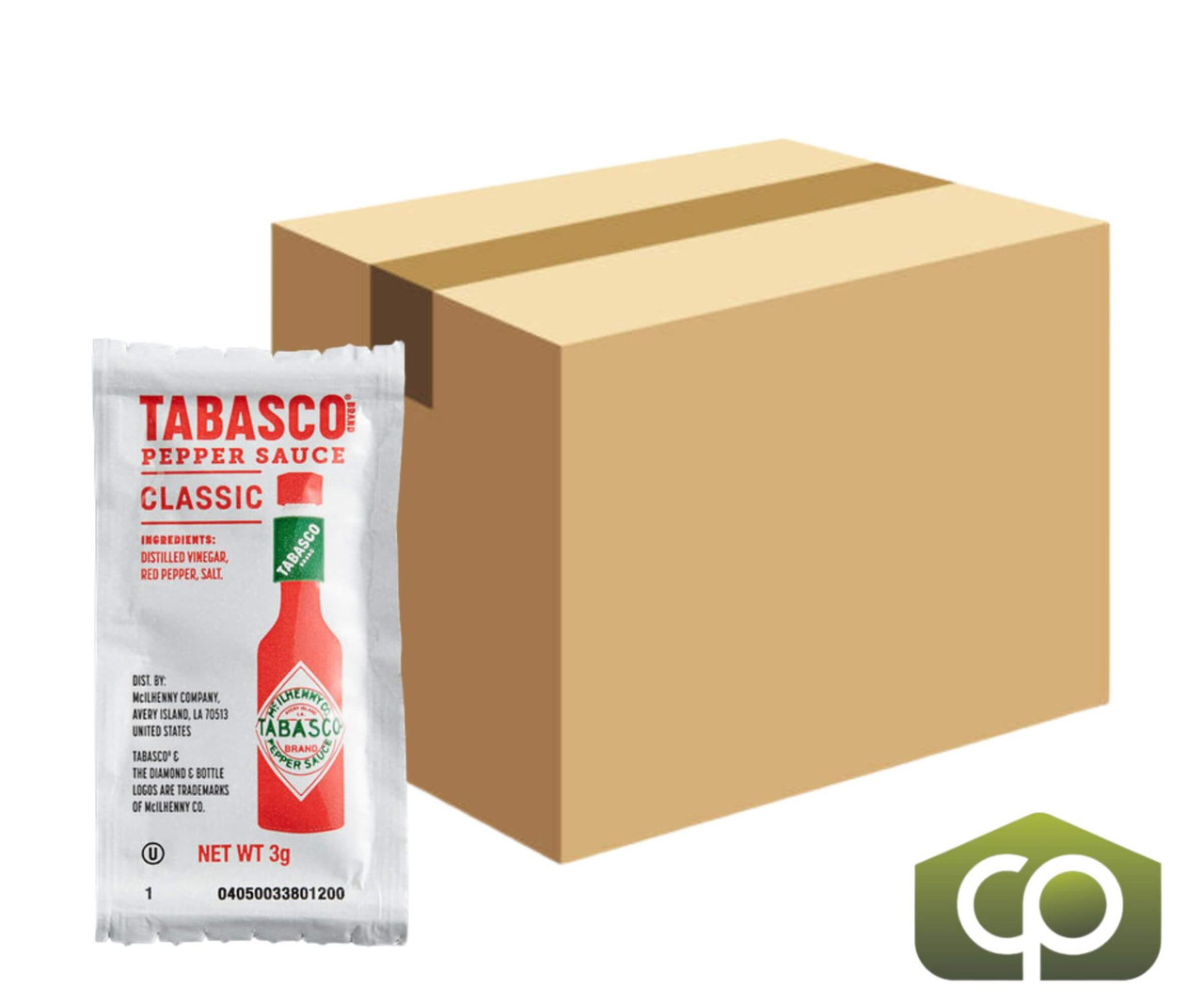
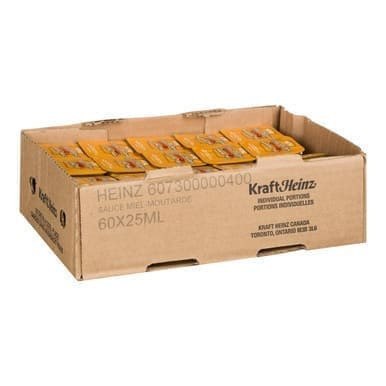
Fill sizes span a wider range than most operators expect. Tabasco Original ships at 3 grams. Heinz Mustard sits at 6 mL, ketchup and sweet green relish at 8 mL, vinegar at 9 grams, mayonnaise and tartar sauce at 18 mL, honey mustard at 25 mL, and Kraft Creamy Ranch at 40 mL. The spread is not arbitrary. A hot sauce is a two-drop condiment and a ranch is a dipping condiment, so the packaging follows how the sauce is used rather than what it costs to fill.

The seal does more work than the sauce inside it. An unopened packet has never met a shared spoon, a dipped fry, or a squeeze bottle tip that touched a plate. For any operation feeding people who cannot risk cross-contact, the intact factory seal is the entire argument, and it is a far easier thing to defend to an inspector than a relabelled bottle in a walk-in.

Expand: full fill-size reference for the current lineup

3 g — Tabasco Original Hot Sauce · 6 mL — Heinz Mustard · 8 mL — Heinz Ketchup, Heinz Sweet Green Relish · 9 g — Gordon Choice White Vinegar · 18 mL — Kraft Mayonnaise, Kraft Tartar Sauce · 25 mL — Heinz Honey Mustard · 28 g — Olde Style BBQ Sauce · 40 mL — Kraft Creamy Ranch Dressing.

Use this when you are matching a packet to a menu item. A dipping application below 18 mL will generate second-packet requests, and a drizzle application above 25 mL generates waste.

Format Choice

When do packets beat bottles, pumps and cups?

Each format has a job. Buying one format for every station is the expensive mistake.

Pump dispensers win on cost per serving wherever volume is high and the jug turns over fast. A busy dine-in burger counter pushing ketchup all day should run a pump. The economics are not close, and anyone telling a high-volume dine-in operator to switch entirely to packets is selling packets rather than solving a problem.

Packets win the moment the sauce has to leave the building. Takeout, delivery, catering drops, boxed lunches, hospital tray line, school service, and airline-style meal assembly all favour a sealed single serve. They also win at any station where nobody has time to break down and sanitize a pump at close, which in practice means most late-night and satellite locations.

Lidded portion cups sit awkwardly between the two. They are fine on a tray handed across a counter and they fail in a bag. We have seen an operator switch back to cups to save on packaging and then absorb weeks of delivery refunds from popped ranch lids before reversing the decision. If more than roughly a fifth of your volume goes out the door in a bag, the cup is the wrong tool and the refunds will tell you so before your supplier does.

Product Comparison

Fill size, case count and best application by product

Match the packet to the job before you match it to a case count.

Product Fill Size Units / Case Storage Best For
Heinz Ketchup, Portion8 mL1000AmbientHigh-volume takeout and delivery
Heinz Mustard, Portion6 mL500AmbientCounter service, sandwich assembly
Heinz Sweet Green Relish8 mL500AmbientConcession and event service
Tabasco Original Hot Sauce3 g200AmbientBreakfast service, tray line
Gordon Choice White Vinegar9 g500AmbientFish and chip counters, cafeterias
Kraft Mayonnaise, Portion18 mL200Per labelBoxed lunches and catering drops
Heinz Honey Mustard, Portion25 mL120Per labelDipping application, sharing plates
Kraft Creamy Ranch Dressing40 mL100Per labelFull dipping portion, salad service
Order Sizing

How do you order what you will actually use?

Case count is a storage decision as much as a purchasing one.

Start from attach rate, not from the case. Count how many orders in a week include the item that carries the sauce, then multiply by how many packets each of those orders realistically takes. Guests take two ketchup packets for a fry order far more often than they take one, and pretending otherwise is how kitchens run dry on a Friday.

Then look at the case count and be honest about your shelf. A 1000-unit ketchup case is efficient per unit and it is also a physical object that has to live somewhere dry for however long it takes to move. A café doing forty covers a day does not need 1000 ketchup portions in a back room, and a stadium concession absolutely does. The right case is the one that clears in a reasonable window at your actual pace.

Watch the fill sizes at the top of the range most carefully. Kraft Creamy Ranch at 40 mL ships 100 per case, which sounds small until you realize that is four litres of dressing in one box. Ordering by case count without checking fill volume is the most common sizing error we see, and it goes wrong in both directions.

Expand: a four-step sizing worksheet you can run in ten minutes

1. Count the carrier. How many orders per week include the menu item this sauce goes with?

2. Set the real attach rate. Observe a service period. Count packets issued, not packets assumed. Round up.

3. Multiply and divide. Weekly packets ÷ case count = cases per week. Anything under a quarter case per week is a slow mover.

4. Check the shelf, then the freight. If a product clears more than a case a week, price the pallet. Below that, order cases and keep the space.

Storage

What does shelf-stability actually free up?

Cooler space is the constraint nobody budgets for until it bites.

Ambient-stable condiment portions store on a dry rack at room temperature until they are opened. Vinegar, hot sauce, ketchup, mustard and relish portions are the most tolerant of the group. Moving those off refrigerated shelving returns cooler capacity to prepped food, dairy and anything with a short window, which is where that space belongs.

Dairy-based and emulsified portions are a different conversation. Ranch, tartar sauce and mayonnaise follow the manufacturer's stated storage conditions, and those conditions are printed on the case for a reason. Read the label rather than assuming the whole category behaves the same way. Treating a ranch portion like a ketchup portion because both arrived in the same delivery is how a case gets written off.

Rotation still applies. Sealed and shelf-stable does not mean indefinite, and a case pushed to the back of a dry store in March will surface in November with a date nobody wants to explain. Date the case on arrival, front the oldest, and the format takes care of the rest.

Control

Why do packets change how much sauce leaves the building?

The format sets the serving. Placement sets the count.

An open bottle produces whatever pour the person holding it decides on, and that decision changes with how busy the line is. A packet removes the decision entirely. The first thing most operators notice after switching is not a cost line, it is that the same order looks the same every time it goes out, which matters more for repeat delivery customers than almost anything else on the plate.

Placement then does the second half of the work. Packets in an open self-serve bin near the door will disappear at a rate that has nothing to do with how many orders you served. Move the bin behind the counter and issue against the order, and consumption drops sharply without a single guest complaining, because the guests who wanted sauce still get sauce. The ones who were filling a pocket stop.

This is the one change we recommend before anyone renegotiates a condiment price. Buying better is worth something. Issuing deliberately is usually worth more, and it costs nothing to implement on the next shift.

Shop the Range

Condiment portion packets we stock and ship from Calgary

Ten portion-control condiments covering counter service, delivery, catering and tray line.

Heinz Ketchup Portion Packets 8 mL
Heinz Ketchup, Portion
8 mL fill · 1000 units per case · ambient storage
Heinz Mustard Portion Packets 6 mL
Heinz Mustard, 1/4 oz Portion
6 mL fill · 500 units per case · ambient storage
Kraft Mayonnaise Portion Packets 18 mL
Kraft Mayonnaise, Portion
18 mL fill · 200 units per case · store per label
Olde Style BBQ Sauce Portion Packets 28 g
Olde Style BBQ Sauce Portions
28 g fill · 160 units per case · trans fat compliant
Kraft Tartar Sauce Portion Packets 18 mL
Kraft Tartar Sauce, Portion
18 mL fill · 200 units per case · store per label
Heinz Sweet Green Relish Portion Packets 8 mL
Heinz Sweet Green Relish, Portion
8 mL fill · 500 units per case · ambient storage
Kraft Creamy Ranch Dressing Portion Packets 40 mL
Kraft Creamy Ranch Dressing, Portion
40 mL fill · 100 units per case · full dipping portion
Tabasco Original Hot Sauce Portion Packets 3 g
Tabasco Original Hot Sauce, Portion
3 g fill · 200 units per case · aged pepper sauce
Heinz Honey Mustard Portion Packets 25 mL
Heinz Honey Mustard, Portion
25 mL fill · 120 units per case · dipping application
Gordon Choice White Vinegar Portion Packets 9 g
Gordon Choice White Vinegar, Portion
9 g fill · 500 units per case · ambient storage
Reviews

What Canadian operators say

Feedback from buyers running portion condiments across counter, delivery and tray service.

★★★★★

"We moved our delivery orders from lidded cups to sealed ranch and honey mustard portions and the leak complaints stopped inside a week. Ordering one case at a time to test it first was the part that sold me — nobody else let us do that."

D
Darren M.
Owner, quick-service group — Ontario
★★★★★

"Ketchup, mustard and vinegar portions came off our refrigerated shelving and went onto a dry rack, which gave us back a full cooler shelf for prep. The Calgary warehouse means our restock lands in two days instead of the week we were used to."

P
Priya S.
Food Services Manager — British Columbia
★★★★★

"Sealed portions with the ingredient panel printed on them made our allergen audit straightforward for the first time. We run the Tabasco and mayonnaise portions on the tray line and the inspector had no follow-up questions."

L
Louise T.
Nutrition Services Lead — Nova Scotia
FAQ

Condiment Portion Packets: Frequently Asked Questions

What is a condiment portion packet?

A condiment portion packet is a sealed single-serve sachet holding one fixed measure of sauce, typically between 3 grams and 40 millilitres. Heinz Ketchup portions run 8 mL and Kraft Creamy Ranch runs 40 mL, so the serving size is decided at the factory rather than by whoever is on the line that shift.

Do condiment packets need refrigeration?

Most shelf-stable condiment portions store at ambient room temperature on a dry shelf until opened. Vinegar, hot sauce, ketchup and mustard portions are the most tolerant. Dairy-based portions such as ranch and tartar sauce follow the manufacturer's stated storage conditions, so read the case label rather than assuming.

How many packets come in a case?

Case counts run from 100 to 1000 units depending on the product and fill size. Heinz Ketchup 8 mL ships 1000 per case, Heinz Mustard 6 mL ships 500 per case, and Kraft Creamy Ranch 40 mL ships 100 per case. Larger fill volumes almost always mean smaller case counts.

Are portion packets better than pump dispensers?

Pumps win on cost per serving for dine-in volume where a jug turns over quickly. Packets win on takeout, delivery, catering, and any station where nobody has time to clean a pump. Most operations run both rather than choosing one.

Do packets survive delivery bags better than portion cups?

A sealed packet has no lid to pop. Lidded portion cups fail when a bag tips or a courier stacks orders, and a leaked cup of ranch means a refund and a bad review. This is the single most common reason operators switch to packets once delivery passes roughly a fifth of their volume.

How do you stop staff over-issuing packets?

Move packets out of an open bin and behind the counter, then issue against the order rather than letting guests self-serve. Operators who make that one change typically cut condiment consumption noticeably without a single guest complaint.

Are portion packets good for allergen control?

A sealed factory-filled packet carries its own ingredient statement and has not been cross-contaminated by a shared spoon or a dipped utensil. For allergen-sensitive service, that intact seal and printed label is far easier to defend during an inspection than a decanted squeeze bottle.

Can I order condiment packets by the pallet?

Yes. Pallet quantities ship from our Calgary warehouse on standard freight. Pallet buying makes sense once a single condiment moves more than roughly a case a week, since the freight cost per case drops sharply at pallet volume.

Is there a minimum order quantity?

No. ChickenPieces.com has no MOQ, so a single café can order one case of Heinz Sweet Green Relish and a multi-site operator can order forty cases of ketchup on the same terms. Buy against real usage rather than against a supplier's minimum.

How do you calculate shipping on bulk orders?

We calculate shipping on live carrier rates at checkout, not on flat or subsidized tiers. Every order is priced against real LTL, parcel, or pallet-freight quotes from our Calgary warehouse to your dock. That means you never absorb hidden shipping costs into product margins, and for bulk and pallet orders this typically runs 15-25% lower than competitors who bake shipping into their unit prices.

Why operators buy condiment portions from ChickenPieces

Four reasons buyers running Canadian kitchens keep the reorder here.

No minimum order

Test one case before you commit to a pallet. A single-site café and a forty-site group buy on the same terms.

Canadian-owned, ships nationwide

Stock moves from our Calgary warehouse to any province on live carrier rates, with no border paperwork on your desk.

Full condiment range in one order

Ketchup, mustard, mayo, relish, vinegar, hot sauce, BBQ, honey mustard, tartar and ranch on a single purchase order.

CFIA-compliant product selection
Institutional supply experience

We supply tray line, cafeteria, concession and delivery operations, so the sizing advice comes from live accounts.

Get a condiment portion quote sized to your actual usage

Send us your weekly covers and your delivery share and we will come back with case counts that clear your shelf instead of filling it. Quotes include live freight from Calgary to your dock, with no minimum order on any line.

Request a Quote