
2026 Aug 10th
Colour-Coded Cutting Boards for Safer Commercial Kitchens
Commercial kitchens use colour-coded cutting boards to stop cross-contamination. Each colour handles one food type: yellow for raw bird, red for raw beef, green for produce, white for dairy and baked goods, and brown for unwashed root vegetables. Polyethylene boards withstand commercial dishwashers; wood suits presentation service.
Colour-Coded Cutting Boards for Safer Commercial Kitchens
Airbnb hosts, property managers, and facility operators need cutting boards that protect guests and simplify staff training across multiple properties.
Key Takeaways
Six practical points to implement colour-coded boards in your operation.
Match colour to food type
Yellow boards handle raw bird. Red boards take raw beef before cooking or marinating. Green boards cover all produce, fruits, and salads. Staff learn faster with visual cues than verbal instructions alone.
Separate unwashed vegetables
Brown boards hold soil-covered root vegetables like potatoes and carrots before washing. Moving these to white or green boards only after cleaning stops dirt and microbe transfer to ready-to-eat foods.
White for dairy and bakery
White boards cut bread, pastries, and cheese. This separation matters for properties serving continental breakfasts or charcuterie boards where dairy contacts ready-to-eat surfaces.
Polyethylene for heavy use
Thick polyethylene boards resist knife scarring and survive commercial dishwashers. Scored boards harbour bacteria; replace them before grooves become deep channels.
Wood for guest-facing service
Cherry and bamboo boards suit breakfast bars and in-suite presentation. These boards need hand-washing and mineral oil conditioning, so reserve them for display, not prep.
Pair boards with matching knives
Colour-coded knife sets reinforce the system. A yellow-handled knife on a yellow board removes guesswork during busy turnover periods with temporary or rotating staff.
How the Seven-Board Colour System Works
Standard kitchen colours map directly to food handling stages.
The colour-coded system assigns each food category a board colour. Yellow covers raw bird. Red takes raw beef, including trimming and marinating. Green handles all washed produce, fruits, and salads. White serves dairy, bread, and pastries. Brown holds unwashed root vegetables before cleaning. Blue sometimes handles fish; some operations use purple for allergen-free prep. The system works because colour recognition is faster than reading labels during rush periods.
James Morris of SFBB Training emphasizes that colour boards and matching knives together prevent cross-contamination. A yellow board with a yellow-handled knife creates an immediate visual block against mixing raw bird with salad greens. This matters most in properties with high staff turnover or seasonal helpers who lack deep kitchen training. The colour becomes the rule, not a memorized policy.
MealPro's kitchen guidance notes that colour codes force the right words and right actions simultaneously. Staff say yellow board, raw bird while handling it. This verbal reinforcement catches errors before they reach plates. For multi-unit operators, standardizing colours across every property means a cook transferred from Calgary to Edmonton faces identical rules.
Aligning Board Choice with HACCP Principles
Colour coding supports hazard analysis critical control points documentation.
HACCP requires identifying hazards and establishing critical control points. Colour-coded boards become a physical control at the preparation stage. The hazard is cross-contamination from raw proteins to ready-to-eat foods. The control is dedicated board and knife sets. The verification is visual inspection before each shift. The correction is removing a misused board from service and sanitizing it.
For Airbnb hosts and property managers, HACCP alignment protects more than guests. Insurance providers and platform cleanliness standards increasingly ask for documented food safety systems. Colour-coded boards provide visible, photographable evidence of control without complex equipment. A shelf of seven colours signals systematic thinking to inspectors and guests alike.
BecomeAChef's professional kitchen guidance notes that colour systems are more common in commercial settings than home kitchens, precisely because volume multiplies risk. A facility serving fifty units daily faces more exposure than a single-family home. The efficiency gain matters too: a porter collects used boards by colour, knowing brown boards need more scrubbing, white boards less, without reading labels or checking contents.
Polyethylene, Wood, or Composite for Your Operation
Board material determines durability, maintenance, and appropriate use cases.
Polyethylene boards dominate commercial kitchens for good reason. The material does not absorb moisture, resists knife scarring better than softer plastics, and tolerates repeated dishwasher cycles. Thickness matters: half-inch boards warp less than quarter-inch under heavy use. White polyethylene provides a neutral base that shows stains and cuts clearly, prompting timely replacement before bacteria colonize grooves.
Wood boards serve specific roles. Cherry and bamboo carry warmth for guest-facing presentation. Breakfast bars, in-suite cheese service, and wine-and-charcuterie setups benefit from wood aesthetics. The compromise is maintenance: hand-wash only, dry immediately, and condition monthly with food-safe mineral oil. For operations with limited maintenance time, reserve wood for display and keep polyethylene for prep.
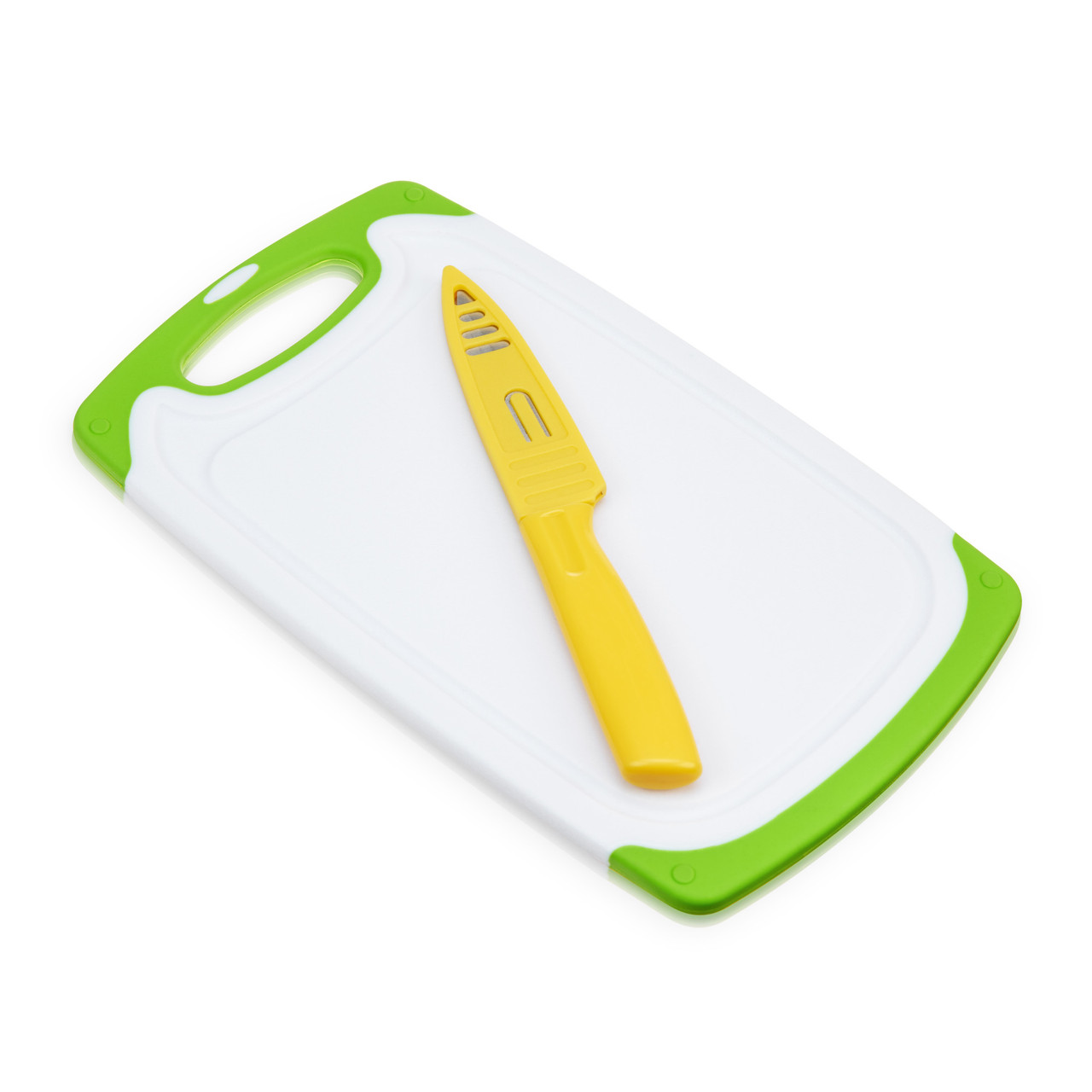
Composite and glass boards occupy niche positions. Glass destroys knife edges quickly. Composite boards vary by resin content; some soften in commercial heat. Neoflam's translucent polypropylene sets offer a middle ground: lighter than polyethylene, dishwasher-safe, and colour-tinted for coding. Match material to task, not to kitchen fashion.
Board Dimensions That Match Your Prep Volume
Surface area and thickness affect stability, workspace efficiency, and storage.
The twelve by eighteen inch half-inch polyethylene board suits compact kitchens and single-item prep. It handles a head of lettuce, a block of cheese, or a small fruit selection. For properties with limited counter space, this size stores in standard shelving and fits most residential-style sinks for hand washing.
The eighteen by twenty-four inch half-inch board serves higher-volume operations. The extra length accommodates multiple ingredients or longer cuts without crowding. Facility operators prepping breakfast for twenty units need this workspace. The weight increases, which becomes an advantage: heavier boards slide less during vigorous chopping.
Thickness at half-inch provides stability without excessive weight. Thinner boards flex under pressure, creating rocking that dulls knives unevenly. Thicker boards add cost and storage bulk without proportional benefit for most operations. Match size to your typical batch, not your maximum theoretical demand.
Matching Knife Sets to Board Systems
Coordinated knife and board colours close the cross-contamination loop.
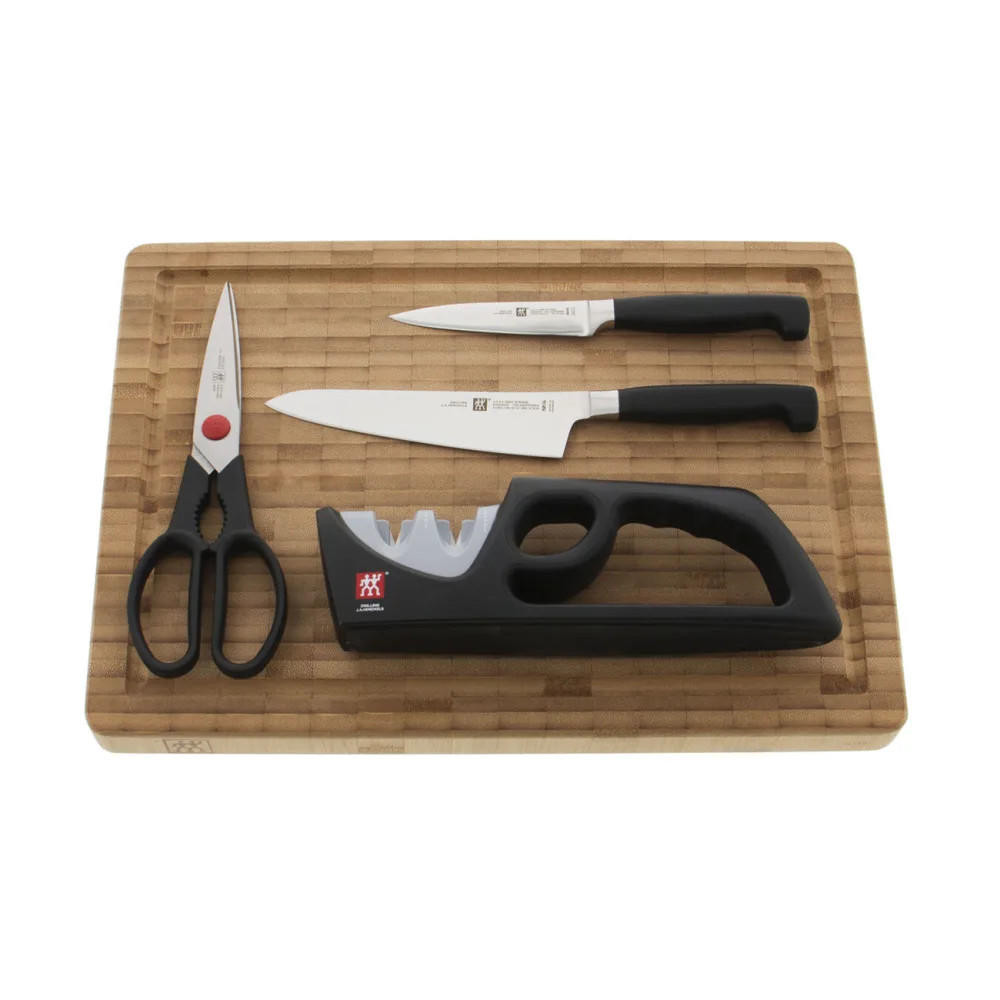
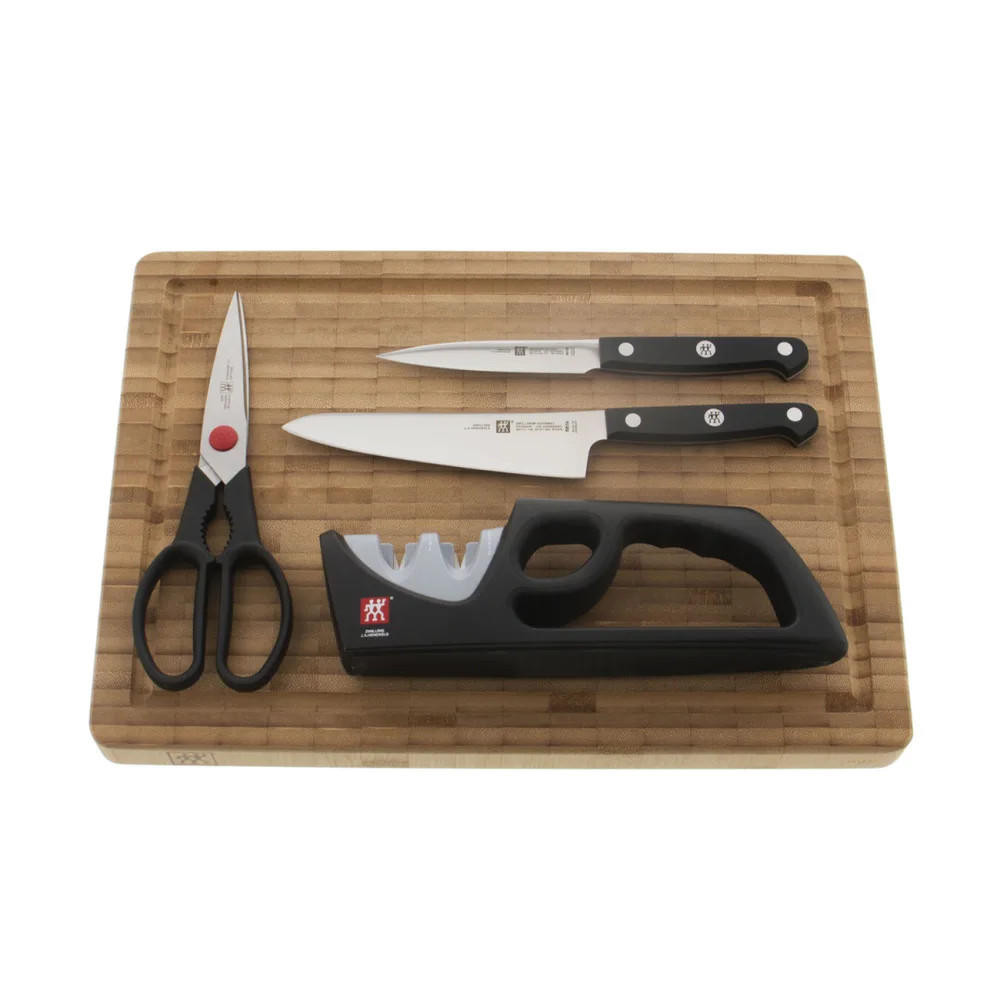
Henckels and Zwilling both offer paring knife sets with bamboo boards, but the principle extends to full colour coordination. A five-piece set with colour-matched handles lets staff grab yellow knife, yellow board without deliberation. The bamboo boards in these sets suit light service; the knives carry professional-grade steel.
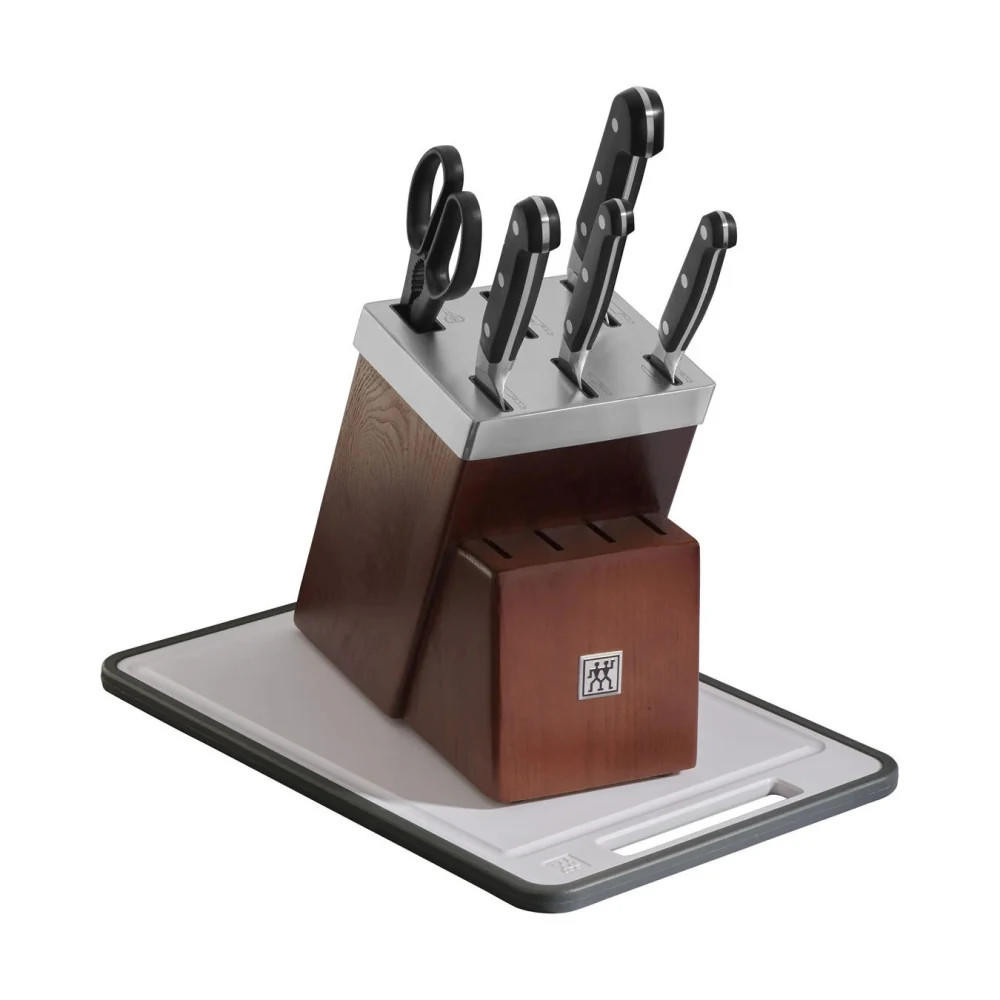
Zwilling's Pro seven-piece self-sharpening block includes a plastic cutting board. The block maintains edge geometry automatically, reducing the skill burden on less experienced staff. For properties with varying skill levels, self-sharpening systems maintain consistent cutting performance without dedicated maintenance roles.
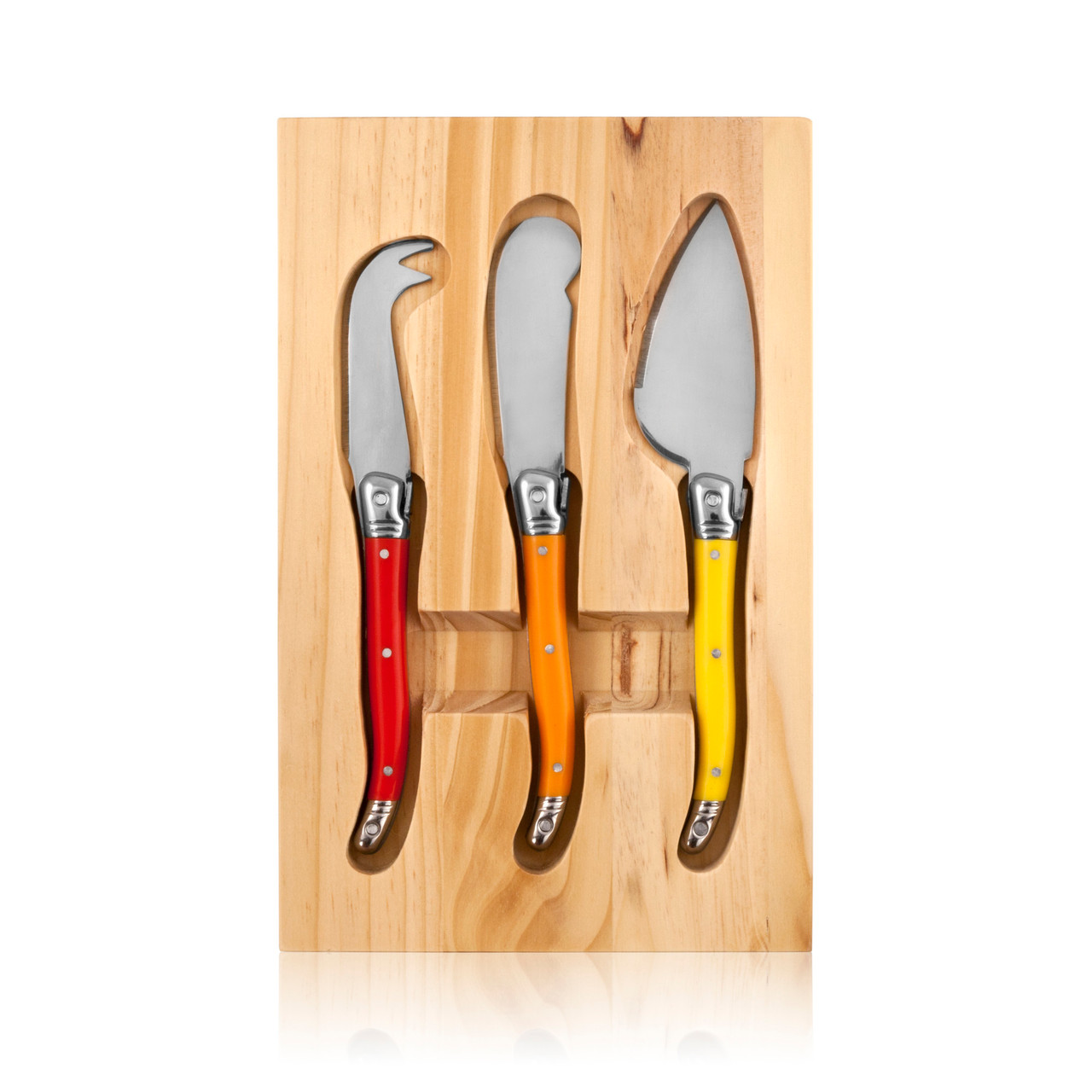
Sunnyside's cheese knife and board sets target presentation rather than prep. The specialized knives handle soft and hard cheeses cleanly. For Airbnb hosts offering local cheese boards as guest amenities, these sets bridge function and aesthetics. Reserve them for service, not for the initial cheese cutting and wrapping.
Rolling Out Colour Coding Across Properties
Standardized rollout reduces training friction and maintains consistency.
Start with inventory: count prep stations, estimate board wear rates, and identify which properties share staff. Order complete colour sets per station, not individual boards. A station missing its brown board will substitute white, breaking the system in the first week.
Train with physical demonstration, not posted charts alone. Have staff handle raw bird on yellow, then move to green for salad without washing hands. The visible wrongness of the demonstration sticks. Post the colour chart afterward as reinforcement, not primary training. MealPro's guidance emphasizes that colour codes only work when they become automatic, not remembered.
Audit monthly. Check for knife-handle paint wear, board scoring depth, and colour substitutions. Replace faded or damaged items immediately. The system integrity depends on every user trusting the colours absolutely. For multi-property operators, photograph standard setups at your best-run location and distribute as the template.
Commercial Cutting Board Comparison
Match board type to your kitchen's prep volume, maintenance capacity, and service style.
| Board Type | Best For | Maintenance Level | Typical Lifespan |
|---|---|---|---|
| White polyethylene, 12x18 | Compact kitchens, dairy, bakery | Dishwasher, replace when scored | 12-18 months heavy use |
| White polyethylene, 18x24 | High-volume prep, multiple ingredients | Dishwasher, replace when scored | 12-18 months heavy use |
| Cherry wood with juice groove | Guest-facing service, breakfast bars | Hand-wash, monthly oiling | 5+ years with care |
| Bamboo board in knife set | Light prep, presentation, in-suite use | Hand-wash, occasional oiling | 3-5 years with care |
| Translucent polypropylene set | Colour-coded starter system, limited space | Dishwasher safe | 2-3 years |
| Composite with knife block | Self-sharpening convenience, mixed staff skill | Wipe block, dishwasher board | Block: 10 years; board: 2-3 years |
| Wood board in cheese set | Charcuterie service, wine pairings | Hand-wash, immediate drying | 5+ years with care |
Commercial Cutting Boards and Knife Sets
Polyethylene boards for prep, wood boards for service, and matched knife sets for complete colour-coded systems.



People Also Ask
Real questions buyers search before they order — answered straight.
Are plastic cutting boards food-safe and non-toxic?
Commercial boards made from food-grade polyethylene (HDPE) or polypropylene are manufactured to be non-toxic and safe for direct food contact, and they are the standard across professional kitchens. Look for boards labelled food-safe or NSF-listed rather than generic craft plastics. Replace any board once its surface is heavily scored, since deep grooves are harder to sanitise no matter the material.
Are cutting boards heat resistant — can I rest a hot pan on one?
Most polyethylene boards are not designed as trivets and can soften, warp, or scorch under a hot pan, so keep them for cutting rather than as a heat rest. Wood and bamboo tolerate warmth a little better but can still scorch and crack. Use a proper trivet or heatproof surface for hot cookware to protect both the board and your worktop.
Are cutting boards recyclable at the end of their life?
Worn plastic boards are rarely accepted in curbside recycling because they are thick, food-contact plastic that most programs will not take, though some regions run rigid-plastic drop-off streams. Wood and bamboo boards can often be composted or repurposed once they are no longer food-safe. Checking your local program before disposal is the practical way to keep a retired board out of general waste where possible.
Can cutting boards get mouldy, and how do I prevent it?
Yes — boards that stay damp, especially wood or bamboo left wet or stored flat, can grow mould in cracks and grooves. Wash and sanitise after each use, dry the board fully, and store it upright with airflow on both faces. Replacing any board with deep, hard-to-clean splits also removes the hiding spots where mould and bacteria take hold.
Where should cutting boards be stored in a commercial kitchen?
Store boards upright in a rack or slotted holder so both faces can air-dry and colour-coded boards stay separated by task. Keeping them off wet counters and away from raw-preparation zones reduces cross-contamination and helps them dry fully between shifts. A dedicated storage spot near each station also keeps the right colour to hand and speeds up service.
What cutting boards do commercial kitchens and restaurants use?
Most professional kitchens use food-grade high-density polyethylene (HDPE) boards, usually in a colour-coded set, because they are hard-wearing, dishwasher-safe, and easy to sanitise at scale. Thicker boards resist warping under heavy daily use, and a colour system keeps raw and ready-to-eat preparation separate. Wood boards still appear front-of-house for serving, but plastic remains the workhorse for high-volume prep.
What Canadian facility operators say
Facility operators and hosts describe how colour-coded boards changed their kitchen workflows.
We manage fourteen Airbnb units in Kensington. Switching to yellow-for-bird and green-for-salad boards cut our guest complaints about stomach issues to zero in six months. Staff training took one afternoon.
The polyethylene boards go through our commercial dishwasher fifty times a week without warping. We replace them when grooves get deep, about every fourteen months. The white shows wear clearly so we know exactly when.
Our breakfast bar uses the cherry board for local cheese displays. Guests photograph it constantly. We keep a separate polyethylene board for actual prep behind the counter. Guests see wood; we work smart.
Board Selection and Care: Frequently Asked Questions
The following operator questions are answered with cited sources. Every FAQ links to the community thread, buyer guide, or regulator page it was researched from.
What colour cutting board do I use for raw chicken?
Source: What Color Cutting Board Is Used for Chicken? — Culina Cooks
What are the standard colour codes for cutting boards in a commercial kitchen?
Source: Anyone want to argue about cutting board colors today? — r/KitchenConfidential
Which colour cutting board do I use for cooked eggs or dairy?
Source: Which colour board for boiled eggs? — r/KitchenConfidential
Do colour-coded cutting boards actually reduce cross-contamination if I wash boards between tasks?
How do I get prep staff to actually follow the colour system?
Source: My work requires us to label the cutting boards — r/KitchenConfidential
Where can I buy commercial colour-coded cutting boards in Canada?
Source: Where to buy commercial kitchen grade cutting boards — r/Edmonton
What size cutting board do commercial kitchens use?
Source: Where to buy commercial kitchen grade cutting boards — r/Edmonton
When should I replace a plastic cutting board instead of resurfacing it?
Source: Commercial Cutting Board Lifespan: Resurface or Replace — ChefStop
Are colour-coded boards required by health inspectors, and does a red board always mean raw meat?
Source: Chopping Board Colours: Your Complete Guide — HSEDocs
Related guides from ChickenPieces
Why Source from ChickenPieces
Calgary-based supply for Canadian hospitality operators, with compliance-focused product selection.
Volume pricing
Case quantities and multi-property ordering reduce per-unit cost without minimum order penalties. Scale from single Airbnb to fifty-unit portfolios.
HACCP-aligned range
We stock NSF-listed polyethylene and colour-coded systems that support your food safety documentation from day one.
Cross-country reach
Ship to Alberta, Ontario, British Columbia, and all provinces. Carrier rates calculate at checkout with no hidden handling.
Canadian compliance
Products meet Health Canada food contact material requirements and CFIA guidance for commercial food preparation surfaces.
Sources & further reading
Request Your Kitchen Supply Quote
Tell us your property count and typical guest volume. We will recommend board quantities, colours, and replacement schedules matched to your operation. No minimum order required.
Request a QuoteAuthoritative References