
 US Dollar (USD)

2026 Mar 13th
Beef Tallow Substitutes
Beef Tallow Substitutes: When to Use Them and When to Stick with the Real Thing in Canadian Kitchens
Key Takeaways
- The best substitutes for beef tallow in commercial frying are lard (pork fat), palm shortening, and refined coconut oil — all of which have comparable smoke points and saturated fat content, though none replicate tallow's specific flavour profile.
- Duck fat is the closest substitute for tallow in terms of flavour complexity and cooking performance, but it is significantly more expensive and available only in small formats — making it impractical for high-volume commercial frying.
- Vegetable oils (canola, soybean, sunflower) are the most common substitutes in Canadian commercial kitchens, but they sacrifice fryer longevity and flavour quality compared to tallow. They are the right choice when a neutral fat flavour is required or when serving vegetarian or vegan customers.
- Tallow is genuinely irreplaceable in applications where its specific flavour is the point — traditional chips, British-style fish and chips, beef dripping roast potatoes. No substitute produces the same result.
- For Canadian food service operators who want tallow but have had supply chain difficulties, ChickenPieces.com stocks commercial 20kg bulk tallow from Sysco and Gordon Food Service, shipped from Calgary.
Table of Contents
- Why Would a Canadian Commercial Kitchen Need a Beef Tallow Substitute?
- How Do the Main Tallow Substitutes Compare for Commercial Frying?
- When Is Lard the Best Substitute for Beef Tallow?
- When Should You Use Vegetable-Based Fats Instead of Tallow?
- When Is Beef Tallow Genuinely Irreplaceable?
- Frequently Asked Questions
The question of beef tallow substitutes comes up in Canadian commercial kitchens for several practical reasons. Supply chain gaps — tallow has historically been harder to source in Canada than vegetable oils. Menu requirements — some dishes call for a specific fat, and the kitchen may not have it. Dietary restrictions — vegetarian and vegan customers cannot eat food fried in animal fat. Cost management — tallow is generally more expensive per kilogram than commodity vegetable oils, and some operations need to manage fat costs carefully.
The honest answer to the substitution question is that it depends entirely on what you are making and why you are using tallow in the first place. If you are using tallow for its flavour — for chips that taste the way chips used to taste, for roast potatoes with a genuinely crispy beef-fat crust — then there is no substitute that produces the same result. If you are using tallow primarily for its stability and fryer longevity, then lard or palm shortening are reasonable alternatives. If you are using it because it is what you have always used and you are not particularly attached to the flavour, then canola oil will do the job.
This guide gives you the data to make that decision for each application in your kitchen.
Why Would a Canadian Commercial Kitchen Need a Beef Tallow Substitute?
Canadian commercial kitchens may need a beef tallow substitute for four main reasons: supply chain availability (tallow has historically been harder to source in Canada than vegetable oils), dietary restrictions (vegetarian and vegan customers cannot eat food cooked in animal fat), cost management (tallow is generally more expensive per kilogram than commodity vegetable oils), and specific application requirements (some dishes are better suited to neutral fats).
Supply chain availability has been the most common practical reason for substitution in Canadian kitchens. Until recently, commercial-scale tallow in 20kg bulk cubes was genuinely difficult to source in Canada outside of direct relationships with rendering facilities or the major food service distributors. Many Canadian restaurants that wanted to use tallow simply could not reliably source it at the volume and format they needed.
This has changed. ChickenPieces.com now stocks the Sysco Canadian Beef Tallow Shortening 20kg and the Gordon Beef Blended Tallow Frying Shortening 20kg Cube with Canada-wide shipping from Calgary. For operators who have been substituting vegetable oil for tallow primarily because they could not source it reliably, that barrier has been removed.
Dietary restrictions are a legitimate and permanent reason to maintain a non-tallow frying option. Any Canadian restaurant serving vegetarian or vegan customers needs at least one fryer running on plant-based fat. This is not a reason to abandon tallow entirely — it is a reason to run a dual-fat operation, with a dedicated tallow fryer for premium items and a canola or other vegetable oil fryer for vegetarian applications.
How Do the Main Tallow Substitutes Compare for Commercial Frying?
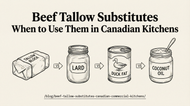
The main substitutes for beef tallow in commercial frying are lard (pork fat), palm shortening, refined coconut oil, duck fat, and refined vegetable oils (canola, soybean, sunflower). Of these, lard and palm shortening are the closest in terms of smoke point and fryer stability. Duck fat is the closest in terms of flavour complexity. Vegetable oils are the most available and lowest cost, but sacrifice both fryer longevity and flavour quality.
The table below provides a direct comparison of beef tallow and its main substitutes across the dimensions that matter most for Canadian commercial kitchen decision-making:
| Fat | Smoke Point | Saturated Fat | Fryer Life | Flavour | Vegan? | Canadian Availability | Commercial Format |
|---|---|---|---|---|---|---|---|
| Beef Tallow | 400–420°F | ~50% | 3–5 days | Rich, savoury, beefy | No | Good (improving) | 20kg cubes |
| Lard (pork) | 370°F | ~39% | 2–4 days | Mild, slightly porky | No | Good | 10–20kg pails |
| Palm Shortening | 450°F | ~50% | 3–5 days | Neutral | Yes | Good | 15–20kg cubes |
| Refined Coconut Oil | 400°F | ~86% | 3–5 days | Neutral (refined) | Yes | Good | 5–15kg pails |
| Duck Fat | 375°F | ~33% | 2–3 days | Rich, gamey, complex | No | Limited | 1–5kg tubs |
| Refined Canola Oil | 400–450°F | ~7% | 1–3 days | Neutral | Yes | Excellent | 8–20L jugs |
| Refined Soybean Oil | 450°F | ~15% | 1–3 days | Neutral | Yes | Excellent | 16–20L jugs |
| Refined Sunflower Oil | 440°F | ~10% | 1–2 days | Neutral | Yes | Good | 8–20L jugs |
The key insight from this table is that no single substitute matches tallow across all dimensions. Lard comes closest in terms of animal fat character but has a lower smoke point and a different (pork) flavour. Palm shortening matches tallow's stability but has no flavour. Duck fat has comparable flavour complexity but lower stability and significantly higher cost. Vegetable oils are widely available and neutral but degrade faster and produce less flavourful fried food.
When Is Lard the Best Substitute for Beef Tallow?
Lard (rendered pork fat) is the best substitute for beef tallow when the application requires an animal fat with good stability and flavour, but a specifically beefy flavour is not required. Lard has a smoke point of approximately 370°F, a saturated fat content of ~39%, and a mild, slightly porky flavour that works well for pastry, baking, and frying applications where a neutral-to-mild fat flavour is acceptable.
Lard is the traditional alternative to tallow in Canadian and British cooking. Before the vegetable oil era, Canadian kitchens used both — tallow for beef-specific applications and lard for everything else. Lard's slightly lower smoke point (370°F vs tallow's 400–420°F) means it is less suitable for the highest-temperature frying applications, but it is perfectly adequate for standard commercial frying at 350–375°F.
For pastry and baking applications, lard is actually superior to tallow for most purposes. Lard produces a flakier, more tender pastry than tallow because its fat crystal structure is different — it creates larger, more distinct fat pockets in the dough that produce the characteristic flakiness of traditional pie crust and biscuits. For Canadian restaurants with a pastry programme, lard is the traditional fat of choice and is worth considering alongside tallow.
The practical limitation of lard as a tallow substitute in Canadian commercial kitchens is that it is also not always easy to source in bulk commercial formats. The same supply chain issues that have affected tallow have affected commercial lard. For operations that want an animal fat but cannot source tallow, lard is the right alternative — but sourcing it may require the same effort as sourcing tallow.
When Should You Use Vegetable-Based Fats Instead of Tallow?
Vegetable-based fats (canola oil, soybean oil, palm shortening, refined coconut oil) are the better choice than tallow when serving vegetarian or vegan customers, when a completely neutral fat flavour is required for the dish, or when the operational simplicity of a liquid fat at room temperature is a meaningful advantage. They are not better than tallow for flavour or fryer longevity, but they are the right tool for specific applications.
The vegetarian and vegan consideration is the most clear-cut. Any Canadian restaurant with a meaningful vegetarian or vegan customer base needs at least one fryer running on plant-based fat. This is non-negotiable — animal fat is not vegetarian, and customers with dietary restrictions or ethical commitments to plant-based eating cannot eat food fried in tallow or lard. The right operational response is a dedicated plant-based fryer, not abandoning tallow entirely.
Neutral flavour applications are the second legitimate case for vegetable oil over tallow. Tempura batter, certain Asian-style fried dishes, doughnuts with delicate flavour profiles, and other applications where the fat flavour should be invisible are better suited to neutral canola or soybean oil. Tallow's flavour, while excellent in the right context, is present — and in some dishes, it is the wrong flavour.
Palm shortening deserves a specific mention as a vegetable-based alternative with stability comparable to tallow. Refined palm shortening has a smoke point of approximately 450°F and a saturated fat content of ~50%, giving it fryer longevity comparable to tallow. It is neutral in flavour and suitable for vegetarian and vegan applications. The environmental controversy around palm oil production is a consideration for some Canadian operators, but from a pure performance standpoint, it is the closest vegetable-based fat to tallow in terms of fryer stability.
When Is Beef Tallow Genuinely Irreplaceable?
Beef tallow is genuinely irreplaceable in applications where its specific flavour is the primary quality driver: traditional British-style chips, beef dripping roast potatoes, fish and chips cooked in the traditional manner, and any dish where the goal is to produce the flavour that tallow-fried food had before the vegetable oil era. In these applications, no substitute — animal or vegetable — produces the same result.
The most commercially significant of these applications is chips. The reason McDonald's fries tasted different before 1990 is not a matter of nostalgia — it is chemistry. The Maillard reaction products produced when potato starch and sugars interact with beef tallow at frying temperatures are chemically different from those produced with canola oil. The flavour compounds are different, the crust structure is different, and the way the crust holds up after frying is different. For any Canadian restaurant where chips are a signature item, tallow is the fat that produces the best result, and no substitute fully replicates it.
Beef dripping roast potatoes — a staple of traditional British and Canadian Sunday roast cooking — are another application where tallow is irreplaceable. The combination of the fat's flavour, its high saturated fat content (which produces a very hot, stable cooking medium in the oven), and the way it coats the potato surface produces a crust that is genuinely difficult to achieve with any other fat. Restaurants serving traditional British or Canadian cuisine that include roast potatoes on the menu should be using tallow.
For Canadian food service operators who are ready to commit to tallow for these applications, the Real Good Kitchen Premium Rendered Angus Beef Tallow For Cooking, 794g is an excellent starting point for smaller operations or for trialling specific applications before moving to bulk 20kg ordering. See Today's Current Wholesale Price.
Frequently Asked Questions
What is the closest substitute for beef tallow in commercial frying? For flavour, duck fat is the closest substitute — it has a similar richness and complexity, though with a gamey note rather than a beefy one. For fryer stability and longevity, palm shortening or lard are the closest substitutes. No single fat replicates all of tallow's properties simultaneously.
Can I use lard instead of beef tallow for frying chips? Yes, lard works well for frying chips and produces a better result than vegetable oil. The flavour will be slightly different — milder and less distinctly beefy — but the crust quality and texture will be comparable. Lard's slightly lower smoke point (370°F) means you should be more careful about temperature control than with tallow.
Is coconut oil a good substitute for beef tallow in commercial kitchens? Refined coconut oil (not virgin coconut oil) has a smoke point of approximately 400°F and a very high saturated fat content (~86%), giving it excellent fryer stability comparable to tallow. It is neutral in flavour and suitable for vegetarian and vegan applications. The main limitations are cost (coconut oil is generally more expensive than tallow at commercial scale) and the fact that it produces no flavour contribution to the food.
Can I use palm shortening instead of beef tallow? Palm shortening is one of the better tallow substitutes for commercial frying — it has a high smoke point (450°F), high saturated fat content (~50%), and good fryer longevity. It is neutral in flavour and suitable for vegetarian applications. The environmental concerns around palm oil production are a consideration for some operators.
What do vegetarian restaurants use instead of beef tallow? Vegetarian and vegan restaurants typically use refined canola oil, refined soybean oil, or palm shortening for high-heat frying. Refined coconut oil is used by some operations that want a high-stability vegetable fat. None of these produce the same flavour as tallow, but they are appropriate choices for operations that serve vegetarian and vegan customers.
Is there a way to get some of the tallow flavour without using animal fat? Some operators add a small amount of beef tallow to a vegetable oil fryer to get some flavour benefit while reducing the overall animal fat content. This is not a vegan-suitable approach, but it can be a cost management strategy for operations that want tallow flavour without running a full tallow fryer. The ratio is typically 20–30% tallow to 70–80% vegetable oil.