
 US Dollar

2026 Mar 13th
Beef Tallow for Frying
Beef Tallow for Frying: The Complete Guide for Canadian Commercial Kitchens
Key Takeaways
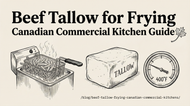
- Beef tallow has a smoke point of 400–420°F (204–215°C), making it well-suited to commercial deep frying at standard operating temperatures of 350–375°F — with meaningful headroom before degradation begins.
- Tallow's high saturated fat content (~50%) gives it superior oxidative stability compared to vegetable oils, translating to longer fryer life: 3–5 days between oil changes versus 1–3 days for canola or soybean oil at equivalent volume.
- Daily filtering is the single most important maintenance step for a tallow fryer — food particles left in the fat accelerate degradation regardless of fat type, and tallow must be filtered while still hot because it solidifies at room temperature.
- Canadian food service operators can source bulk beef tallow in 20kg commercial cubes from ChickenPieces.com, shipped from Calgary — eliminating the supply chain uncertainty that has historically made tallow harder to source than vegetable oils.
- The flavour advantage of tallow in fried foods — particularly chips, fried chicken, and fish and chips — is measurable and commercially meaningful: customers notice and return for it.
Table of Contents
- What Makes Beef Tallow Suitable for Commercial Deep Frying?
- How Does Tallow Perform in a Commercial Fryer Over Time?
- What Is the Daily Fryer Management Routine for Beef Tallow?
- What Are the Real Cost Implications of Switching to Tallow in a Canadian Restaurant?
- Which Foods Benefit Most from Being Fried in Beef Tallow?
- Frequently Asked Questions
Ask any chef who has cooked in both tallow and vegetable oil what the difference is, and you will get the same answer: the food tastes better. This is not nostalgia or marketing. The chemistry of how saturated animal fats interact with food at high heat is genuinely different from how polyunsaturated vegetable oils behave, and the difference shows up on the plate. Chips fried in tallow are crispier, hold their texture longer after frying, and have a depth of flavour that neutral canola oil cannot produce.
For Canadian commercial kitchens, the practical question is not whether tallow produces better fried food — it does — but whether it is operationally viable at scale. The answer is yes, with some important caveats about fryer management, sourcing, and cost structure. This guide covers all of it, from the chemistry of why tallow works so well for frying to the daily management routine that keeps a tallow fryer running at peak performance.
What Makes Beef Tallow Suitable for Commercial Deep Frying?
Beef tallow is suitable for commercial deep frying because of its smoke point (400–420°F), its high saturated fat content (~50%) which resists oxidation under prolonged heat, and its flavour profile which enhances rather than masks the taste of fried food. These three properties together make it one of the most technically capable frying fats available to Canadian food service operators.
The smoke point is the temperature at which a fat begins to break down and produce visible smoke — and, more importantly, the point at which it begins generating harmful oxidation products that affect both food quality and kitchen air quality. For commercial deep frying, which typically operates at 350–375°F, a fat needs a smoke point comfortably above that range. Tallow's smoke point of 400–420°F provides 25–70°F of headroom, which is adequate for most frying applications.
The table below compares beef tallow against the most common commercial frying fats across the dimensions that matter most for a Canadian food service operator:
| Fat | Smoke Point | Saturated Fat | Fryer Life | Flavour | Commercial Format | Canadian Availability |
|---|---|---|---|---|---|---|
| Beef Tallow | 400–420°F | ~50% | 3–5 days | Rich, savoury | 20kg cubes | Excellent |
| Refined Canola Oil | 400–450°F | ~7% | 1–3 days | Neutral | 8–20L jugs | Excellent |
| Soybean Oil | 450°F | ~15% | 1–3 days | Neutral | 16–20L jugs | Excellent |
| Lard (pork) | 370°F | ~39% | 2–4 days | Mild, porky | 10–20kg pails | Good |
| Palm Shortening | 450°F | ~50% | 3–5 days | Neutral | 15–20kg cubes | Good |
| Duck Fat | 375°F | ~33% | 2–3 days | Rich, gamey | 1–5kg tubs | Limited |
| Coconut Oil (refined) | 400°F | ~86% | 3–5 days | Neutral | 5–15kg pails | Good |
The saturated fat content is the key variable for fryer longevity. Saturated fats have no double bonds in their molecular structure, which means they have very few sites where oxygen can attack and initiate the chain reaction of oxidative degradation. Polyunsaturated fats — canola, soybean, sunflower — have many double bonds and degrade significantly faster under the same heat and time conditions. Tallow's ~50% saturated fat content places it in the high-stability category alongside palm shortening and coconut oil, but with a flavour profile that neither of those fats can match.
How Does Tallow Perform in a Commercial Fryer Over Time?
A well-maintained beef tallow fryer will typically last 3–5 days between full oil changes at standard commercial frying volumes and temperatures. The key indicators of tallow degradation are darkening colour (from pale yellow to amber to dark brown), increased foaming during frying, a sharp or acrid smell, and a greasy or off-flavoured finish on fried food. Daily filtering is the primary tool for extending fryer life.
Understanding how tallow degrades in a commercial fryer helps operators make better decisions about when to filter, when to top up, and when to change the fat entirely. The degradation process has three main drivers: heat, food particles, and oxygen. Heat causes the fat to break down chemically over time. Food particles — crumbs, breading, protein fragments — sink to the bottom of the fryer and burn, releasing compounds that accelerate fat degradation. Oxygen from the air oxidises the fat, particularly at the surface.
Tallow's high saturated fat content slows the heat-driven and oxygen-driven degradation significantly compared to vegetable oils. However, food particle contamination affects tallow and vegetable oil equally — which is why daily filtering is non-negotiable regardless of fat type. A tallow fryer that is not filtered daily will not achieve the 3–5 day fryer life that makes tallow economically attractive.
One characteristic of tallow that catches operators off guard the first time is foaming. Some foaming during frying is normal — it is caused by moisture in the food being fried. Excessive foaming, however, is a sign that the fat is degrading. If your tallow fryer is foaming significantly more than usual, it is approaching the end of its useful life and should be changed. The Reddit r/restaurateur thread on tallow frying is full of operators who encountered foaming after two weeks of use — the answer is almost always that the fat was not being filtered daily.
What Is the Daily Fryer Management Routine for Beef Tallow?
The daily fryer management routine for a beef tallow fryer consists of four steps: filtering the fat while hot at the end of each service, topping up with fresh tallow to replace what has been absorbed by food, checking the colour and smell of the fat, and maintaining the correct frying temperature throughout service. Tallow must be filtered while hot because it solidifies at room temperature — this is the most important operational difference from liquid vegetable oils.
Morning Start-Up
Allow 15–20 additional minutes in the morning for the solid tallow to melt before service begins. Turn the fryer on at low heat first to melt the fat gradually, then bring it up to operating temperature. Rushing this step by using high heat risks scorching the fat at the bottom of the fryer before it is fully liquid.
During Service
Maintain the frying temperature at 350–375°F throughout service. Tallow's smoke point gives you headroom above this range, but consistently operating above 400°F will shorten the fat's life. Skim any floating food particles from the surface during service — this takes 30 seconds and meaningfully extends fryer life.
End-of-Service Filtering
Filter the tallow while it is still hot — ideally at 160–180°F, hot enough to remain liquid but cool enough to handle safely. Use a commercial fryer filter or a fine-mesh strainer lined with food-grade filter paper. Pour the filtered tallow back into the fryer. This step removes the food particles that would otherwise burn and contaminate the fat overnight.
Weekly Full Change
Even with daily filtering, tallow will eventually reach the end of its useful life. The visual indicators are reliable: fresh tallow is pale yellow and clear; end-of-life tallow is dark amber or brown, may foam excessively, and will produce food with a greasy or off-flavour. Most high-volume Canadian restaurants running a tallow fryer change the fat every 3–5 days; lower-volume operations may get a full week.
What Are the Real Cost Implications of Switching to Tallow in a Canadian Restaurant?
The cost comparison between beef tallow and vegetable oil for commercial frying is more nuanced than a simple per-kilogram price comparison. Tallow's longer fryer life — 3–5 days versus 1–3 days for canola oil — means fewer oil changes per week, which reduces both material costs and the labour cost of oil changes. For high-volume operations, the total cost-of-use difference between tallow and canola oil is often smaller than the per-unit price difference suggests.
The calculation that matters for a Canadian food service operator is total cost per week of fryer operation, not cost per kilogram of fat. Consider a restaurant running a single commercial fryer at high volume. With canola oil requiring a full change every 2 days, that is 3.5 changes per week. With tallow lasting 4 days, that is 1.75 changes per week — half the number of changes, half the disposal cost, and significantly less labour time spent on oil management.
The Sysco Canadian Beef Tallow Shortening 20kg is the benchmark commercial product for Canadian food service operators making this switch — a full 20kg cube sized for high-volume fryer use. See Today's Current Wholesale Price.
For operations that want a blended product — tallow combined with other animal fats for a slightly different flavour profile and handling characteristics — the Gordon Beef Blended Tallow Frying Shortening 20kg Cube is a well-regarded option in Canadian food service. Check Live Availability.
For smaller operations or for trialling tallow before committing to 20kg bulk orders, the Real Good Kitchen Premium Rendered Angus Beef Tallow For Cooking, 794g provides a premium entry point. See Today's Current Wholesale Price.
Which Foods Benefit Most from Being Fried in Beef Tallow?
The foods that benefit most from being fried in beef tallow are those where the fat's flavour and the quality of the crust are primary quality indicators: chips (French fries), fried chicken, fish and chips, onion rings, and pastry-based items. Foods where a neutral fat flavour is preferred — tempura, certain Asian-style fried dishes, doughnuts — are better suited to neutral vegetable oils.
Chips and French Fries
This is the application where tallow's superiority is most dramatic and most commercially significant. Chips fried in tallow are crispier, hold their texture longer after frying (meaning they stay crispy through a longer hold time), and have a depth of flavour that customers consistently notice and comment on. The reason McDonald's fries tasted different before 1990 is because they were fried in tallow. The reason Steak 'n Shake's fries are generating significant consumer attention in 2026 is because they switched back to tallow. For any Canadian restaurant where chips are a signature item, this is the highest-return application for tallow.
Fried Chicken
Fried chicken cooked in tallow develops a crust with exceptional colour, crunch, and flavour. The Maillard reaction — the chemical process responsible for browning and flavour development — is enhanced by tallow's fatty acid profile. The result is a darker, more flavourful crust that holds its crunch better than chicken fried in vegetable oil. For Canadian restaurants running a dedicated fried chicken programme, tallow is worth serious consideration.
Fish and Chips
Traditional British-style fish and chips were fried in beef dripping (essentially tallow) for most of their history. The fat's flavour complements rather than competes with the fish, and the batter develops a lighter, crispier texture than in vegetable oil. Canadian fish and chip shops that have returned to tallow consistently report positive customer feedback.
Frequently Asked Questions
What temperature should I fry in beef tallow? The standard commercial frying temperature of 350–375°F (175–190°C) works well for beef tallow. Tallow's smoke point of 400–420°F provides adequate headroom above this range. Avoid consistently operating above 400°F, as this will shorten the fat's useful life. For chips, 375°F is the sweet spot for a crispy exterior without excessive oil absorption.
How often should I change the tallow in a commercial fryer? For a high-volume commercial fryer operating 8+ hours per day, plan on changing the tallow every 3–5 days with daily filtering. Lower-volume operations may get a full week. The visual indicators are reliable: change the fat when it turns dark amber or brown, foams excessively, or produces food with an off-flavour.
Can I mix beef tallow with vegetable oil in a commercial fryer? Mixing fats is not recommended. Different fats have different smoke points, degradation rates, and filtration requirements. If you want to run both, use dedicated fryers for each. Mixing will compromise the stability advantage of tallow.
Does beef tallow foam in a commercial fryer? Some foaming is normal — it is caused by moisture in the food being fried. Excessive foaming is a sign that the fat is degrading and approaching the end of its useful life. Daily filtering significantly reduces the rate at which tallow degrades and foams.
Is beef tallow suitable for all commercial frying applications? Tallow works well for most high-heat frying applications: chips, fried chicken, fish and chips, onion rings, doughnuts (though the flavour will be present), and pastry. For applications where a completely neutral fat flavour is required — certain Asian-style fried dishes, tempura — a neutral vegetable oil is the better choice.
Where can I buy beef tallow in bulk for a Canadian restaurant? ChickenPieces.com supplies bulk beef tallow in 20kg commercial cubes, shipped from Calgary across Canada. Both the Sysco Canadian Beef Tallow Shortening 20kg and the Gordon Beef Blended Tallow Frying Shortening 20kg Cube are available with competitive wholesale rates for food service operators.