
 US Dollar (USD)

2025 Dec 11th
Finding the Best Commercial Coffee Machines for Your Business
Finding the Best Commercial Coffee Machines for Your Business
Picking the right commercial coffee machine isn't about finding one "best" model. It's about finding the one that perfectly fits your business reality. The top choice is always a balance between your expected volume, your staff's skill level, and the kind of coffee experience you want to deliver to your customers.
That perfect machine could be a super-automatic powerhouse like the WMF 1100S for a high-speed lunch rush, or a traditional workhorse like the La Marzocco Linea Mini for a café that prides itself on craft.
How To Choose The Right Commercial Coffee Machine
Let's get one thing straight: the perfect machine for a bustling café is completely wrong for a corporate office kitchen. This is less about buying a product and more about matching the right technology to your specific day-to-day operations. Get it right, and you've made an investment that boosts workflow, quality, and your bottom line.
To cut through the noise, start by asking three simple but critical questions:
- Daily Volume: How many cups are you realistically serving during your busiest hour? What about over a whole day?
- Staff Expertise: Are your people trained baristas who can dial in a grinder and pull a perfect shot, or do they need a simple "press-and-go" button? Be honest.
- Coffee Program: Are you just serving black coffee, or do you need a machine that can crank out a full menu of lattes, cappuccinos, and macchiatos?
Answering these questions will immediately slash your list of options in half. It stops you from overspending on a machine with features you'll never use, or worse, buying an underpowered unit that can't keep up when the line is out the door.
A high-volume restaurant, for example, lives and dies by speed and consistency. A super-automatic bean-to-cup machine is a no-brainer. But for a specialty coffee shop where quality and the craft are the main attractions, a semi-automatic espresso machine that gives the barista full control is the only real choice.
One of the biggest mistakes I see people make is getting fixated on the sticker price. The total cost of ownership—factoring in installation, water filtration, ongoing maintenance, and staff training—gives you a much more realistic picture of what you're actually investing long-term.
To help you get started, here's a quick look at how the main machine types stack up.
| Machine Category | Ideal Use Case | Required Staff Skill | Key Advantage |
|---|---|---|---|
| Super-Automatic | High-volume restaurants, offices, hotels | Low | Speed and consistency |
| Semi-Automatic | Specialty cafés, espresso bars | High | Barista control and quality |
| Batch Brewers | Diners, conference centres, catering | Low | High-volume drip coffee |
Comparing the Different Types of Coffee Machines
Choosing the right commercial coffee machine starts with understanding that not all machines are created equal. Each type is built for a specific job, balancing things like staff skill, service speed, and the quality of the coffee in the cup. A machine that's a dream for a high-end specialty café would be a frustrating nightmare in a busy hotel lobby, making this a critical first step.
The decision you make here will ripple through your entire operation, affecting your workflow, customer happiness, and, ultimately, your bottom line. Let's break down the most common machine types to see where each one truly shines.
This decision tree gives you a quick visual guide. Follow the flow based on your expected volume, staff skill level, and the kind of coffee you want to serve, and it'll point you toward the right category.

As you can see, high-volume needs often lead to automated workhorses like batch brewers or super-automatics, while a focus on craft and quality points directly to semi-automatic espresso machines.
Semi-Automatic Espresso Machines: The Barista's Choice
Semi-automatic espresso machines are the heart and soul of the specialty coffee world. They put a trained barista in complete control over the variables that matter most—grind, dose, tamp, and shot time. It's this hands-on process that allows for the highest possible cup quality, empowering your staff to pull nuanced, perfectly extracted espresso shots.
Of course, that level of control demands real skill and training. Inconsistent technique from an inexperienced barista leads directly to bad espresso and can slow service to a crawl during a rush. These machines are the perfect fit for dedicated coffee shops and upscale restaurants where the art of coffee is a central part of the customer experience.
Super-Automatic Espresso Machines: Speed and Simplicity
Super-automatic machines, often known as bean-to-cup machines, are all about one-touch convenience. They automate everything from grinding the beans to frothing the milk, pumping out consistent lattes and cappuccinos with almost no staff input. This makes them a fantastic choice for any place where speed and ease of use are the top priorities.
Think busy offices, hotel breakfast bars, and quick-service restaurants. While they won't hit the absolute peak quality that a skilled barista can achieve on a semi-automatic, their consistency is unbeatable. Every customer gets the same quality drink, every single time.
A key differentiator lies in workflow. A semi-automatic machine is a tool for a craftsperson, demanding focus and expertise. A super-automatic machine is a productivity appliance, designed to empower any team member to serve coffee quickly and reliably.
Batch Brewers: For High-Volume Drip Coffee
When you need to serve a lot of consistently good drip coffee—and fast—the batch brewer is king. These machines can brew several litres of coffee at once, holding it at the perfect serving temperature in thermal carafes or airpots. They are the absolute workhorses of conference centres, diners, and catering businesses.
Operation is dead simple: add a filter, measure the grounds, and push a button. This means anyone on staff can run them, making them ideal for high-turnover environments where you just need to keep the coffee flowing without tying up a dedicated staff member. To keep customers happy, pairing a high-capacity brewer with a premium coffee blend from a trusted brand is a must.
Single-Serve Pod Machines: Convenience in Niche Settings
Single-serve pod machines offer the ultimate convenience for very specific, lower-volume situations. You'll typically find them in hotel rooms, small office breakrooms, or client waiting areas where self-service is the name of the game. Each pod has a pre-measured amount of coffee, which means no mess and a fresh cup every time.
Their cost-per-cup is much higher and they create more waste, but the trade-off is zero training and absolute simplicity. They're not built for primary service in a café or restaurant, but they perfectly fill the niche where on-demand, single-cup brewing is needed.
The sheer variety of machines reflects a booming industry. North America's commercial coffee machine market is a global powerhouse, projected to hold a 41.3% share of the worldwide market in 2025. This growth is fuelled by a strong café culture and high expectations for quality coffee, driving demand for reliable equipment everywhere from cafes to offices. You can explore more coffee machine market trends and analysis on coherentmarketinsights.com.
Matching Machine Capacity to Your Business Volume
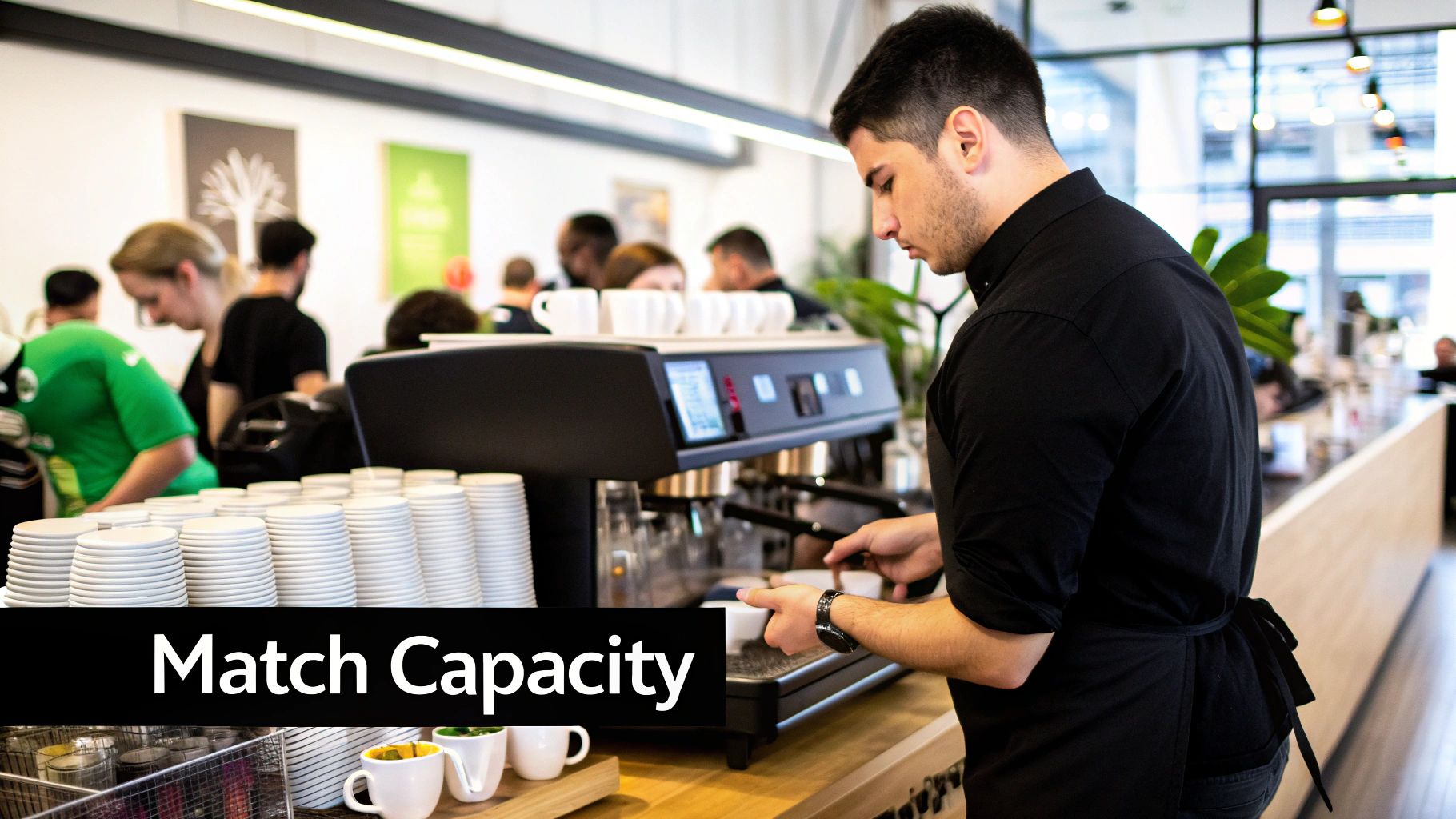
Getting the right commercial coffee machine starts with an honest look at your business's daily rhythm. Choosing the right capacity isn't just about keeping customer queues short; it's about protecting your investment from burnout and ensuring the coffee is consistently great when you're slammed. If you aim too low, you'll create bottlenecks during peak hours. If you aim too high, you've just tied up a bunch of cash in a machine you can't even push to its limits.
The best place to start? Calculate your peak-hour demand. Don't just guess—actually track your sales for a few busy mornings or lunch rushes. If you find you're selling 30 coffees between 8 AM and 9 AM, that's your benchmark. This one number is the most powerful tool you have for narrowing down your options.
Translating Volume Into Technical Specs
Once you've got that peak volume number, you can start matching it to the technical specs that actually define a machine's output. Different machines measure capacity in different ways, so it's critical to know what you're looking for.
Here are the key specs that really matter:
- Boiler Size (Espresso Machines): This is the heart of any espresso machine, measured in litres. A bigger boiler (think 10-14 litres) can handle a relentless stream of drink orders without losing temperature or pressure—vital for consistent shots and powerful milk steaming.
- Brewing Capacity (Batch Brewers): For drip coffee makers, this is usually measured in gallons or litres per hour. A machine rated for 3-5 gallons per hour is perfect for a small office, but a high-volume diner might need something that can churn out over 15 gallons per hour.
- Group Heads (Espresso Machines): Each group head is a workstation for pulling a shot. A single-group machine is fine for a quiet spot, but a bustling café needs a two or three-group machine so multiple baristas can work side-by-side.
- Recovery Time: This is all about how fast a machine gets back to the perfect brewing temperature after making a drink. Shorter recovery times are non-negotiable for getting through a sustained rush without sacrificing quality.
To put this in context, California's coffee scene is a massive driver for high-performance gear. In 2024, the state represented a staggering 23.97% of the entire United States coffee market. This is fuelled by a dense network of specialty cafés and tech offices that all expect a premium coffee experience. That intense demand for both quality and speed pushes owners to invest in machines with serious specs, like multi-boiler systems and high-capacity brewers that can keep up. For more great insights on the U.S. coffee market, check out the analysis on mordorintelligence.com.
Real-World Scenarios
The specs on paper only start to mean something when you apply them to an actual business. The machine an office needs is worlds away from what a downtown café requires to survive.
Choosing capacity isn't just about surviving your busiest hour today. It's about ensuring your machine can support your business as it grows over the next three to five years. Always plan for moderate growth.
A small office with 50 employees might only need a single-group espresso machine with a 5-litre boiler or a small-footprint batch brewer. Their peak demand is short and totally predictable.
On the other hand, a café serving 300 customers daily needs a true workhorse. A two-group espresso machine with at least an 11-litre boiler, like the La Marzocco Linea PB, is the bare minimum. This setup ensures baristas can pull shots and steam milk for multiple lattes at the same time without a single hiccup in performance, keeping the line moving and your customers happy.
Understanding Key Features and Technical Specifications
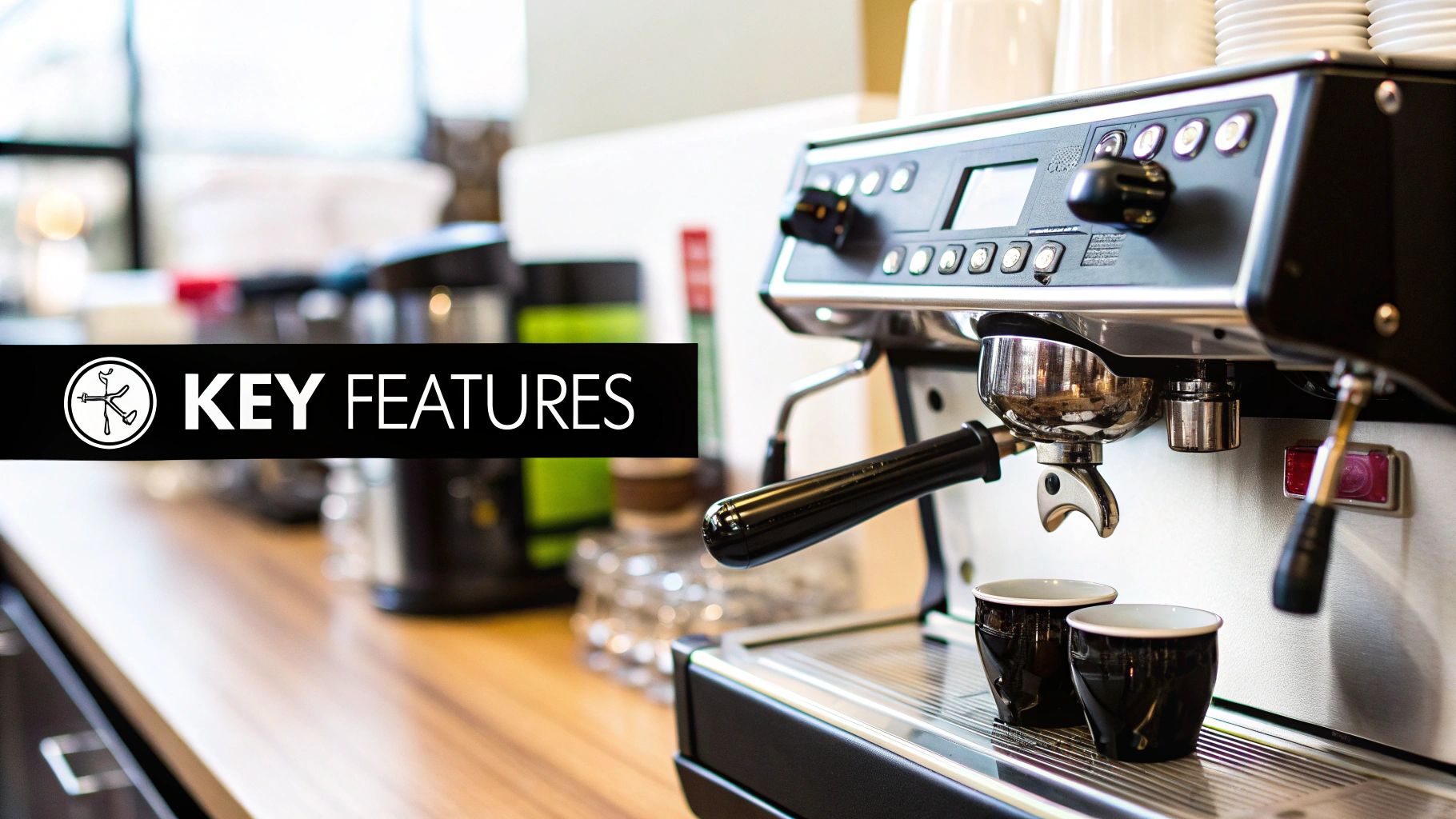
When you start digging into the specs of commercial coffee machines, it can feel like learning a whole new language. You'll see terms like "dual boiler," "group heads," and "pressure profiling" thrown around, and it's easy to get overwhelmed. But these aren't just buzzwords; they're the engine components that dictate your workflow, the quality of your coffee, and how many customers you can serve during a morning rush.
Think of it this way: understanding the difference between a heat exchange and a dual boiler system is like knowing why one car can accelerate smoothly while another sputters. One lets you steam milk and pull espresso shots at the same time without losing a degree of temperature, while the other might struggle. It's all about translating the technical jargon into real-world results for your business.
Boilers: The Heart of Your Machine
The boiler system is the absolute core of any espresso machine. It controls temperature stability, which is non-negotiable for pulling consistent, delicious shots. You'll run into two main types, each with its own pros and cons for a commercial setting.
A Heat Exchange (HX) machine has one big boiler that does double duty, creating steam and heating the water for brewing. A copper tube carrying the brew water passes through this boiler, flash-heating it just before it hits the group head. It's a cost-effective and space-saving design, but it sometimes requires a quick "cooling flush" before pulling a shot to make sure the water isn't scorching hot.
On the other hand, a Dual Boiler (DB) machine features two dedicated boilers—one just for steam and one just for brewing. This complete separation gives you incredibly precise temperature control over both functions. You can pull a shot and steam a pitcher of milk at the same time without either one affecting the other. For any serious café slinging lattes and flat whites, a dual boiler machine offers the consistency and workflow horsepower you need.
Group Heads and Portafilters
The number of group heads on a machine is a direct measure of its output capacity. Each group head is a workstation where a barista can lock in a portafilter to pull shots. It's that simple.
- One Group: Best for low-volume environments like a small restaurant, an office kitchen, or a mobile coffee cart.
- Two Groups: This is the workhorse of the industry, perfect for most small to medium-sized cafés. It allows two baristas to work side-by-side or lets one efficient barista handle multiple orders at once.
- Three or Four Groups: These are the big guns, reserved for high-volume specialty shops that face relentless queues and need maximum speed.
Another game-changing feature is programmable, or volumetric, dosing. This lets you pre-program the exact volume for a single or double shot. The barista hits one button, the machine dispenses the perfect amount of water, and they can immediately turn to steam milk or take the next order. It's a huge win for consistency, drastically reducing human error and speeding up service.
A machine that combines multiple group heads with volumetric dosing is a powerhouse of efficiency. It lets you maintain incredible consistency and speed, even with less experienced staff behind the counter.
Plumbed In vs. Water Tank Models
How your machine gets its water is a critical logistical choice. A plumbed-in machine connects directly to your building's main water line, giving you an endless, uninterrupted supply. This is a must-have for any medium-to-high volume business because it completely eliminates the chore of refilling a water tank. It also means you'll need a professional water filtration system—like the ones from 3M which we carry at Chicken Pieces—to protect your investment from scale buildup and ensure the best-tasting coffee.
A machine with a portable water tank (sometimes called a "pour-over" model) offers flexibility. With no plumbing required, it's the perfect solution for mobile carts, catering gigs, or spots where you can't easily access a water line. The obvious drawback is the manual labour. Having to constantly stop and refill a tank can become a serious bottleneck during a busy service. For almost any permanent commercial setup, a plumbed-in model is the clear winner for reliability and workflow.
Calculating the True Cost of Your Coffee Machine
That shiny new commercial coffee machine has a sticker price, but trust me, that's just the down payment. To truly understand what you're getting into, you need to look at the total cost of ownership (TCO). This isn't just business jargon; it's the real-world calculation that separates a profitable investment from a financial headache.
Thinking about TCO means looking past the initial thrill of the purchase to see the full financial picture over the machine's entire life. Get this right, and you'll budget accurately and protect your bottom line.
Beyond the Initial Purchase Price
Once you've paid for the machine, a few other crucial costs pop up before you can even think about pulling your first shot. These often catch new owners off guard, but they're absolutely essential.
For any plumbed-in model, professional installation is non-negotiable. It guarantees your machine is correctly hooked up to water and power, preventing the kind of catastrophic (and expensive) failures that can happen down the road. You'll also need to invest in a commercial-grade water filtration system. Think of it as health insurance for your machine—it's the single best defence against limescale, which is the number one killer of coffee equipment.
Finally, set aside a budget for proper staff training right from the start. A well-trained team operates the machine efficiently, pours consistent drinks, and—most importantly—handles the daily cleaning routines that are critical for keeping it running smoothly.
The real cost of a commercial coffee machine isn't what you pay for it; it's what you pay to run it, maintain it, and repair it over the next five years. Overlooking these ongoing expenses can turn a great deal into a financial drain.
Ongoing Operational Expenses
With your machine up and running, your focus shifts to the recurring costs that will directly affect your daily profitability. These are the predictable, day-in-day-out expenses that need to be baked into your financial planning.
Your key ongoing costs will include:
- Consumables: This goes way beyond just coffee beans. You've got to factor in milk, syrups, paper cups, lids, and everything else that goes into a finished drink.
- Cleaning Supplies: To keep your machine hygienic and performing at its best, you'll need a steady supply of specialized detergents for backflushing, descaling solutions, and cleaning brushes. This isn't optional.
- Energy and Water: High-volume machines are thirsty. They use a significant amount of electricity and water, which will show up on your monthly utility bills.
These costs add up faster than you'd think. A solid grasp of your consumption rate is what allows you to price your menu correctly and protect your profit margins. It's this kind of detailed planning that's essential in the U.S. coffee machine market, which is expected to hit USD 3.79 billion by 2025. As demand for great coffee grows, having efficient and reliable equipment is the bedrock of a successful business. You can read Statista's full forecast on the U.S. coffee machine market for a deeper dive.
Maintenance Plans and Warranty Protection
Lastly, we need to talk about the most significant long-term costs: maintenance and repairs. The manufacturer's warranty is great for covering defects, but it won't touch the normal wear and tear that comes from a machine working hard day after day. This is where a preventative maintenance plan becomes your best friend.
Signing up with a certified technician for regular service is the smartest way to avoid a crisis. These plans usually involve semi-annual check-ups where they replace worn gaskets, calibrate grinders, and deep clean internal parts you can't reach. Yes, it's an ongoing expense, but it's a drop in the bucket compared to the sales you'll lose when your machine dies in the middle of the morning rush. When you're looking at service agreements, read the fine print carefully to make sure you're covered for the inevitable realities of high-volume coffee service.
Picking the Right Machine for Your Business
Let's get down to brass tacks. The "best" commercial coffee machine is the one that fits your specific operation like a glove. To cut through the noise, I've broken down my top picks for four common business types. These aren't just random suggestions; they're based on years of seeing what works—and what doesn't—in the real world.
Think of this as the final step, matching a machine's strengths to your daily grind. This is about making an investment you'll be happy with a year from now, not just on day one.
For the Small Independent Café
The heart and soul of an independent café is the craft. Your customers come for quality and consistency, and your baristas need a machine that gives them the control to deliver just that. It has to be a reliable workhorse, ready for the morning rush without ever skipping a beat. This is semi-automatic espresso machine territory.
I always recommend a solid two-group semi-automatic for this setup. It's the sweet spot between output and footprint. A skilled barista can fly solo on it, or two can work side-by-side when things get hectic. It empowers your team to pull those exceptional shots that build a loyal following.
For the High-Volume Restaurant or Hotel
In a busy restaurant or hotel, the game is different. It's all about speed, simplicity, and rock-solid consistency. You need to serve dozens of guests at a breakfast buffet or after a dinner service, often with staff who aren't trained baristas. For this environment, a single machine won't cut it.
The winning combination here is a powerful batch brewer paired with a super-automatic espresso machine. A high-capacity Bunn or similar brewer can churn out gallons of fantastic drip coffee, serving big groups without breaking a sweat. At the same time, a user-friendly super-automatic can handle every latte and cappuccino order with the press of a button. No training needed, no slowdowns—just great coffee, fast.
The smartest strategy for restaurants is to split your coffee production. Let a dedicated batch brewer handle the high-volume drip, and a separate machine tackle the specialty drinks. This setup eliminates bottlenecks and lets your team serve everyone quickly, without sacrificing quality.
For the Modern Corporate Office
Office coffee has come a long way. Today's teams expect a self-serve solution that's mess-free and delivers premium, café-quality drinks. The machine has to be dead simple for anyone to use, yet tough enough to handle daily use from the entire company. The clear winner here is a bean-to-cup machine.
Look for a model that offers a wide menu of drinks, from a straight espresso to a foamy latte, all made automatically. These machines grind fresh beans for every single cup, which is a massive step up from any pod system. A great bean-to-cup machine is a genuine employee perk, one that boosts morale and keeps people energized. Just be sure to protect your investment by hooking it up to a dependable 3M water filtration system.
For Mobile Carts and Concession Stands
When your business is on the move—whether it's a coffee cart, food truck, or concession stand—every single centimetre of counter space counts. You need equipment that's compact, efficient, and powerful enough to keep the line moving. It has to be easy to set up and run reliably in a tight spot.
For this exact scenario, a compact one-group semi-automatic espresso machine is the perfect tool for the job. It gives you the power to craft high-quality espresso drinks without eating up your entire workspace. When you're shopping, zero in on models with a boiler that's large enough to provide consistent steam pressure for milk drinks. That's the key to making sure you can serve a full, café-quality menu, no matter where you set up shop.
Your Top Questions Answered
Making a big investment in a commercial coffee machine always brings up a few last-minute questions. I get it. You want to be sure you're making the right call. Here, I'll tackle the most common things business owners ask, helping you get clear on the final details before you commit.
Think of this as the last step in your research—getting straight answers to ensure the machine you pick is a workhorse for years to come.
What's The Real Difference Between A Commercial And A Home Coffee Machine?
The biggest difference comes down to two things: durability and duty cycle. A commercial machine is built like a tank. It's engineered with bigger boilers, heavy-duty pumps, and tougher components designed to run non-stop, all day, every day. It's built for volume and consistency in a way a home machine simply can't handle without breaking down.
But there's more to it than just brute strength. Commercial machines are almost always NSF-certified. This is a non-negotiable standard for food service, proving the machine meets strict public health and safety rules. Your home espresso machine doesn't have this, and using it in a café, restaurant, or even an office would put you out of compliance. They're fundamentally different tools for very different jobs.
Do I Actually Need A Water Filtration System?
Yes. Full stop. A commercial-grade water filtration system isn't a nice-to-have accessory; it's a critical part of your setup. I've seen it time and time again: poor water quality, especially limescale from mineral buildup, is the number one killer of expensive coffee equipment. It causes catastrophic failures that your warranty won't cover.
A good system does more than just protect your investment, though. It makes your coffee taste dramatically better. Since coffee is over 98% water, ensuring it's clean and properly balanced is a direct investment in the quality of the product you serve your customers.
Investing in a professional water filter is the single best piece of insurance you can buy for your commercial coffee machine. It prevents the most common and costly breakdowns while guaranteeing a better-tasting cup for your customers.
How Often Should I Get My Commercial Coffee Machine Serviced?
Preventative maintenance is what keeps a machine running smoothly for a decade instead of failing after two years. For most businesses, I recommend scheduling a professional service call every 6 to 12 months. The exact timing really depends on your volume—a slammed café needs more frequent check-ups than a low-traffic office.
Just remember, professional servicing doesn't let you off the hook for daily cleaning. You still need to do the essential stuff—like backflushing group heads, wiping down steam wands, and emptying drip trays—every single day. Consistent daily care is your first line of defence against performance problems.
At Chicken Pieces, we know that the right equipment is just the start. That's why we offer a curated selection of essential supplies to support your business, from high-performance water filtration systems to the daily cleaning products that keep your machine in peak condition. Explore our full range of coffee and beverage solutions today at https://www.chickenpieces.com.