
 US Dollar (USD)

2025 Oct 22nd
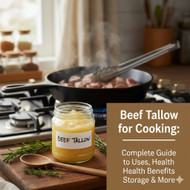
Beef Tallow for Cooking
Updated February 2026. Beef tallow is back — and Canadian cooks, restaurant owners, and food service professionals are leading the charge. This guide covers everything: what it is, the best ways to cook with it, honest health information, how to store it, and where to buy bulk beef tallow in Canada.
Key Takeaways:
- Beef tallow has a smoke point of approximately 400°F (204°C) — ideal for deep frying, roasting, and all high-heat cooking
- It adds a subtle, savoury richness to food without an overpowering beef flavour
- Shelf-stable at room temperature — lasts up to 12 months unopened when stored correctly
- Contains fat-soluble vitamins A, D, E, and K, plus conjugated linoleic acid (CLA)
- A natural, non-hydrogenated fat — no trans fats — preferred by keto, paleo, and carnivore cooks
- You can reuse beef tallow for frying 8–10 sessions with proper filtering and storage
- Available in Canada in bulk — no membership required — from Chicken Pieces, Calgary
What Is Beef Tallow?
Beef tallow is rendered fat from cattle. The rendering process is simple: raw beef fat (most commonly suet — the hard fat surrounding the kidneys and loins) is slowly heated until it melts and separates from any remaining connective tissue. The liquid fat is then strained and allowed to cool, resulting in a creamy white to pale yellow solid that becomes a clear, golden liquid when heated.
This is not a new or trendy product. Beef tallow was the dominant cooking fat in North American and European kitchens for centuries. It was the fat McDonald's used for its famous French fries until 1990. It is still the fat behind the most iconic fish and chips shops in Britain, traditional Belgian frites, and old-school steakhouse flavour. It fell out of fashion in the latter half of the 20th century when vegetable and seed oil marketing reshaped how the food industry thought about fat — but it never actually stopped being good.
Today, beef tallow is experiencing a genuine revival — driven by chefs who care about flavour, home cooks exploring traditional techniques, and a broader cultural shift away from heavily processed seed oils.
What Are the Best Uses for Beef Tallow in Cooking?
Beef tallow is one of the most versatile cooking fats available. Its high smoke point, stable fat structure, and mild flavour make it suitable for virtually every high-heat cooking method.
Deep Frying
This is where beef tallow truly shines. Its smoke point of 400°F (204°C) keeps it stable throughout extended frying sessions at the standard operating range of 350–375°F. Foods fried in tallow emerge golden, crispy, and dry — with minimal oil absorption compared to most vegetable oils. The fat solidifies quickly on the surface of food as it cooks, creating that coveted crispy shell. French fries cooked in beef tallow develop an unmatched depth of flavour; fried chicken gets a richer, crispier coating. It also holds up across multiple frying sessions without the rapid degradation that plagues polyunsaturated vegetable oils.
Pan Frying & Searing
Beef tallow is exceptional for pan frying steaks, burgers, pork chops, and fish in cast iron. It reaches the extreme heat needed for a proper sear without smoking or burning, and adds a subtle savoury richness to the crust. For cast iron cooking specifically, tallow is also the traditional choice for seasoning the pan itself — the fat polymerises into a smooth, non-stick surface layer.
Roasting Vegetables
Toss root vegetables — potatoes, carrots, parsnips, Brussels sprouts, beetroot — in melted beef tallow before roasting at 425–450°F. The high smoke point means the fat stays stable at high oven temperatures, and the result is superior caramelisation, crispier edges, and a depth of savoury flavour you simply cannot achieve with olive oil or butter at these temperatures.
Baking & Pastry
Beef tallow is a traditional baking fat. Use cold, solid tallow in place of butter or shortening for pie crusts and you get exceptionally flaky, tender results. The fat creates layers in the dough without making it greasy. It works beautifully in biscuits, scones, savoury crackers, and herb shortbread. For sweet baking, the flavour is subtle enough that most people don't detect it — though butter remains preferred for delicate sweet desserts.
Sautéing & Everyday Cooking
Tallow works perfectly for sautéing vegetables, cooking eggs, and pan frying proteins at medium to medium-high heat. A small amount goes a long way — the fat is rich and coats food evenly. It handles higher-than-usual sautéing temperatures without breaking down or creating off-flavours.
Confit & Slow Cooking
Traditional duck confit is made by slowly cooking duck legs submerged in fat at low temperature. Beef tallow works as an excellent medium for confits of duck, pork, garlic, and vegetables — it keeps the food tender and moist while infusing a subtle, savoury richness.
? Ready to cook with beef tallow? Buy Sysco Canadian Beef Tallow 20kg — ships from Calgary →
How to Render Beef Tallow at Home
Rendering your own tallow is straightforward — all you need is raw beef fat (ask your butcher for suet) and time. The result is a clean, pure fat with no additives.
What you need:
- Raw beef fat or suet — the more you start with, the more tallow you get (roughly 70–80% yield)
- A heavy-bottomed pot or slow cooker
- Fine-mesh strainer or cheesecloth
- Clean glass jars for storage
Method:
- Cut or grind the raw fat into small, roughly equal-sized pieces — the smaller the pieces, the faster and more efficient the rendering
- Place the fat in a heavy-bottomed pot over the lowest possible heat, or in a slow cooker on low
- Heat slowly for 2–4 hours, stirring occasionally — do not rush this with high heat, which will cause browning and off-flavours
- As the fat melts, the solids (called cracklings or grieben) will separate and begin to sink and brown slightly
- Once most of the fat has rendered and the cracklings are lightly golden and crispy, remove from heat
- Pour the liquid fat through a fine-mesh strainer lined with cheesecloth into clean, dry glass jars
- Allow to cool at room temperature — it will solidify from golden liquid to creamy white as it cools
- Store sealed at room temperature for up to 12 months, or refrigerate for extended shelf life
Note: The cracklings left behind are delicious — season with salt and eat them as a snack, or crumble them into salads and soups.
If rendering at home isn't practical for your volume — particularly for restaurant or commercial use — our Sysco 20kg bulk cube delivers consistent, professional-grade tallow ready to use.
Beef Tallow Smoke Point: What You Need to Know
Beef tallow has a smoke point of approximately 400°F (204°C). This is the temperature at which the fat begins to break down, smoke, and release potentially harmful compounds. Understanding smoke points matters because cooking above this threshold degrades fat quality, creates off-flavours, and can produce acrolein and free radicals.
For reference, standard commercial deep frying operates at 350–375°F — comfortably below tallow's smoke point, leaving a meaningful safety buffer. Compare this to extra virgin olive oil at 375°F, butter at 300–350°F, and coconut oil at 350°F — tallow outperforms all three for high-heat applications.
What makes tallow's smoke point practically significant is not just the number but the stability behind it. The high saturated fat content (approximately 50%) makes it molecularly resistant to oxidation. This means that even after extended use across multiple frying sessions, tallow degrades far more slowly than polyunsaturated oils — which can begin oxidising well below their stated smoke points after repeated heating cycles. For a busy commercial kitchen frying daily, this translates directly to longer fat life and lower cost per serving.
Health Benefits of Beef Tallow — and the Drawbacks
Beef tallow's health profile is more nuanced than either its critics or its enthusiasts suggest. Here is an honest breakdown.
What's in Beef Tallow
The fat profile of beef tallow is approximately: 50% saturated fat, 42% monounsaturated fat, and 4% polyunsaturated fat. It also contains:
- Fat-soluble vitamins A, D, E, and K — essential for immune function, bone health, vision, and blood clotting; better absorbed in the presence of fat
- Conjugated linoleic acid (CLA) — a naturally occurring fatty acid with research suggesting potential benefits in immune function and body composition, particularly in grass-fed sources
- Stearic acid — a saturated fat that some research suggests has a neutral effect on LDL cholesterol, unlike other saturated fats
- Zero carbohydrates — making it compatible with ketogenic and low-carb dietary approaches
The Case For
The main practical health argument for cooking with beef tallow (versus highly processed seed and vegetable oils) is about thermal stability. When polyunsaturated vegetable oils are heated repeatedly to frying temperatures, they oxidise and produce harmful compounds including aldehydes and trans fats — even in oils that don't contain trans fats in their raw state. Tallow, with its saturated fat structure, resists this oxidation. For someone eating fried food regularly, the cooking fat matters as much as the food itself.
Additionally, tallow is a whole food fat with minimal processing. It contains no hydrogenated fats, no industrial processing, and no seed oil byproducts. For those following keto, paleo, carnivore, or whole-food dietary approaches, it is one of the most aligned cooking fats available.
The Honest Drawbacks
Beef tallow is calorie-dense — approximately 115 calories per tablespoon — and high in saturated fat. While current research is shifting away from blanket condemnation of saturated fat, it remains true that individual metabolic responses to dietary fat vary. Those with specific cardiovascular conditions or cholesterol concerns should consult a healthcare professional before significantly increasing saturated fat intake.
It is also worth noting that the nutrient density of tallow — particularly vitamin and CLA content — is higher in grass-fed sources. Conventionally raised beef tallow still contains these nutrients but at lower levels. If grass-fed sourcing matters to you, look for it specifically on the label.
Beef Tallow vs. Vegetable Oils: An Honest Comparison
This comparison comes up constantly — and it deserves a straight answer rather than either pro-tallow propaganda or reflexive dismissal.
Beef Tallow vs. Canola Oil
Canola oil has a higher polyunsaturated fat content, which makes it less thermally stable under repeated high-heat frying. It also undergoes extensive industrial processing including bleaching, deodorising, and often solvent extraction. Tallow is more heat-stable and minimally processed. Canola oil is significantly cheaper and more accessible at retail. For professional frying applications, tallow produces superior results. For casual at-home cooking at moderate temperatures, canola is a reasonable, economical choice.
Beef Tallow vs. Lard
Both are traditional animal fats with similar benefits. Beef tallow has a slightly higher smoke point (400°F vs. approximately 370°F for lard) and a slightly firmer texture at room temperature. Lard is rendered pork fat and is prized in specific baking traditions — tamales, flour tortillas, traditional pie crusts — where its slightly softer texture is preferred. Tallow has a more neutral flavour profile, making it more versatile across cooking applications. Neither is the wrong choice — they serve slightly different culinary purposes.
Beef Tallow vs. Coconut Oil
Coconut oil has a smoke point of approximately 350°F — notably lower than tallow — limiting its usefulness for high-heat frying. It imparts a pronounced coconut flavour that can clash with savoury dishes. Tallow is more thermally stable, more flavour-neutral, and produces better texture in fried foods. Coconut oil has its place in baking and moderate-heat cooking, but it is not a superior replacement for tallow in professional frying.
Beef Tallow vs. Butter
Butter has a smoke point of 300–350°F — far too low for deep frying or high-heat searing without burning. Clarified butter (ghee) raises this to approximately 375–400°F. Tallow matches or slightly exceeds ghee's smoke point and is significantly more economical at commercial scale. For flavour, butter wins in delicate applications; for high-heat performance and cost, tallow wins.
How to Store Beef Tallow
One of tallow's most practical advantages is its shelf stability. Properly stored, it outlasts virtually every other cooking fat.
Unopened Commercial Tallow (e.g. Sysco 20kg Cube)
Store in a cool, dry location away from direct sunlight and heat sources. Ideal temperature is 50–70°F (10–21°C). A cool pantry, dry storage room, or climate-controlled commercial kitchen storage area is appropriate. Properly stored, the unopened product maintains full quality for up to 12 months.
After Opening — Commercial Use
In a commercial kitchen, cover the tallow tightly between uses and keep it at room temperature. Refrigeration is not required for short-term commercial use. When using in a deep fryer, store overnight with the fryer covered or drain into a clean covered container. Filter out food particles daily to extend fat life.
After Opening — Home Use
For home use or in warm climates, refrigerating after opening is recommended and will significantly extend freshness. Use within 3–6 months when refrigerated. Alternatively, portion home-rendered or opened tallow into smaller containers and freeze — frozen tallow keeps for up to 12 months with no quality loss.
Signs Tallow Has Gone Off
Fresh beef tallow has a mild, clean, slightly meaty scent and a uniform off-white to pale yellow colour. Discard if you notice: a rancid, sour, or unpleasant smell; unusual yellowing or grey discolouration; visible mould; or if fried food begins tasting bitter or off even at correct temperatures.
How to Store Used Frying Tallow
After frying, allow the tallow to cool slightly (not fully — it should still be liquid), then strain through a fine-mesh sieve lined with cheesecloth to remove food particles. Store strained tallow in a clean, covered container. The cleaner you keep it between sessions, the longer it lasts. Label with the date of first use — replace after 8–10 frying sessions or when quality declines.
How Many Times Can You Reuse Beef Tallow for Frying?
With proper care, beef tallow can be reused for 8–10 frying sessions in a commercial setting before needing full replacement. This is significantly more than most vegetable oils, which degrade faster due to their higher polyunsaturated fat content.
To maximise the number of uses:
- Filter daily — strain out food particles after every use; they accelerate degradation
- Maintain correct temperature — fry between 350–375°F; exceeding 400°F shortens fat life significantly
- Avoid moisture — water causes violent splattering and accelerates breakdown; pat food dry before frying
- Don't mix fats — avoid adding fresh oil to degraded tallow; the old fat degrades the new
- Cover between uses — exposure to air and light accelerates oxidation
Signs it is time to replace your frying tallow: the colour has darkened significantly; it smokes at normal operating temperature; fried food tastes bitter or greasy; the fat foams excessively when food is added.
Where to Buy Beef Tallow in Canada
This is the question we get most often — and the answer is simpler than most people expect.
For bulk food service and restaurant quantities: Chicken Pieces stocks the Sysco Classic Canadian Beef Tallow Shortening Cube in 20kg / 44lb format. It ships from our Calgary warehouse across Canada via UPS with tracked delivery. Flat rate shipping at $16.50, or free shipping on orders over $199 CAD. No membership required. Bulk discount pricing applies at 3+ and 10+ units. This is the same Sysco product used by professional kitchens, food trucks, caterers, and institutional kitchens coast to coast.
For smaller retail quantities: Some specialty grocery stores and butcher shops across Canada carry small containers of beef tallow — often in the specialty fats section near lard and duck fat. It can be harder to find outside major urban centres, and retail pricing per kilogram is significantly higher than bulk.
For grass-fed or organic tallow: Certified grass-fed beef tallow is available from specialty online retailers and some farm-direct suppliers in Canada. These command a premium but offer higher CLA and vitamin content. We are actively sourcing clean-label options for our catalogue — contact us if this is a priority for your operation.
For home rendering: Ask your local butcher for beef suet or kidney fat — many will sell or even give it away. Rendering your own tallow is inexpensive and gives you complete control over sourcing.
Who Should Be Cooking With Beef Tallow?
Restaurant & Commercial Kitchens
Any kitchen doing high-volume frying — French fries, fried chicken, fish and chips, donuts — should seriously evaluate beef tallow. The superior crispiness, longer fat life, and flavour differentiation are real and measurable. Margins on fried food are tight; a fat that lasts longer and produces better product is a genuine operational advantage.
Food Trucks & Mobile Kitchens
Tallow's stability makes it ideal for mobile operations where consistent quality matters and refrigeration may be limited. Long shelf life reduces spoilage risk. It handles the repeated heat cycles of a busy service without rapid degradation.
Keto, Paleo & Carnivore Home Cooks
Beef tallow is one of the most aligned cooking fats for these dietary approaches — a natural animal fat, zero carbohydrates, no seed oils, no processing. For cast iron cooking, roasting, and high-heat applications, it is a natural fit.
Traditional Cooking Enthusiasts
If you're interested in traditional techniques — British roast potatoes, Belgian frites, classic American diner-style cooking, old-school pastry — tallow is simply the historically correct fat. The results speak for themselves.
Airbnb Hosts & Hospitality Providers
If you're stocking a kitchen for guests or providing hospitality services, bulk tallow is an economical, versatile fat that handles whatever your guests throw at it — from a full English breakfast to roasted vegetables.
? Buy Beef Tallow in Canada — Ships from Calgary
Sysco Canadian Beef Tallow Shortening Cube — 20kg / 44lbs
$111.99 CAD | Bulk discounts available | Free shipping over $199 | No membership required
Frequently Asked Questions About Beef Tallow
What is beef tallow?
Beef tallow is rendered fat from cattle — specifically made by slowly heating raw beef fat until it melts, separates from any remaining tissue, and is strained into a clean fat. The result is a creamy white solid at room temperature that becomes clear and golden when heated. It is one of the most stable and versatile cooking fats available, used in traditional kitchens for centuries before being largely displaced by vegetable oils in the mid-20th century.
What is beef tallow used for?
Beef tallow is used for deep frying, pan frying, searing, roasting, sautéing, baking, pastry making, confit, cast iron seasoning, and as a base for gravies and sauces. Its high smoke point of 400°F (204°C) makes it suitable for virtually all high-heat cooking methods. Specific foods it excels at: French fries, fried chicken, fish and chips, roasted vegetables, pie crusts, biscuits, steaks, and holiday roasts.
What is the smoke point of beef tallow?
Beef tallow has a smoke point of approximately 400°F (204°C). This makes it suitable for deep frying (which operates at 350–375°F), high-heat searing, and oven roasting at temperatures up to 450°F. Its high saturated fat content provides molecular stability that prevents rapid degradation even under sustained high heat — a key advantage over polyunsaturated vegetable oils.
Is beef tallow healthy?
Beef tallow is a natural, minimally processed animal fat containing fat-soluble vitamins A, D, E, and K, conjugated linoleic acid (CLA), and zero carbohydrates. It is high in saturated and monounsaturated fats and thermally stable — meaning it produces fewer harmful oxidation compounds during high-heat cooking compared to many polyunsaturated vegetable oils. It is calorie-dense and high in saturated fat, so individual dietary context matters. Many nutritionists and chefs view it as a better choice for high-heat cooking than highly processed seed oils, while acknowledging that moderation and dietary balance remain important.
What are the health benefits of beef tallow?
Key nutritional attributes of beef tallow include: fat-soluble vitamins A, D, E, and K (essential for immune health, bone health, and vision); conjugated linoleic acid (CLA), which research suggests may support immune function and healthy body composition; stearic acid, a saturated fat that some research shows has a neutral impact on LDL cholesterol; and zero carbohydrates, making it compatible with ketogenic and low-carb dietary approaches. Grass-fed tallow contains higher levels of these beneficial compounds than conventionally raised sources.
What are the drawbacks of beef tallow?
Beef tallow is high in saturated fat (approximately 50%) and calorie-dense at around 115 calories per tablespoon. While current research is nuanced on saturated fat and cardiovascular risk, individuals with specific heart conditions or cholesterol concerns should consult a healthcare professional. Commercial tallow products (including the Sysco cube) may contain preservatives like BHA and BHT — those seeking additive-free tallow should look for specifically rendered or grass-fed clean-label products.
Does beef tallow make food taste like beef?
No — beef tallow has a mild, subtle flavour that enhances rather than overwhelms food. Most people do not detect a strong "beefy" taste in foods cooked with tallow. Instead, food tastes richer, more savoury, and more satisfying. The fat amplifies the natural flavours of whatever is being cooked. This is why McDonald's original fries — fried in beef tallow until 1990 — are still talked about: people tasted something better without being able to identify what it was.
What is the difference between beef tallow and lard?
Beef tallow is rendered from beef fat; lard is rendered from pork fat. Tallow has a slightly higher smoke point (400°F / 204°C versus lard's approximately 370°F / 188°C) and is slightly firmer at room temperature. Both are traditional animal fats with similar cooking benefits. Tallow has a more neutral flavour, making it more versatile across applications. Lard is particularly prized in specific baking traditions — tamales, flour tortillas, traditional pie crusts — where its slightly different fat structure is preferred. Neither is superior overall; they serve slightly different culinary purposes.
How do I render beef tallow at home?
Start with raw beef fat or suet from a butcher. Cut into small pieces and heat slowly in a heavy pot over the lowest possible heat for 2–4 hours, stirring occasionally. Do not rush with high heat — slow rendering produces clean, neutral-flavoured tallow. Once the solids (cracklings) are lightly golden and most fat has rendered, strain through cheesecloth into clean glass jars. Cool at room temperature — it will solidify to a creamy white. Store sealed at room temperature for up to 12 months, or refrigerate for longer shelf life.
How long does beef tallow last?
Unopened, properly stored beef tallow lasts up to 12 months at room temperature in a cool, dry location. Once opened, commercial tallow in a professional kitchen environment keeps well at room temperature when tightly covered. For home use, refrigerating after opening is recommended — refrigerated tallow lasts 3–6 months. Frozen tallow keeps for up to 12 months. Signs it has gone off: rancid or sour smell, unusual discolouration, or off-flavours in cooked food.
How many times can you reuse beef tallow for frying?
With proper maintenance, beef tallow can be reused for 8–10 frying sessions before needing replacement — significantly more than most vegetable oils. To maximise reuse: strain after every use to remove food particles, maintain correct frying temperature (350–375°F), avoid introducing water or moisture, and store covered between sessions. Replace when you notice darkening colour, smoke below normal operating temperature, excessive foaming, or bitterness in fried food.
Where can I buy bulk beef tallow in Canada?
Chicken Pieces (chickenpieces.com) sells bulk beef tallow Canada-wide with no membership required. The Sysco Classic 20kg / 44lb cube ships from Calgary via UPS with tracked delivery — flat rate shipping at $16.50, or free shipping on orders over $199 CAD. Bulk discount pricing applies at 3+ and 10+ units. It is the same Sysco product used by professional kitchens across Canada.
Are there any local Canadian stores that stock beef tallow?
Beef tallow is increasingly available in specialty grocery stores, butcher shops, and health food retailers across Canada's major cities — check the specialty fats section near lard and duck fat. However, availability outside major urban centres remains inconsistent and retail pricing per kilogram is significantly higher than bulk. For reliable access at commercial quantities, online ordering from a Canadian supplier like Chicken Pieces is the most practical option for most buyers.
Which Canadian brands of beef tallow are available?
The Sysco Classic Canadian Beef Tallow is the most widely available commercial-grade option, produced from Canadian beef and sold through food service distributors and online at Chicken Pieces. For grass-fed or organic options, smaller Canadian specialty brands and farm-direct suppliers exist — these are typically available through specialty online retailers or direct from farms. Chicken Pieces is actively sourcing clean-label grass-fed tallow options for the Canadian market.
Is beef tallow suitable for keto, paleo, or carnivore diets?
Yes — beef tallow is one of the most compatible cooking fats for keto, paleo, and carnivore dietary approaches. It is a natural animal fat with zero carbohydrates, no plant-based processing, no seed oils, and no hydrogenation. It is naturally gluten-free. Those following strict versions of these diets who prefer additive-free products should note that commercial tallow cubes (including the Sysco product) may contain BHA, BHT, and Dimethylpolysiloxane — look for pure rendered tallow or grass-fed options if this matters to your protocol.
Related Articles
This guide is updated regularly to reflect current nutritional research and product availability. Last updated February 2026. Information provided is for general knowledge only and does not constitute nutritional or medical advice.