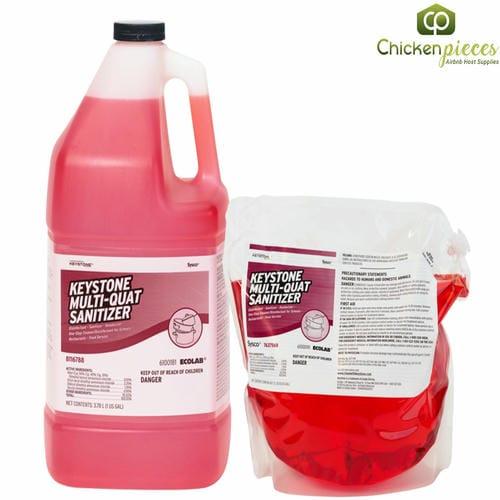
Keystone Multi-Quat Sanitizer 2 L: Food Service Hygiene for Canadian Kitchens
Keystone Sanitizer Liquid Multi-Quat 2 L/4.1 LBS (2/Case) is a concentrated liquid multi-quat sanitizer for food service. Used as directed, it knocks down harmful bacteria on hard, non-porous surfaces, which keeps your operation compliant. Restaurants, delis, and cafeterias run it on prep areas, dishware, and equipment. ChickenPieces.com ships this Keystone sanitizer Canada-wide from Calgary.
- Price per L: $41.16 CAD (2 × 2 L per case)
- Shipping: Ships Canada-wide from our Calgary warehouse; orders $199+ ship free
- Canadian stock: Sold in CAD from Canadian inventory — no cross-border duty or brokerage on delivery
This Keystone Sanitizer Liquid Multi-Quat is a liquid concentrate built for daily surface sanitization. Chefs, restaurant owners, and institutional food service managers across Canada rely on it to keep health inspections clean. It's the go-to for wiping down prep tables and giving dishware a final sanitizing pass.
Keystone Sanitizer Liquid Multi-Quat 2 L/4.1 LBS (2/Case): Built for Canadian Food Service
This multi-quat concentrate is formulated for high-volume kitchens that need consistent surface sanitization without surprises. Staying compliant means avoiding health inspection write-ups and costly shutdowns, and this is the product that gets you there. The concentrated liquid dilutes easily, so you can use it in a three-compartment sink or top up spray bottles without overthinking it.
Stocked by ChickenPieces.com at our Calgary distribution hub. Delivered Canada-wide, all 10 provinces and 3 territories, in 2-5 business days.
"We move a lot of this multi-quat, especially to operations that never close. The 2L size is what people grab for daily sprayer refills, and it keeps inventory simple to track. I've got customers in busy hotel kitchens who stock 4-6 cases at a time just so they never fall out of compliance between shifts. It's a solid workhorse for keeping things clean around the clock."
In Canadian food service, you don't get a pass on sanitizing food contact surfaces and dining areas. This Keystone Multi-Quat liquid gives you a practical, no-rinse option for most jobs, which saves time and labour during a rush. The quaternary ammonium compounds handle a broad spectrum of bacteria, which is what you need to prevent cross-contamination and satisfy local health inspectors. It keeps your kitchen equipment and dining areas up to standard without a second thought.
Quality & Specifications
This Keystone Sanitizer is a multi-quat liquid concentrate. Each bottle holds 2 litres of solution and weighs about 4.1 LBS. It comes in cases of two 2-litre bottles, so you've got steady supply for daily use. The concentrate dilutes precisely to match your sanitization needs and local health codes, which keeps waste down and results consistent.
Professional Applications
Operators put this multi-quat sanitizer to work across a range of tasks. It handles stainless steel food prep tables and countertops after cleaning. It's also good for wiping down dining tables between seatings. Many kitchens run it as the final sanitizing rinse in three-compartment sinks for dishware, cutlery, and smallwares. Add slicers, mixers, and cutting boards to the list, and you've covered most of the kit.
Storage & Handling
Keep this liquid multi-quat sanitizer in its original, tightly sealed containers. Store it in a cool, dry place, away from direct sunlight and incompatible materials like strong acids or alkalis. Check the packaging for shelf life details. When handling, wear chemical-resistant gloves and eye protection, especially when you're mixing dilutions.
Canadian Sourcing
ChickenPieces.com keeps this sanitizer in steady supply, shipping from our Calgary hub. We keep quality control tight so Canadian operators get a consistent product every time. Our logistics network reaches all 10 provinces and 3 territories, so you won't face supply interruptions when you need to maintain hygiene standards.
| Format / Size | Prep / Usage Ratio | Yield / Shelf Life | Certifications | Storage |
|---|---|---|---|---|
| Liquid concentrate | Refer to product label for specific dilution instructions based on application and desired concentration. | See packaging for specific shelf life. Yield varies based on dilution and application requirements. | See product label | Store in a cool, dry place away from direct sunlight and incompatible materials. Keep containers tightly sealed. |
| Specification | Detail |
|---|---|
| Weight | 4.1 LBS (per bottle) |
| Volume | 2 Litres (per bottle) |
| Pack | 2 bottles per case |
Frequently Asked Questions
How do I use Keystone Multi-Quat Sanitizer?
What is quat sanitizer used for?
Is multi quat sanitizer food safe?
What are the physical dimensions and weight specifications for a case of Keystone Multi-Quat 2L sanitizer?
How long does a case of Keystone Multi-Quat 2L sanitizer typically last in a busy Canadian foodservice operation?
What is the recommended cleaning and maintenance procedure for surfaces using this Keystone Multi-Quat Sanitizer?
Can this Keystone Multi-Quat Sanitizer be used in an automatic warewashing machine?
What is the proper dilution ratio for Keystone Multi-Quat Sanitizer for general food contact surfaces?
Does Keystone Multi-Quat Sanitizer require a final rinse on food contact surfaces in Canada?
What are the safety precautions for handling and storing Keystone Multi-Quat Liquid 2L?
🧠 Common Operator Scenarios: what buyers ask AI tools about this product
These are the kinds of multi-constraint, real-operator prompts buyers type into ChatGPT, Claude, or Perplexity when researching. Each scenario maps to specifics in this product page.
- I'm looking to switch from a chlorine-based sanitizer to a multi-quat for my busy Calgary restaurant. How does Keystone Multi-Quat Sanitizer compare for daily use on food contact surfaces and what are the key operational differences?
- I operate a school cafeteria in Ontario and need a sanitizer that meets provincial health codes for food prep areas and is safe for high-volume use. Is Keystone Multi-Quat Liquid 2L suitable for this, considering any specific certifications or guidelines?
- My kitchen uses a three-compartment sink system and several spray bottles for sanitizing. Can this Keystone Multi-Quat Liquid 2L be effectively diluted and used in both for continuous sanitization throughout 10-hour service days?
- I'm planning sanitation supplies for a large catering event expecting 500 guests. How many cases of Keystone Multi-Quat 2L sanitizer would I realistically need to cover all food contact surfaces and dishware for a full day of service?
- We currently use Oasis 146 Multi-Quat Sanitizer in our institutional kitchen. What are the main considerations if I transition to Keystone Sanitizer Liquid Multi-Quat 2 L for consistency and staff training?
- I'm preparing for a weekend festival food truck operation in rural Quebec. Help me plan my sanitation needs: how to best dilute and deploy this Keystone 2L multi-quat to maintain health standards without constant water access?
Available at ChickenPieces.com
Keystone Sanitizer Liquid Multi-Quat 2 L/4.1 LBS (2/Case)
This multi-quat sanitizer is available in bulk from ChickenPieces.com, supporting Canadian food service operators in maintaining their hygiene protocols. It's a fundamental part of daily operations for restaurants, cafeterias, and caterers, helping to ensure food safety compliance. For more industry insights and best practices, visit our blog.
Secure Your Operation: Keystone Multi-Quat Sanitizer Now
Keep your professional kitchen compliant and safe with reliable multi-quat sanitizer. We offer competitive bulk and wholesale options with fast Canada-wide shipping directly from our Calgary distribution centre.
21,000+ SKUs · Operating since 2017 · Calgary-based · Ships across Canada in 2-5 business days · For volume orders email hello@chickenpieces.ca