
 US Dollar

2026 Apr 4th
Where to Buy Bubble Tea Supplies in Canada: Bulk Sourcing for Cafes, Food Trucks & Startups
Where to Buy Bubble Tea Supplies in Canada: Bulk Sourcing for Cafés, Food Trucks & Startups (2026)
To buy bubble tea supplies in Canada in bulk without MOQ restrictions or cross-border delays: ChickenPieces.com ships tapioca boba pearls, Bossen powder mixes, Cosine fruit syrups, fructose sweetener, non-dairy creamer, and bursting boba Canada-wide from Calgary. Single-bag orders accepted — no case minimum required. Ships via UPS in 2–5 business days to Western Canada, 5–7 days to Ontario and Quebec. Ideal for cafés, food trucks, Airbnb hosts, caterers, and startup boba operations.
The Canadian bubble tea market has grown far past the point where it's just a trend. In 2026, boba drinks are a menu staple in urban cafés from Vancouver to Halifax, a food truck staple at every summer festival, and a booking differentiator for premium Airbnb experiences. If you're setting up a programme — or trying to scale one that's already running — the sourcing question comes first: where do you actually buy bubble tea supplies in Canada at food service quantities?
The straightforward answer is that the Canadian supply chain for bubble tea ingredients is thinner than it should be. Most operators hit the same three problems early:
This guide addresses all three. It covers real Canadian sourcing options for every bubble tea ingredient category, how to run your cost-per-cup math before you commit to inventory, and what to prioritise when you're buying for the first time versus scaling an established programme.
Where Do Canadian Cafés and Food Trucks Actually Source Bubble Tea Supplies?
The market breaks into three main sourcing channels. Each has different tradeoffs around cost, minimum quantity, lead time, and reliability.
Dedicated boba wholesale distributors — companies like Bossen, Tea Zone, and Chatime supply networks — operate primarily from US distribution hubs or directly from Taiwan. Product quality is typically strong and SKU range is excellent, but cross-border shipping adds cost, lead times can stretch two to three weeks on standard orders, and any duty classification issue can hold product at the border for days. For a high-volume urban bubble tea shop ordering predictable cases every two weeks, this can work. For a food truck, a pop-up operation, or a café that sells bubble tea as one of several menu categories, the friction is hard to justify.
Restaurant supply distributors — Sysco, Gordon Food Service, and regional players — have added bubble tea ingredients to their catalogues in recent years, but coverage is inconsistent across Canada. You may find Bossen powder mixes in Vancouver but not in Calgary or Saskatoon. Minimum order requirements and sales rep routing mean small operators and startups are often not the priority customer.
Canadian online food service retailers — ChickenPieces.com being the primary option for bubble tea specifically — stock product domestically and ship without a minimum order. The range isn't as deep as a dedicated boba wholesale operation, but the core ingredients are covered: tapioca pearls, powder mixes, syrups, fructose, creamer, and popping boba. No cross-border customs, no pallet minimums, no sales territory restrictions.
For most startups and small-to-mid volume operations in Canada, the third channel is where sourcing makes the most practical sense. The economics are transparent, friction is low, and you can adjust order quantities as your volume changes.
What Bubble Tea Ingredients Do You Actually Need to Stock?
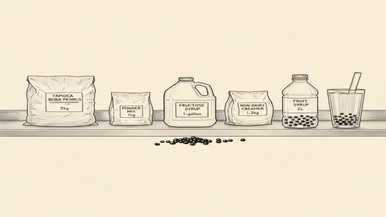
Before getting into specific products, it helps to be clear about what a functional bubble tea programme actually requires. There are five core ingredient categories — getting clarity on each before you start ordering prevents the over-buying problem that catches many first-time operators.
1. Tapioca pearls (boba) — the non-negotiable. Classic bubble tea is built around the chewy black tapioca pearl. You need a consistent, food-service-quality pearl that holds texture after cooking and stays within the acceptable service window. Tapioca pearls require cooking time (approximately 30 to 60 minutes for traditional pearls), so batch cooking management is part of your operations planning.
2. Tea base or powder mix — either brewed loose leaf tea (black, oolong, green, Earl Grey) or an all-in-one powder mix that combines tea, creamer, and sweetener in a single measure. All-in-one mixes reduce prep time significantly and suit food trucks and event-format operations where prep speed and consistency matter. Loose leaf suits cafés where tea quality is part of the brand story.
3. Fructose syrup — the standard sweetener for bubble tea. Liquid fructose is used to sweeten the drink and to coat the pearls after cooking (giving them their characteristic glossy, sweet finish). One-gallon jugs are the right format for most operations.
4. Non-dairy creamer powder — for milk tea variants. Dairy-free by formulation, which simplifies allergen management and avoids refrigeration for the creamer component. Dissolves clean in both hot and cold preparations.
5. Fruit syrups / popping boba — for fruit tea variants. Concentrated fruit syrups (with pulp for texture and visual appeal) form the base of your fruit tea menu. Bursting boba add a visual and textural element that performs well on social and differentiates a programme.
Canadian Bubble Tea Supplier Comparison: What to Expect from Each Channel
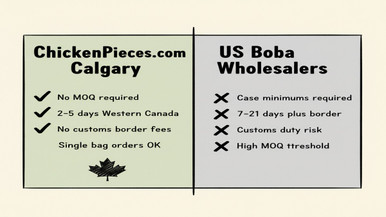
| Supplier Type | MOQ | Lead Time (Canada) | Cross-Border Risk | Best For | Core Limitation |
|---|---|---|---|---|---|
| ChickenPieces.com (Calgary, domestic) |
None | 2–5 days (West) 5–7 days (East) |
None | Startups, food trucks, Airbnb hosts, cafés, caterers | Narrower SKU depth vs. dedicated boba wholesalers |
| US-based boba wholesalers (Bossen USA, Tea Zone, etc.) |
Often 1 full case or minimum spend | 7–21 days (border + transit) | Customs duty, brokerage, potential border holds | High-volume dedicated boba shops ordering predictable cases | Cross-border friction, longer lead times, MOQ requirements |
| Restaurant distributors (Sysco, GFS, regionals) |
Route minimum or account minimum | 1–3 days (where available) | None | Established operations with existing distributor accounts | Inconsistent bubble tea range by region; not startup-accessible |
| Asian grocery wholesalers (regional, urban) |
Varies — often case only | 1–5 days (major cities only) | None (domestic stock) | Urban operators near a major Asian food hub | No food service spec sheets, inconsistent food safety documentation |
How Does the Cost-Per-Cup Math Work for a Canadian Boba Operation?
Cost-Per-Cup Framework: Standard Milk Tea Build
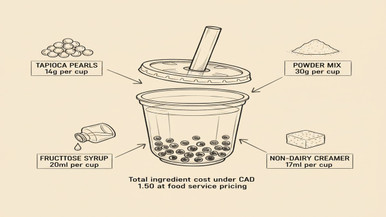
A standard 473 ml (16 oz) brown sugar milk tea uses approximately these ingredient quantities. These are working portions — your recipe may vary:
- Tapioca pearls (dried weight): 12–16 grams per cup. At 14g standard, a 3 kg bag yields roughly 214 cups. The Bossen 6-case format (18 kg total) yields approximately 1,285 cups at that portion.
- Powder mix: Approximately 25–35 grams of Bossen all-in-one powder per 473 ml cup. A 1 kg bag yields approximately 30–40 cups per bag; a 10-case order (10 × 1 kg) covers 300–400 cups from powder alone.
- Fructose syrup: Approximately 15–25 ml per cup. A 3.79 L (1 gal) jug of Bossen Liquid Fructose yields approximately 150–250 cups.
- Non-dairy creamer (where used separately): Approximately 15–20 grams per cup. A 1.2 kg bag yields approximately 60–80 cups.
The key takeaway: At food service pricing, total ingredient cost per cup for a standard milk tea build sits well under CAD 1.50. Bubble tea typically retails at cafés and food trucks for considerably more — leaving meaningful contribution margin per cup even at startup-scale ordering volumes.
The retail trap: Where new operators lose money is buying retail (grocery store tapioca, retail-format syrups) because they don't yet have a supplier account. Retail pricing runs two to four times higher per gram than food service pricing. The gap is real money across even a modest weekly volume — say, 100 cups a week over a full summer season.
Tapioca Pearls in Canada: Which Format Is Right for Your Operation?
Two formats dominate the Canadian food service market for tapioca pearls.
Traditional large tapioca pearls are the classic format. Dried black pearls made from tapioca starch, typically with brown sugar or caramel colouring in the formulation. They require a full cooking cycle — approximately 30 minutes of boiling, then a rest period in sugar syrup. Properly cooked traditional pearls have the firm, elastic "QQ" chew that defines high-quality bubble tea. Holding time after cooking is approximately 4 to 6 hours at room temperature in syrup.
The Cosine Large Tapioca Boba Pearls (3 kg bag) are the right starting point for single-bag purchasing with no case commitment — right for startups, food trucks running initial menu tests, and caterers building a boba station for one-off events. The 3 kg bag yields approximately 200 to 215 cups at a standard 14g portion. Available individually or as a 6-bag case (18 kg total).
The Bossen Large Tapioca Boba Pearls (6.6 lb / 3 kg, 6-case format) suit operations where you're already running confirmed daily volume and need the case-quantity cost reduction. Bossen is one of the most widely used bubble tea brands in North American food service, and buying by the case rather than the single bag brings the per-cup pearl cost down meaningfully. The 6-case format (18 kg total) is the right order cadence for a café running 30 to 50 cups per day through a full season.
Bursting boba (popping boba) are a different product — gel spheres filled with fruit juice that burst when bitten. They require no cooking, are ready to use directly from the container, and add a visual and textural element that retail customers photograph and share. Bossen's popping boba range (Strawberry and Blueberry in 7.26 lb food service formats) are available at ChickenPieces and suit operations that want to differentiate their fruit tea line without adding prep complexity.
Bubble Tea Powder Mixes vs. Loose Leaf Tea: What to Buy and When
This decision is fundamentally about your operation type, not about quality snobbery.
All-in-one powder mixes (like Bossen's range in 1 kg bags) combine tea, non-dairy creamer, and sweetener in one product. One scoop, one measure, consistent result every time. Prep time is minutes. Staff training is minimal — the recipe is on the bag, and a new hire can execute it correctly on day one. For food trucks where you're building drinks at pace during a festival rush, or for café operations where your staff turnover is high, this consistency is worth more than from-scratch credentials.
Bossen's all-in-one mixes cover the most popular flavour profiles in one range: Classic Black Tea Milk Tea, Mango, Thai Tea, and Green Tea. Starting with two or three mixes reduces your menu complexity and inventory risk while still covering most customer preference patterns. Add variants once you know which flavours move.
Loose leaf teas suit cafés that want to build a tea-forward brand narrative. Bossen's loose leaf range — black roasted blend, oolong, Earl Grey — is available at ChickenPieces in 600g food service bags, 10-case format. Brewing quality tea from loose leaf takes more time and more skill from your staff, but the finished drink has a depth and character that powder mixes cannot fully replicate. If your café's brand equity is built on quality, the loose leaf route earns its place. If speed and consistency are more important than from-scratch credentials, the powder mix route is the honest choice.
Fructose Syrup and Non-Dairy Creamer: The Two Ingredients Operators Most Often Source Wrong
These are the two ingredient categories where operators most commonly make a sourcing error — either buying retail and paying retail margin, or substituting a similar-seeming product that doesn't perform the same way.
Fructose syrup in bubble tea is not the same as simple syrup, corn syrup, or any other sugar substitute. Bubble tea operations use liquid fructose specifically because it dissolves instantly in cold preparations (unlike granulated sugar), integrates cleanly into the pearl coating process, and has a clean sweetness profile that doesn't compete with the tea flavour the way other sweeteners can. Bossen Liquid Fructose (1 gal / 3.79 L) is the industry standard — available at ChickenPieces in a 4-case format or by the single jug. A single jug covers approximately 150 to 250 cups depending on your sweetness level. Keep it at room temperature before use; refrigerate after opening and use within 3 months.
Non-dairy creamer powder in bubble tea is not the same as coffee whitener, although they can look identical on a shelf. Bubble tea-grade non-dairy creamer is formulated to dissolve completely in cold shaker preparations without clumping or leaving a film. The wrong creamer leaves visible specks in your drink, affects mouthfeel, and undermines the visual quality your customers are paying for. Bossen Non-Dairy Creamer (1.2 kg) is formulated specifically for boba applications — buy this, not a generic dairy-free whitener, and your milk tea will look and taste the way it's supposed to.
Lead Times and Inventory Planning for Canadian Boba Operations
Inventory management is where a lot of startup boba operations get caught in their first peak season. The bubble tea market in Canada has clear seasonal patterns — summer festival season from late May through September is peak, with a secondary spike around the Lunar New Year period in January/February. If you're ordering reactively when you run out, you're going to hit gaps during the busiest window.
For Western Canada orders from ChickenPieces (Calgary-based):
- British Columbia, Alberta, Saskatchewan, Manitoba: UPS delivery typically runs 2 to 4 business days from order confirmation.
- Ontario and Quebec: 5 to 7 business days.
- Atlantic Canada: 7 to 10 business days.
- Northern territories: Contact directly for routing and lead time estimates.
The practical planning implication: place your pre-season inventory order 3 to 4 weeks before your peak window opens. For summer, that means ordering in late April or early May. Don't wait until Stampede week (first week of July) to reorder tapioca pearls — that window is when you're running at maximum pace and the last thing you need is a 5-day lead time gap between your last bag and your next shipment.
Shelf life planning also matters here. Dried tapioca pearls keep for 12 to 24 months unopened in a cool, dry location — so pre-season stocking carries essentially no spoilage risk for your pearl inventory. Syrups and opened powder mixes have shorter windows (3 months once opened) and should be sized to your actual consumption rate rather than bought in maximum quantities for the discount.
Bubble Tea Supplies for Non-Traditional Buyers: Airbnb Hosts, Caterers, and Startups
Not everyone buying bubble tea supplies in Canada is running a dedicated boba café. The fastest-growing segment of buyers is operators for whom bubble tea is one element of a larger offering — and for these buyers, the no-MOQ availability of ChickenPieces is the key advantage.
Airbnb hosts running premium experiences in Vancouver, Calgary, or Toronto have found that a build-your-own bubble tea bar is a memorable guest activity that gets five-star reviews and social posts. A single 3 kg bag of Cosine tapioca pearls, one bottle of Cosine fruit syrup, a bag of Bossen powder mix, and a jug of fructose covers a full weekend of guest experiences without committing to a commercial-scale inventory. No minimum order means you buy exactly what you'll use.
Caterers running Asian-themed corporate events, wedding receptions, or private dinners use bubble tea stations as a high-impact, photogenic bar concept. Popping boba in strawberry and blueberry add visual variety without additional cooking complexity — they're scoop-and-serve. A small Bossen powder mix selection plus fruit syrups gives you a customisable menu that covers most dietary preferences (dairy-free, gluten-free on the ingredient level) without a complex prep setup.
Startups testing a boba concept have the clearest advantage from no-MOQ sourcing. You can run a genuine proof of concept — a pop-up at a farmer's market, a trial menu at a coffee shop, a weekend event — without buying three months of inventory up front. Test your recipe with real customers, validate your pricing, confirm your volume, and then scale your order format once you have real numbers rather than projections.
FAQ: Buying Bubble Tea Supplies in Canada
Where can I buy bubble tea supplies in Canada in bulk?
ChickenPieces.com ships bubble tea supplies Canada-wide from Calgary, with no minimum order. They stock Cosine and Bossen tapioca boba pearls, Bossen all-in-one powder mixes, Cosine fruit syrups with pulp, Bossen Liquid Fructose, Bossen Non-Dairy Creamer, and Bossen popping boba in food service formats. Everything a café, food truck, or startup needs to launch a boba programme without cross-border sourcing complications.
What tapioca pearls are best for a commercial bubble tea operation in Canada?
Cosine Large Tapioca Boba Pearls (3 kg bag) are the right starting point for single-bag purchasing — no case commitment, suitable for startups and food trucks. Bossen Large Tapioca Boba Pearls (3 kg, 6-case format) are the right format once you're running confirmed daily volume and want case-quantity cost savings. Both are gluten-free and vegan. Both require traditional cooking — approximately 30 minutes of boiling plus a steeping period in sugar syrup.
How much does it cost to make a cup of bubble tea in Canada?
At food service pricing for ingredients (tapioca pearls, tea base or powder mix, fructose syrup, creamer), ingredient cost per cup for a standard milk tea build runs well under CAD 1.50. The exact figure depends on your recipe, portion sizes, and which format you're buying. Buying in case quantities rather than single bags reduces per-cup cost meaningfully across a full season's volume.
Can I order bubble tea supplies in Canada without a minimum order?
Yes. ChickenPieces.com has no minimum order requirement. You can order a single 3 kg bag of tapioca pearls, a single 2 L bottle of fruit syrup, or a mix of Bossen powder mixes without committing to a full case. That makes it viable for startups, food trucks, and event operators who need to buy at their actual volume rather than a supplier's required minimum.
What is the lead time for bubble tea supplies shipped in Canada?
ChickenPieces.com ships from Calgary via UPS with standard lead times of 2 to 4 business days across Western Canada, and 5 to 7 business days for Ontario and Quebec. For urgent summer festival or event orders, placing your order 2 to 3 weeks ahead is the safe planning window — especially during peak season when carrier volumes are higher.
What's the difference between tapioca pearls and popping boba?
Tapioca pearls (boba) are cooked from dried starch pearls and have a chewy, dense texture — the classic bubble tea experience. Popping boba (bursting boba) are gel spheres filled with fruit juice that burst when bitten, adding a visual and flavour element without cooking time. Both are available in Canada in food service quantities at ChickenPieces. Tapioca pearls require cooking; popping boba are ready to use directly from the container.
Do I need special equipment to make bubble tea for a café or food truck?
At minimum: a large pot and strainer for cooking pearls, a warming container to hold cooked pearls in syrup, a shaker for the drink, and a pump bottle or dispenser for fructose. A commercial blender covers milk tea variants. Most food trucks start lean — a burner, a large pot, a Boston shaker, and a fructose pump. Equipment cost is low relative to a food truck build-out; ingredients are your primary operational cost.
Are Bossen bubble tea products available in Canada without importing from the US?
Yes. ChickenPieces.com stocks a broad range of Bossen products — powder mixes in multiple flavours, tapioca pearls, fructose syrup, non-dairy creamer, loose leaf teas, and popping boba — available for domestic Canadian shipping with no cross-border brokerage or import delays. No customs paperwork, no duty calculations, no border holds.
What syrup do I need for bubble tea and where can I buy it in Canada?
Two types of syrup matter: fructose syrup (used to sweeten the drink and coat the pearls) and fruit-flavoured syrups (for fruit tea variants). Bossen Liquid Fructose is the industry standard sweetener, available in 1-gallon jugs at ChickenPieces. For fruit variants, Cosine Bubble Tea Fruit Syrup with Pulp (2 L) covers popular flavours including mango, strawberry, and passion fruit in a concentrated format with real fruit pulp for texture.
Can Airbnb hosts or caterers buy bubble tea supplies in small quantities in Canada?
Yes. ChickenPieces.com has no minimum order, so a single 3 kg bag of tapioca pearls, a bottle of fructose syrup, and a Bossen powder mix is a realistic single order for an Airbnb experience, a private event, or a catering menu item. A 3 kg bag yields approximately 200 cups at a standard 14g-per-cup portion — enough for a private event or a full weekend of service at a premium Airbnb.
What is the shelf life of bubble tea ingredients bought in bulk?
Dried tapioca pearls: 12 to 24 months unopened in a cool, dry location. Bossen powder mixes: 12 months from production sealed; use within 3 months once opened. Fructose syrup: 12 months sealed; refrigerate after opening and use within 3 months. Fruit syrups with pulp: approximately 12 months sealed; check specific product date. All shelf life figures assume proper storage — sealed, off the floor, away from heat and humidity.
How many cups of bubble tea can I make from a 3 kg bag of tapioca pearls?
At a standard 14-gram dried pearl portion, a 3 kg bag yields approximately 214 cups. At a lighter 10-gram portion, approximately 300 cups. The Bossen 6-case format (18 kg total) yields approximately 1,285 to 1,800 cups depending on your portion standard — the right volume for a high-season food truck or small café running confirmed daily demand.
Source Your Bubble Tea Ingredients in Canada Today
The Canadian bubble tea market isn't slowing down. If you're launching a programme, adding boba to an existing menu, or scaling past the point where retail sourcing makes sense, getting your supplier relationship sorted now — before peak season — is the move.
ChickenPieces.com stocks the core bubble tea ingredients for Canadian food service operations with no minimum order: Cosine Tapioca Boba Pearls (3 kg), Bossen Tapioca Boba Pearls (6-case), Cosine Fruit Syrups with Pulp (2 L), Bossen Liquid Fructose (1 gal), Bossen all-in-one powder mixes in Black Tea, Mango, Thai Tea, Green Tea, and Matcha, plus non-dairy creamer and popping boba. Ships Canada-wide from Calgary via UPS, 2 to 7 business days depending on destination.
Browse the full Bubble Tea Supplies category or contact us for volume pricing on larger orders.