A no-rinse quaternary (quat) sanitizer bay in a three-compartment sink is normally run at about 200 ppm, the working target most food-contact quat labels are built around (health guidance commonly accepts a 150 to 400 ppm band, depending on the product and local code). To hit roughly 200 ppm, most concentrates dose in the region of 2 to 5 mL per litre of water, about 0.25 to 0.7 US fl oz per gallon, but the registered label on the jug in your hand is the exact, legal instruction. ChickenPieces.com stocks quaternary and low-temp concentrates in litre formats and ships them from Calgary with no minimum order.
Quat Sanitizer PPM for a 3-Compartment Sink: A Guide
The working PPM target for a quat sanitizer bay, and how to test it in a three-compartment sink.
A no-rinse quat sanitizer bay in a three-compartment sink is normally run at about 200 ppm, the working target most food-contact quat labels are built around. Health guidance commonly accepts a 150 to 400 ppm band, depending on the product and local code. Test the bay with strips, and dose from the label, not from memory.
Sanitizer calculator
Quat dilution for a three-compartment sink
Enter the sanitize-bay volume, your target PPM, and the active quat percent from the product label. The result is the amount of concentrate to add to that bay.
Enter a volume, a target PPM, and the label percent to see how much concentrate to add.
Always confirm with a quat test strip and the product label. This calculator applies the dilution arithmetic only. The registered label on the jug in your hand is the legal instruction, and a test strip tells you what the bay is actually running.
How this is calculated
Parts per million is milligrams of active sanitizer per litre of finished solution. That is the same as the volume fraction of concentrate, multiplied by the active strength as a decimal, multiplied by 1,000,000.
Rearranged for a kitchen pour, and with volume entered in litres, the dose is:
mL of concentrate = (target PPM × litres of water) / (active percent × 10)
US gallons are converted first, using 1 US gallon = 3.785411784 litres. Fluid ounces are converted from millilitres using 1 US fl oz = 29.5735295625 mL.
Worked example. A 20 L sanitize bay, a 200 ppm target, and a 10% active concentrate:
mL = (200 × 20) / (10 × 10) = 4000 / 100 = 40 mL
40 mL is 1.35 US fl oz. To check the other direction: 40 mL of a 10% concentrate in 20 L (which is 20,000 mL) is (40 / 20,000) × 0.10 × 1,000,000 = 200 ppm.
The same 10% concentrate at 200 ppm is 2 mL per litre, which sits at the mild end of the 2 to 5 mL per litre band described in this guide. A 4% concentrate at 200 ppm would be 5 mL per litre. Your jug may differ, so use the percent on its label.
Start here
What concentration does the sanitizer bay actually need?
Most guides hand you the wash to rinse to sanitize ritual and the compartment order, then skip the one number you need to buy the chemical: the target concentration. For a no-rinse quaternary sanitizer used on food-contact surfaces, that target is about 200 parts per million. Canadian and North American food-safety guidance typically accepts a band of roughly 150 to 400 ppm depending on the manufacturer's instructions and the local health code, with the sanitized surface kept visibly wet for the label's minimum contact time, commonly around one minute, before air drying.
Say this plainly: the registered label on the container in your hand is the instruction that counts. Chemistry and water hardness differ, and a label range exists because the manufacturer tested it. Use the figures here to check that your label reads like others in the category, then dose to your own label and verify.
How many ounces of concentrate go into a gallon of water?
To reach roughly 200 ppm, most food-contact quat concentrates dose somewhere in the region of 0.25 to 0.7 US fluid ounces per US gallon, which is about 2 to 5 mL of concentrate per litre of water. The exact figure depends on the product's active strength, which is why two similar quat concentrates can call for slightly different pours to land on the same ppm.
Metric matters more than most operators expect, because these concentrates are sold in litre formats. One US gallon is 3.785 litres and one US fluid ounce is 29.57 millilitres, so 0.25 oz per gallon works out to about 1.95 mL per litre and 0.67 oz per gallon to about 5.2 mL per litre. Do the conversion once against your own label and tape it above the bay.
How many sink fills does one case actually give you?
This is the number that turns a dilution rate into an order quantity, and it is pure arithmetic once you know your dose. Work an illustrative example. A two-unit case of 3.78 L concentrate holds 7.56 L, or 7,560 mL. Dose at the weak end of a typical band, roughly 2 mL per litre of water, and that case makes about 3,780 L of finished solution. A ten US gallon sink bay is 37.85 L, so the case covers close to 99 fills. Dose at the strong end, about 5.2 mL per litre, and the same case makes roughly 1,454 L, or about 38 fills.
That spread, a two-and-a-half-fold swing across one label's own range, is the argument for measuring rather than free-pouring. Run the same division against your product's stated dose to get your real number. Chemical yield is only half the picture for a manual warewash line; the detergent bay has its own cost behaviour, which we break down in our guide to manual dish detergent cost per sink turn.
Sanitizer concentrates at a glance
| Product | Type | Unit size | Best for |
|---|---|---|---|
| Clean Essential No-Rinse Sanitizer | Quaternary | 3.78 L ×2 | General sink and bucket duty |
| Avmor Sani Stuff Concentrate | Quaternary | 4 L ×2 | Single-chemistry sites |
| Clean Quick Quick Cleaner Concentrate | Quaternary | 3.78 L ×3 | Higher-turn kitchens |
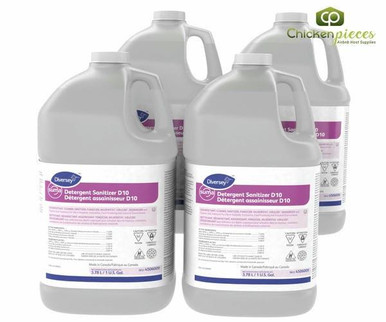
| Diversey Food Surf D10 | Quat sanitizer-detergent | 2.5 L ×2 | One-step food-contact surfaces |
| SUMA Low Temp T20 | Low-temp machine sanitizer | 3.78 L ×4 | Low-temperature dish machines |
| Ecolab 147 Multi Dispenser | Quaternary, dispenser-fed | 9.5 L ×1 | Wall-dispenser programmes |
| Diversey Chlorine Test Strip | Verification (chlorine only) | 1 unit | Chlorine bays, not quat |
Formats reflect current catalogue listings. This is a format and chemistry comparison, not a price list, live pricing is shown on each product page and shipping is quoted on real carrier rates at checkout.
Why a sani bucket stretches a case further
Working kitchens raise this point often, and the arithmetic backs it up: a wiping bucket holds a few litres where a three-compartment sink bay holds tens of litres, so at the same concentration a bucket change consumes a small fraction of the concentrate a full fill does. Crews that run disciplined bucket changes and fill the bay only for real warewash cycles go through cases far more slowly.
Test strips: what to verify with
The correct practice for a quat bay is to verify concentration with quat-specific test strips at every fill and log the reading. We will give you that advice and then tell you straight: our test-strip listing is the Diversey Chlorine Test Strip, which reads chlorine. A chlorine strip will not give a valid quat reading, and using one on a quat bay produces a number that looks like verification and is not. If your operation runs chlorine sanitizer, that listing is the right product. If you run quat, buy quat strips from your chemical representative or a lab supplier, and keep them in a dry drawer rather than the splash zone where humidity degrades them.
What gets an operator written up at the sink?
Four recurring mistakes come up again and again. Washing produce in the sanitizer bay: a no-rinse quat is labelled for food-contact surfaces, not for produce, which belongs in a designated prep sink with a product labelled for that job. Thawing or storing product in the sanitizer bay: that bay has one function, and using it for anything else breaks the compartment logic and invites a citation. Treating a hand-dip as a substitute for handwashing after raw-protein prep: a dip supplements a proper handwash at a dedicated sink, it never replaces it. And running the bay off-label on temperature: follow the minimum temperature on the label, because efficacy claims are tied to the tested conditions.
US operators map these back to the FDA Food Code and the EPA registration on the label. Canadian operators work to their provincial food-premises regulation with the product's Health Canada registration, so confirm the product is registered for food-contact sanitizing before you standardise on it.
How it works in Canada
Buying from a Canadian distributor keeps the supply chain short and the paperwork simple. ChickenPieces.com stocks quaternary sink concentrates, low-temp machine sanitizers and dispenser-fed units, and ships them Canada-wide from our Calgary warehouse with no minimum order, so you can trial a single case before committing a group of sites, and reorder against real usage. Shipping is quoted on live carrier rates at checkout rather than baked into unit prices.
What Canadian operators say
"ChickenPieces shipped to our Calgary cafe inside 48 hours, pricing beat our previous supplier on the bulk shortening line. Already reordered."
CP Buying Desk, Alberta · Alberta (Calgary)
"Switched our Mississauga commissary to CP for syrups and cleaners. Spec sheets arrive with the order, no chasing. Solid for GTA foodservice."
Giselle R., Ontario · Ontario (Toronto)
"Vancouver hotel pantry switched to CP bubble-tea and concession supplies. No membership, transparent pricing, Canada-wide delivery worked for us."
Front-of-house buyer, BC · British Columbia (Vancouver)
Trust the strip, not the last pour
Quat and chlorine sanitizers

Item ID 7425132987945. Quat sanitizer, 3.78 L jug, 4 per case.

Item ID 6010854889878. Quat sanitizer concentrate, 4 L jugs, 2 per case.

Item ID 7425142115109. Detergent sanitizer concentrate, 3.78 L closed loop.

Item ID 7425129214245. Liquid chlorine sanitizer concentrate, 3.78 L.

Item ID 6010856697648. Chlorine test strips for sink and bucket checks.
Cases ship to Canada and the US at live UPS rates. Pallets and frozen products ship within Canada only. Free shipping over $199 CAD is Canada only.
Frequently asked questions
What is the required PPM for quat sanitizer?
A no-rinse quat sanitizer bay in a three-compartment sink is normally run at about 200 ppm, the working target most food-contact quat labels are built around. Health guidance commonly accepts a 150 to 400 ppm band, depending on the product and local code. Always follow the label and your inspector’s requirement. See this quat PPM guide.
What PPM does quat sanitizer need to be?
For food-contact quat in a three-compartment sink, 200 ppm is the usual target. Single-quat solutions are often aimed at 200 ppm, and some multi-quat labels use a 200 to 400 ppm range. Local health codes and the product label decide the exact band, commonly around 150 to 400 ppm. Test the sink with the right quat test strips, not a guess.
How do you test quat sanitizer concentration?
Use quat test strips made for that sanitizer, dip them in the sink, and read the PPM against the chart. Retest during the shift, because food soil can bind quat and drop the reading. If it falls below about 200 ppm, change the solution. Follow the strip and the label, not a spoon measure.
What sanitizer is used in a 3-compartment sink?
The third bay is typically a no-rinse quat sanitizer mixed to the label’s food-contact PPM, usually about 200 ppm. A 3.78 L no-rinse quat and other labelled concentrates are used for that bay. Wash and rinse still come first. Confirm the mix with quat test strips during the shift.
What happens if quat sanitizer PPM is too high?
If the solution is stronger than the label and local code allow, it can leave residue, irritate skin, and fail an inspection just as a weak solution can. The usual food-contact target is about 200 ppm, with a broader 150 to 400 ppm band on some labels. Dump an over-strong sink, remake it, and test again before dishes go in.
What is the difference between quat and chlorine sanitizer?
Quat and chlorine are different chemistries, with different test strips, mix rates and limits. This guide describes a no-rinse quat sink at about 200 ppm. Do not use chlorine strips on a quat sink, and do not copy a chlorine recipe onto a quat label. Read the SDS and the bottle in front of you.
Is quat sanitizer safe for food-contact surfaces?
Yes, when you use a product labelled for food-contact surfaces and mix it to the stated PPM, usually about 200 ppm in a no-rinse three-compartment sink. No-rinse quat concentrates are made for that job. Follow the label, local code, and your SDS. Rinse is not a substitute for the correct concentration.
How often should you change quat sanitizer solution?
Change the sink when test strips show the PPM has dropped, when the water is dirty, or when your health department’s schedule says to. Food soil can bind quat and pull the reading below about 200 ppm. Remake the solution and test it before the next rack. Keep a written log if your inspector requires one.
What is quat binding?
Quat binding happens when food soil, grease or some cloths tie up quat molecules so the solution tests weaker than when you mixed it. The sink can look fine and still sit below about 200 ppm. Retest during the shift and change the solution when the reading drops. Clean first, then sanitize.
How much quat do you add per litre of water?
There is no single household spoon measure that works for every quat. Concentrates differ, so the only safe method is the dilution on that product’s label, mixed to the food-contact target, usually about 200 ppm, and checked with quat test strips. Ignore generic “tablespoon per litre” advice. If the reading is off, remake the sink from the label.
Why Partner With ChickenPieces
Chicken Pieces is a Calgary foodservice, hospitality and medical supply company founded in 2018, with about 20,000 products in the online catalogue. We supply pantry ingredients, medical nutrition and kitchen supplies. We are not a poultry or meat distributor.
Local Calgary Support
Real people in Calgary answer the phone and check labels, pack sizes and stock for you.
Wide Product Range
Pantry staples, medical nutrition, disposables, janitorial and concession supplies from one supplier.
No Membership Needed
Order by the case or the pallet with no membership and no minimum order quantity.
Food Safe Focus
We write for operators working under CFIA and Health Canada aware food safety plans.
Request Your Custom Quote Today
Call 1-833-462-8550 or shop chickenpieces.com. Browse Kitchen supplies for the full range.
Request a Quote