

2026 Sep 1st
Evaporated vs Sweetened Condensed Milk: A Steam Table Sur...
Evaporated milk is the only canned dairy that survives a 165°F steam table for a full service window — its proteins were pre-stressed by retort sterilization, so a cream sauce built on it holds four hours where fresh milk splits inside one. Sweetened condensed milk is a different product entirely: it carries roughly nine times the sugar and belongs in desserts and coffee, never in a savory pan. Stock both, label the cases, and keep them away from kitchen heat.
Evaporated vs Sweetened Condensed Milk: A Steam Table Survival Guide
Why cream sauces built on fresh milk break by minute forty, how evaporated milk buys you a four-hour service window, and the one can-swap mistake that has ruined more banquet sauces than any burner ever did.
Six things to know before the next banquet service
Fresh milk fails hot service
On a 165°F steam table, fresh-milk cream sauces show visible curdling by minute forty. The proteins unwind, clump, and the sauce turns grainy and unserviceable.
Evaporated milk is pre-stressed
Retort sterilization and homogenization at the cannery put the proteins through heat before you ever open the can — so long service does not break them again.
Sweetened condensed is not a substitute
Roughly 225 g of added sugar per 300 mL can versus about 25 g of natural lactose in evaporated milk. One wrong grab and the chowder tastes like caramel.
Label the cases by colour
Green dot on evaporated for savory lines, red dot on sweetened condensed for dessert prep. A dot of tape at receiving beats retraining every new hire.
Storage location matters
Ambient heat near steam kettles triggers irreversible Maillard darkening inside the can — and a browned white sauce cannot be fixed. Keep cases cool and dry.
Case packs ship from Calgary
ChickenPieces stocks 24 and 48-can foodservice cases in our Calgary warehouse and ships Canada-wide on live carrier rates, with no minimum order.
Why fresh milk dies on a steam table
The failure is chemistry, not technique — and no amount of whisking prevents it.
Every banquet cook has watched it happen. The cream sauce goes into the hotel pan glossy and smooth, service opens, and somewhere around minute forty the surface turns matte. By the one-hour mark there are grains in the ladle. The sauce has not burned and nobody did anything wrong — the milk itself gave out.
Fresh milk proteins are folded structures, and sustained heat at steam table temperatures makes them unwind. Once unwound, they find each other and clump. That clumping is the split: the water phase separates, the protein forms grit, and the sauce is unserviceable. On a stovetop you control this with short exposure and constant movement. A steam table offers neither — it is hours of steady heat with occasional stirring, which is close to a worst-case scenario for fresh dairy.
We've seen this fail hardest at festival and stampede catering, where a macaroni sauce has to survive from the 11 a.m. load-in to the 3 p.m. rush. The operator who builds that sauce on fresh milk rebuilds it twice per shift. The operator who builds it on evaporated milk stirs it occasionally and goes back to the grill.
How evaporated milk is built for heat
The can has already done the hard work your steam table would otherwise do destructively.
Evaporated milk starts as ordinary milk that has roughly 60% of its water removed by vacuum concentration. Vacuum matters: the water leaves at low temperature, so the milk concentrates without picking up a scorched flavour. What remains is a dairy base about 2.25 times more concentrated than fresh milk — which is why undiluted evaporated milk makes cream soups and pan sauces taste richer without any added thickener.
Then comes the step that makes it steam-table-proof. The sealed cans are retort sterilized — cooked under pressure — and the milk is homogenized. Together these processes pre-stress the proteins: they have already been pushed through the heat transition that ruins fresh milk, and they came out stable. When that milk later sits in a 165°F hotel pan, there is nothing left to unwind. The practical result is a stable four-hour service window, against less than one hour for fresh milk.
That window changes how a line runs. Cream chowders on a banquet line stop needing a mid-service rebuild. Béchamel for a two-hundred-cover Sunday brunch gets made once, at 8 a.m., and serves until close. The sauce you taste at hour three is the sauce you tasted at hour one.
| Attribute | Evaporated Milk | Sweetened Condensed Milk | Fresh Milk |
|---|---|---|---|
| Sugar per 300 mL | ~25 g natural lactose | ~225 g added sugar | ~14 g natural lactose |
| Texture | Thin, pourable | Thick, syrupy | Thin, fluid |
| Flavour profile | Savory, creamy, lightly nutty | Intensely sweet, caramel notes | Neutral, fresh |
| Steam table hold | Stable through 4-hour window | Not for savory service | Splits in under 1 hour |
| Best uses | Soups, sauces, coffee, quiche | Fudge, caramel, pies, Vietnamese coffee | Cold applications, finishing |
| Unopened shelf life | About 12 months | About 24 months | Days, refrigerated |
| Opened, refrigerated | 3–5 days (decanted) | 2–3 weeks (decanted) | Per date code |
Where evaporated milk earns its place
Beyond the steam table, the can covers jobs across the whole menu.
The headline use is hot-hold sauce work: chowders for banquet lines, cheese sauce for high-volume macaroni service, and béchamel that has to survive brunch. But the same concentration that survives heat also does quieter work. Diabetic and reduced-fat menu programs use evaporated milk as the cream alternative — the skim version delivers a creamy mouthfeel with a fraction of the fat, which lets a care-home or hospital kitchen serve a proper cream soup inside its nutrition targets.
It also whips. Not by itself — the foam collapses in minutes — but with a small assist it holds well enough for tray service. Here is the method our foodservice customers use:
1. Chill the unopened can and the mixing bowl thoroughly — cold is non-negotiable.
2. Bloom 1 teaspoon of gelatine per cup of evaporated milk in cold water for 5 minutes.
3. Whisk the bloomed gelatine into the cold milk.
4. Whip to peaks. The gelatine scaffolds the foam, so it survives tray service instead of weeping on the cart.
DIY sweetened condensed: whisk 1 1/4 cups sugar into 1 cup cold evaporated milk — sugar goes into cold milk first to prevent crystallization — then heat 5–7 minutes until thick.
Whole milk replacement: evaporated milk and water, 1:1.
Richer soups and pan sauces: use it undiluted — it is about 2.25× the concentration of fresh milk.
Those two accordion cards cover the day-to-day and the emergency. The pattern underneath both: evaporated milk is not a compromise ingredient, it is a different tool. Kitchens that treat it that way stop running out of cream on long weekends.
The sugar trap: when the wrong can ruins the pan
The two cans look alike on a shelf. The contents could not be more different.
Sweetened condensed milk is concentrated milk with a heavy load of added sugar — roughly 225 g in a 300 mL can, against about 25 g of natural lactose in the same volume of evaporated milk. It pours thick and syrupy where evaporated pours thin. It tastes of intense sweetness and caramel where evaporated tastes savory, creamy, and lightly nutty. In fudge, caramel, pies, and Vietnamese coffee it is exactly right. In a chowder it is a disaster, and an irreversible one — the sweetness cannot be simmered off, diluted out, or seasoned over.
We've seen this fail when a new receiver shelved a mixed delivery as one line of "canned milk," and a Friday-night cook reached for the nearest can mid-rush. The banquet béchamel came off the line tasting like déssert sauce, two hundred covers deep. The fix cost a full remake; the prevention costs a roll of coloured tape.
Storage rules that protect the case you paid for
Most canned-milk failures happen in the dry store, not the kitchen.
Canned milk is shelf-stable, not indestructible. Store cases cool and dry, and specifically away from steam kettles, dish machines, and oven walls — sustained ambient heat triggers Maillard browning inside the can. The milk darkens and picks up a cooked-caramel note, which is irreversible and will tint every white sauce it touches. A case that spent a summer beside the kettle line may look fine and pour brown.
Unopened, evaporated milk holds about 12 months and sweetened condensed about 24 — the sugar acts as a preservative. Once opened, never hold product in the tin: decant into a non-reactive lidded container and refrigerate. Opened evaporated is good 3 to 5 days; opened sweetened condensed, 2 to 3 weeks. And regardless of dates, discard any can that bulges, smells sour, or shows curdling — those three signs are not judgement calls.
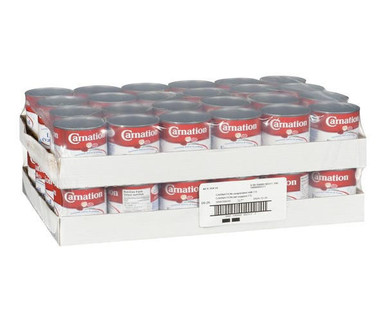
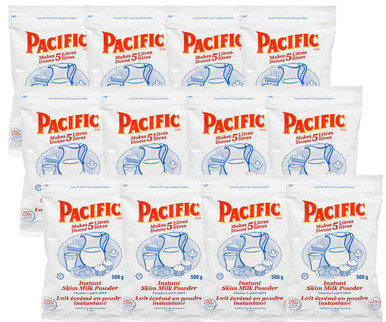
On sourcing: Carnation is the name most kitchens spec, and its consistency is why. Pacific behaves identically in service — same concentration, same heat stability — which makes it a sensible second supply line. Stocking both brands means one supplier shortage never takes the steam table down with it.
Case-pack canned and powdered milk, shipped from Calgary
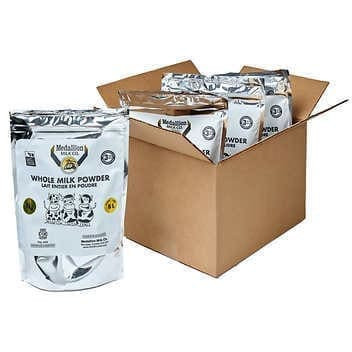
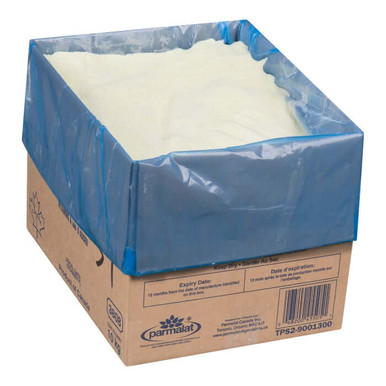
Every product below is stocked in our Calgary warehouse with real supplier images and spec sheets.




What operators say
We switched our banquet béchamel to the Carnation 48-case after losing two sauces in one wedding season. Haven't rebuilt a sauce mid-service since, and the case price beat our broadline distributor's split-case games.
Ordered the Eagle Brand 24-case and the Pacific evaporated together for our café and commissary. The green-dot red-dot tip from this blog is now literally our receiving policy.
Care-home kitchen, strict nutrition targets. The Pacific skim powder plus evaporated milk combo lets us serve cream soups our dietitian actually signs off on. Freight quote at checkout was the real carrier rate, no surprises.
Frequently asked questions
Can I substitute sweetened condensed milk for evaporated milk in a savory sauce?
No. A 300 mL can of sweetened condensed milk carries roughly 225 g of added sugar, against about 25 g of natural lactose in the same volume of evaporated milk. Once it hits a savory sauce the sweetness cannot be cooked out or diluted away. Keep the two on separate shelves and label the cases so a rushed line cook cannot grab the wrong can.
How long does evaporated milk hold on a steam table at 165 degrees Fahrenheit?
A properly built cream sauce made with evaporated milk holds through a four-hour service window at 165 degrees Fahrenheit. The same sauce made with fresh milk typically starts splitting inside the first hour, and often shows visible curdling by minute forty.
Why does fresh milk curdle on a steam table?
Sustained heat makes the proteins in fresh milk unwind and clump together, which splits the sauce and leaves it grainy. Evaporated milk has already been through retort sterilization and homogenization at the cannery, so its proteins have been pre-stressed by heat and stay put during long service.
How do I whip evaporated milk so it holds its peaks?
Chill the can and the mixing bowl thoroughly. Bloom one teaspoon of gelatine per cup of evaporated milk in cold water for five minutes, whisk it in, then whip. The gelatine gives the foam structure, so the peaks hold up during tray service instead of weeping after twenty minutes.
What is the shelf life difference between evaporated and sweetened condensed milk?
Unopened evaporated milk keeps for about 12 months; sweetened condensed keeps for about 24 months because its heavy sugar load acts as a preservative. Both dates assume cool, dry storage away from heat sources like steam kettles and dish machines.
How should I store canned milk once it is opened?
Never hold opened product in the tin — decant it into a non-reactive container with a lid. Opened evaporated milk is good for 3 to 5 days refrigerated; opened sweetened condensed lasts 2 to 3 weeks. Discard any can that bulges, smells sour, or shows curdling.
Can I make sweetened condensed milk from evaporated milk in an emergency?
Yes. Whisk 1 1/4 cups of sugar into 1 cup of cold evaporated milk — adding the sugar while the milk is cold prevents crystallization — then heat gently for 5 to 7 minutes until it thickens. It will cover a dessert service when the delivery truck is late.
Can evaporated milk replace whole milk in recipes?
Yes. Mix it 1:1 with water for a straight whole-milk replacement. Used undiluted it is about 2.25 times more concentrated than fresh milk, which is exactly what you want for richer cream soups and pan sauces.
Is there a real difference between Carnation and Pacific evaporated milk?
Carnation is the industry standard most kitchens spec by name. Pacific behaves identically on the steam table — same concentration, same heat stability. Many operations stock both so one supplier hiccup never empties the dry-store shelf mid-week.
How is shipping calculated on bulk orders?
We calculate shipping on live carrier rates at checkout, not on flat or subsidized tiers. Every order is priced against real LTL, parcel, or pallet-freight quotes from our Calgary warehouse to your dock. That means you never absorb hidden shipping costs into product margins — what we charge is what the carrier charges us, plus a small handling pass-through. For bulk and pallet orders this typically runs 15–25% lower than competitors who bake shipping into their unit prices, because the rate is transparent and tied to the actual shipment weight and distance.
Sources and further reading
- Dairy product regulations and labelling — Canadian Food Inspection Agency
- Safe food storage and handling guidance — Health Canada
- Canadian dairy processing and quality standards — Dairy Farmers of Canada
Why operators order canned milk from ChickenPieces
We stock the cases restaurant supply reps forget about, in a real Calgary warehouse, with no minimum order.
Foodservice case packs
24 and 48-can cases of the exact Carnation, Pacific, and Eagle Brand formats commercial kitchens spec — not retail multi-packs relabelled as bulk.
Real supplier images and specs
Every listing shows the actual product with a spec sheet tab, so your receiver can match the can on the dock to the can on the order.
Live carrier freight
Shipping is quoted at checkout on real parcel, LTL, and pallet rates from Calgary — the rate you see is the rate the carrier charges.
CFIA compliance
We supply CFIA-compliant, Health Canada-listed food products with bilingual labelling, suitable for commercial kitchens, care facilities, and institutional programs across Canada.
Put a four-hour sauce window on your next order
Tell us your volumes and we'll quote case-pack evaporated and condensed milk with live freight from Calgary — usually same business day.
Request a Quote