
2026 Aug 16th
Bursting Boba Add-Ins That Guests Pay Extra For
Bursting boba are juice-filled spheres with thin gel membranes that pop when bitten, releasing concentrated flavour. Operators add them to iced teas, lemonades, and mocktails as premium toppings customers willingly upgrade to. Proper refrigeration and quick assembly keep labour minimal and margins strong.
Bursting Boba Add-Ins That Guests Pay Extra For
For property managers and facility operators who want low-effort menu upgrades that turn standard drinks into premium offerings guests remember.
Key Takeaways
Six practical points to stock, store, and serve bursting boba profitably.
Thin membrane, big payoff
Short bath exposure during spherification creates fragile gel skins that burst instantly—this sensation is what customers pay premium rates to experience repeatedly.
Fruit-forward pairings win
Strawberry, mango, passion fruit, and lychee boba match classic milk tea, jasmine, matcha, and brown sugar bases without clashing or overwhelming.
Cold chain matters
Refrigeration at 4°C preserves sensory quality and texture; even optimal cold storage cannot stop gradual degradation over multiple days.
No heat, no hassle
Room-temperature membrane formation eliminates cooking equipment and energy costs, letting staff assemble drinks in minutes during peak periods.
Seasonal rotation, same setup
Operators switch flavours quarterly—strawberry spring, mango summer, pomegranate fall, berry winter—without changing equipment or retraining staff.
Beyond bubble tea
Popping boba works in smoothies, slushies, frozen yogurt, cold brew, sparkling sodas, and mocktails, expanding menu categories without expanding inventory complexity.
Why bursting boba outperforms chewy pearls
Understanding the spherification science behind the pop helps operators explain value to guests and staff alike.
Bursting boba originated in Taiwan during the 1980s as an evolution of traditional tapioca pearls, using modern spherification instead of starch cooking. The process reacts sodium alginate extracted from cold-water brown seaweed with calcium salts to form a thin gel membrane around liquid juice cores. This membrane behaves entirely differently from cooked tapioca: it does not chew, it fractures.
Reverse spherification—dropping calcium-rich juice into a sodium alginate bath—produces sealed spheres that hold liquid for five to seven days. The method needs no heating or cooling during membrane formation, which removes energy costs and simplifies high-volume production. Short bath exposure yields thin, fragile membranes that burst readily under light pressure; extended contact builds thicker, tougher gels that travel better but deliver less dramatic sensation.
Calcium lactate and calcium lactate gluconate have largely replaced calcium chloride in quality production because they leave minimal bitter aftertaste in the juice core. The spherification bath itself performs best at pH 5.5 to 7.0 and cooled temperatures between 10°C and 18°C, ensuring even gel formation without stalling or accelerating. Higher juice extract concentrations shift gelation temperature upward, which affects timing during production but allows flavour enrichment up to 3% concentration without degrading mouthfeel.
Match boba flavours to your base drinks
Strategic pairing turns standard beverages into layered experiences guests specifically reorder.
Strawberry, mango, passion fruit, and lychee popping boba pair optimally with classic iced milk tea, jasmine, matcha, and brown sugar bases. These combinations work because the fruit acidity cuts through creamy sweetness while the gel membrane adds textural contrast without competing for attention. Operators report that guests who try one flavour combination typically return to test others, building repeat traffic.
Taro, chai, Thai tea, and spiced brown sugar drinks benefit from boba's brighter fruit notes, creating complementary sweet-savory layering that reads as deliberate craft rather than random assembly. The key is balance: earthy or spiced bases need fruit-forward toppings to avoid heaviness, while delicate bases need restraint to avoid masking. Lavender and floral tea pairings succeed only with lighter boba flavours like strawberry or kiwi; bold tropical varieties overwhelm the subtle botanicals entirely.
Ready-to-use popping boba products enable combine-and-serve assembly that finished in minutes during morning rushes: iced tea plus flavoured boba plus syrup plus milk. This operational simplicity means one staff member can manage both standard and premium lines without separate prep stations. Seasonal rotation—strawberry spring, mango summer, pomegranate fall, berry winter—keeps the menu fresh without equipment changes or retraining cycles.
Keep cold chain tight from delivery to scoop
Temperature abuse ruins texture before flavour fades, and guests notice immediately.
Freshly produced boba requires refrigeration at 4°C, roughly 40°F, from manufacture through service. This is not merely preference; sensory quality and texture degrade measurably over time even under optimal cold storage. The gel membrane continues slow cross-linking in the fridge, gradually thickening until the signature burst sensation dulls to a disappointing squish.
The spherification science reveals why temperature discipline matters beyond simple spoilage prevention. Gelation temperature shifts based on juice concentration—higher extract addition raises the gelation point from 19.56°C to 23.65°C. This means concentrated-flavour boba approaches its gelation threshold at ordinary room temperatures faster than standard varieties, narrowing the margin for error during transport, display, or slow service.
Operators should verify refrigerator calibration weekly and train staff to return boba containers promptly after each scoop. Ambient service wells or ice baths that fluctuate above 10°C accelerate membrane deterioration even if the product never reaches room temperature. The five-to-seven-day optimal window assumes consistent cold chain maintenance; each temperature excursion shortens viable service life proportionally.
Build drinks fast without premium labour
Assembly speed determines whether boba upgrades survive busy periods or become bottlenecks.
The practical advantage of ready-to-use popping boba is elimination of the cook-and-hold cycle that tapioca pearls demand. Staff simply open chilled containers, measure or scoop, and add to finished beverages. This matters enormously for Airbnb properties where guests serve themselves during off-hours, or for facility cafes where one person handles both coffee and specialty drinks simultaneously.
Standard build is iced tea or cold brew base, flavoured boba measured with a portion scoop, syrup to taste, and optional milk or alternative. Total assembly time under two minutes matches standard iced tea service, so the premium add-in does not slow throughput. Operators can pre-portion boba into small ramekins or pump-dispensed containers during slow periods, converting rush-hour assembly to pure motion without measuring decisions.
Presentation affects perceived value significantly. Clear cups show boba suspended against ice and liquid colour; wide straws let guests control burst timing; small tongs or spoons for self-serve stations reduce cross-contamination risk. These details cost little but signal intentionality that justifies upgrade pricing in guest perception.
Position boba where guests actually see it
Visibility and naming determine upgrade rate more than flavour quality alone.
Popping boba extends beyond bubble tea into smoothies, slushies, frozen yogurt toppings, fruit teas, cold brew, sparkling sodas, and mocktails. This versatility means operators can feature the same inventory across multiple menu categories, increasing turnover and reducing dead stock. The critical step is naming: menu descriptions should emphasize the sensory experience—'popping passion fruit pearls'—rather than treating boba as silent ingredient.
Placement on physical or digital menus matters equally. Buried in a toppings list, boba becomes an afterthought guests skip. Featured as a highlighted upgrade with brief description—'Add popping boba for burst of real fruit juice'—it converts at significantly higher rates. Property managers running self-serve breakfast or beverage stations should label dispensers with the same experiential language, not merely flavour names.
Seasonal limited offerings create urgency without operational burden. A 'Summer Mango Burst' feature that disappears September first drives trial among guests who might otherwise default to standard orders. The limited format also excuses higher upgrade rates as special pricing, which guests accept more readily than permanent premium positioning.
Choose formats that match your volume
Container size and case configuration should align with your weekly usage, not your monthly ambition.
Bossen produces bursting boba in two primary membrane thicknesses indicated by product naming. Pure10 varieties use thinner gel formation that delivers maximum burst sensation but tolerates less rough handling during transport or self-service. Pure25 varieties build slightly thicker membranes that survive longer in dispenser environments or grab-and-go applications where guests may shake containers before consumption.
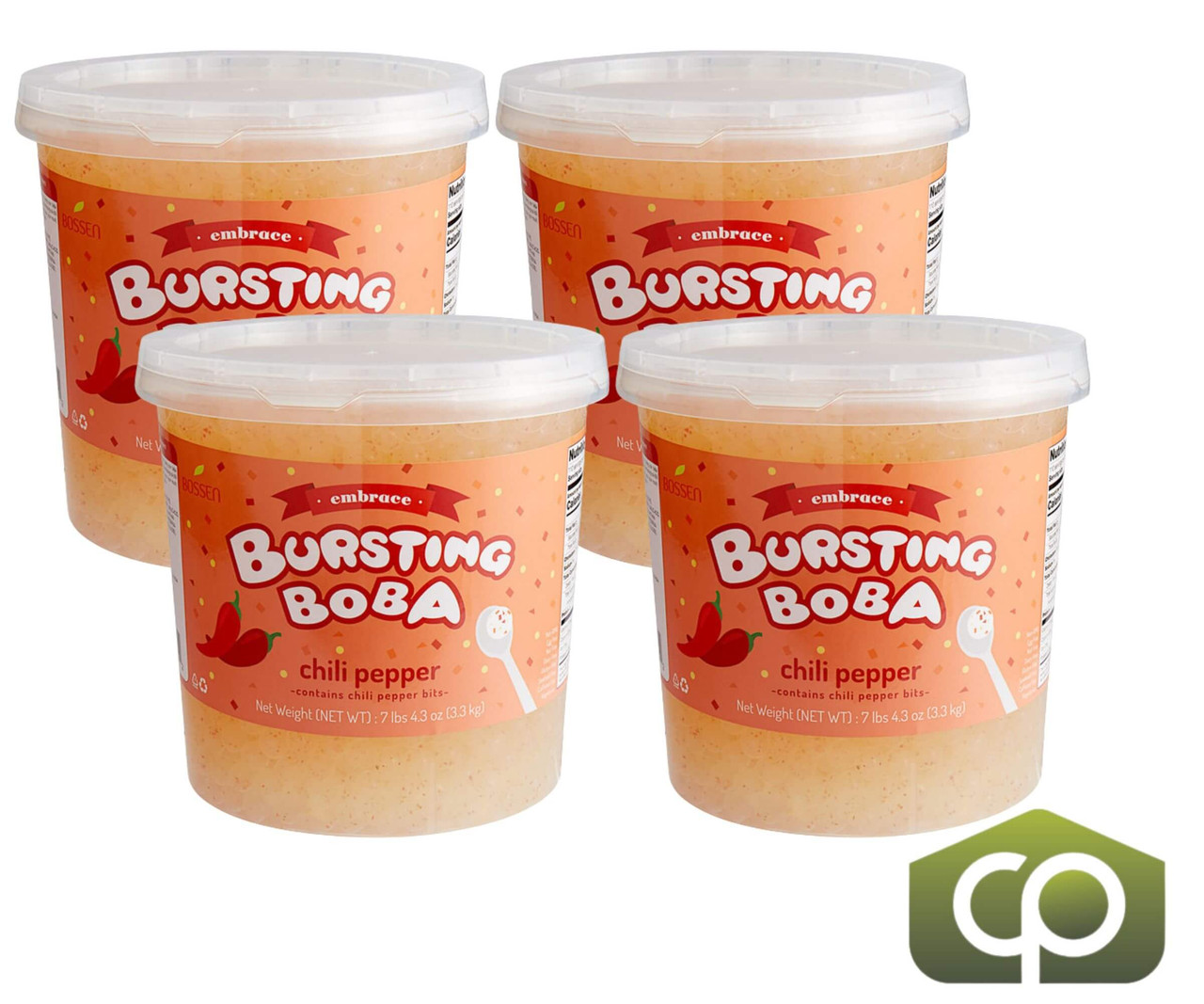
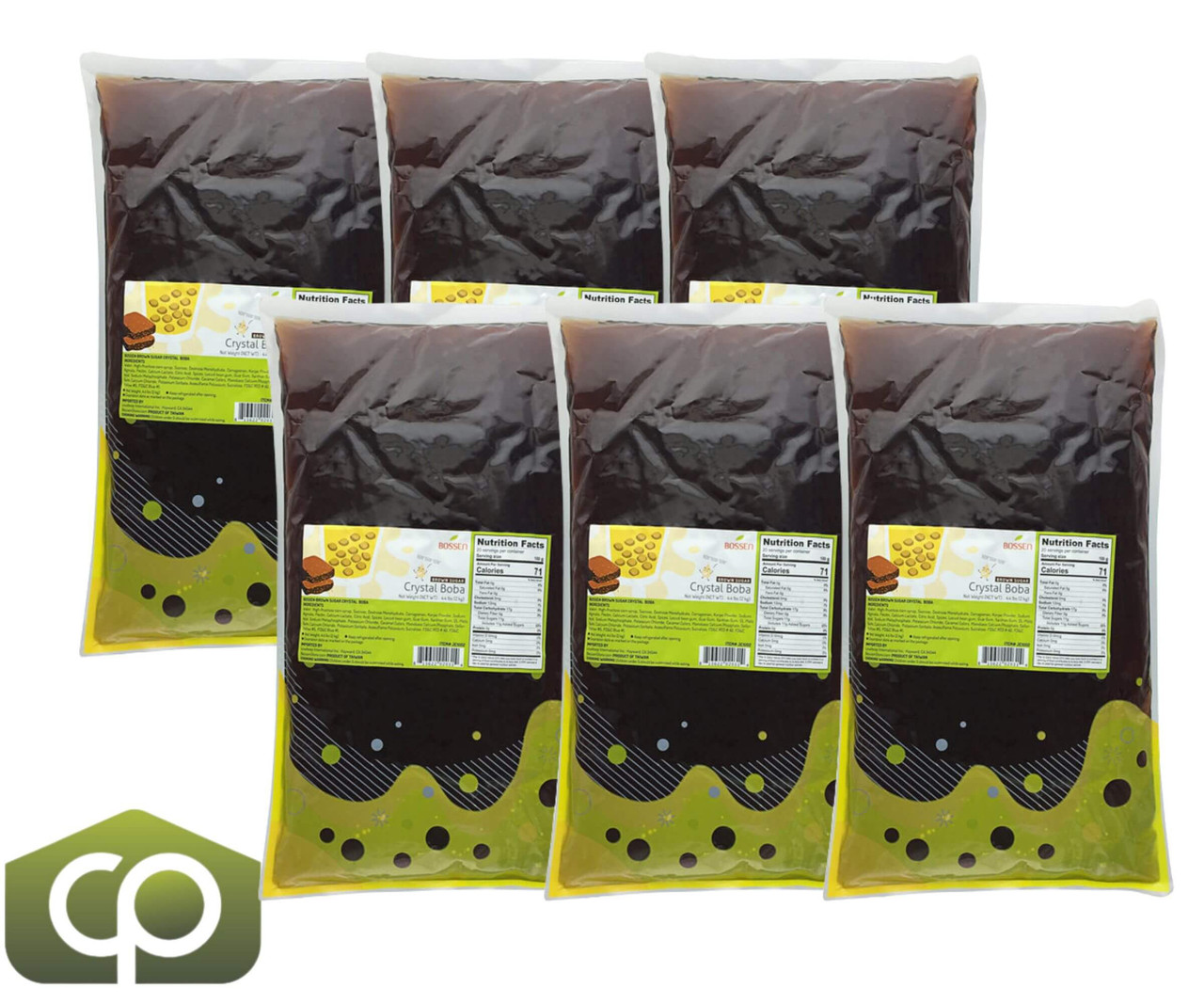
Chili pepper boba represents a niche category suited to operators with adventurous clientele or specific regional positioning—Calgary's diverse food scene supports experimentation that more conservative markets might reject. Brown and black sugar crystal boba, meanwhile, are not bursting varieties but chewy alternatives for guests who specifically request traditional tapioca texture. Stocking both types covers preference spectrum without alienating either camp.
Case configurations of four or six containers suit medium-volume operations with predictable weekly usage. Operators should calculate actual scoop-per-drink yield rather than guessing from container weight; typical portions are small enough that a single case lasts longer than intuition suggests. Starting with one or two proven flavours before expanding prevents inventory commitment to untested preferences.
Bursting boba options compared
Match membrane type, flavour profile, and application to your service model.
| Product line | Membrane type | Best application | Case format |
|---|---|---|---|
| Pure10 Dragon Fruit | Thin, maximum burst | Immediate serve, craft drinks | 4 containers per case |
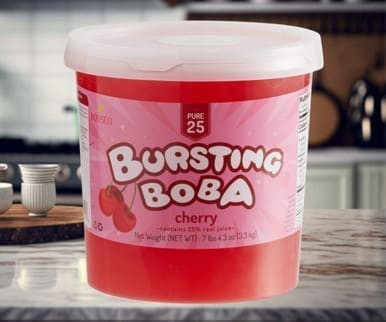
| Pure25 Cherry | Standard, balanced hold | Cafe rushes, dispenser use | 4 containers per case |
| Pure25 Mango | Standard, balanced hold | Seasonal features, all-day menu | 4 containers per case |
| Pure25 Passion Fruit | Standard, balanced hold | Tropical-themed beverages | 4 containers per case |
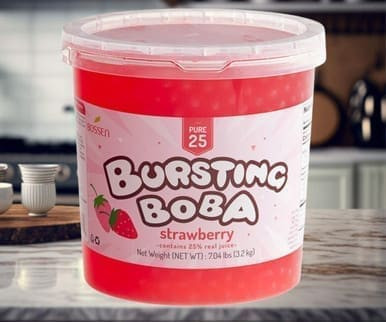
| Pure25 Strawberry | Standard, balanced hold | Spring menus, floral tea pairings | 4 containers per case |
| Embrace Chili Pepper | Standard, bold flavour | Adventurous guest segments | 4 containers per case |
| Brown/Black Sugar Crystal | Chewy, not bursting | Traditional bubble tea requests | 6 containers per case |
Browse bursting boba inventory
Ready-to-serve flavours and textures for immediate menu integration.




What Canadian property managers say
What Canadian operators say about adding boba to their beverage programs.
Added passion fruit boba to our iced tea station last summer. Guests started asking for it by name in reviews. We ran through two cases in July alone.
The mango boba let us create a featured lemonade without any new equipment. Assembly takes thirty seconds and guests pay the upgrade without hesitation.
We rotate strawberry in spring and cherry in winter. Same base drink, different boba, guests think we rebuilt the menu. Labour stayed flat.
Boba storage and use: Frequently Asked Questions
The following operator questions are answered with cited sources. Every FAQ links to Health Canada, CFIA, Canada.ca, or another authoritative regulator.
What are bursting boba and how are they different from tapioca pearls?
Products referenced:
- Popping Boba, Bulk Jars
- Tapioca Pearls, Bulk Bags
Source: I've been a bobarista at 3 different boba shops AMA - r/boba
Which brands of popping boba and toppings do boba shops actually use?
Products referenced:
- Popping Boba, Bulk Jars
- Fruit Syrups, Bulk
- Nata de Coco Jelly, Bulk
Source: I've been a bobarista at 3 different boba shops AMA - r/boba
Where can I buy popping boba online without getting burned?
Products referenced:
- Popping Boba, Bulk Jars
- Bubble Tea Topping Samplers, Case Pack
Where do I find popping boba locally?
Products referenced:
- Popping Boba, Bulk Jars
- Bubble Tea Topping Samplers, Case Pack
How long does an opened jar of popping boba last?
Products referenced:
- Popping Boba, Bulk Jars
- Topping Dispenser Bottles, Case Pack
Source: Where to buy popping boba in smaller quantities? - r/boba
Is it worth buying boba toppings through online marketplaces?
Products referenced:
- Popping Boba, Bulk Jars
- Tapioca Pearls, Bulk Bags
- Aloe and Lychee Jelly, Bulk
Source: Best brands for at-home boba, incl popping bubbles and jelly - r/boba
What can I charge for a boba add-in?
Products referenced:
- Popping Boba, Bulk Jars
- Fruit Syrups, Bulk
Source: Best brands for at-home boba, incl popping bubbles and jelly - r/boba
What is bubble tea and which add-ins should a new cafe stock first?
Products referenced:
- Tapioca Pearls, Bulk Bags
- Popping Boba, Bulk Jars
- Wide Bubble Tea Straws, Case Pack
Source: What is bubble tea? - Quora
How much topping do I need per drink and how many drinks does a jar yield?
Products referenced:
- Popping Boba, Bulk Jars
- Portion Scoops, Bulk
- Topping Dispenser Bottles, Case Pack
Source: Where to buy popping boba in smaller quantities? - r/boba
Related guides from ChickenPieces
Why operators source boba from ChickenPieces
Calgary-based inventory with national reach and compliance documentation.
Bulk case formats
Four and six container cases match real weekly usage without overwhelming small storage spaces or tying up capital in slow-moving inventory.
Proven flavour range
Twelve varieties including seasonal rotations let you test response before committing to standing menu placement.
Cold-chain verified
Refrigerated warehousing and transport documentation track temperature exposure from supplier to your receiving dock.
CFIA-compliant imports
All alginate and juice ingredients meet Canadian Food Inspection Agency import standards with documentation available for your health unit inspections.
Sources & further reading
- Enhanced Functionality and Bio-Accessibility of Composite Pomegranate Peel Extract-Enriched Boba Balls — National Center for Biotechnology Information (NCBI)
- The Science of Spherification: Sodium Alginate in Popping Boba — ChemTrade Asia
- Popping Boba — Wikipedia
- The 12 Best Bubble Tea Flavors You Need to Try in 2026 — Monin (Beverage Ingredients)
Request a boba sample kit
Test portion-sized samples with your actual base drinks before committing to case quantities. Submit your product list and delivery postal code for a tailored quote with live carrier rates.
Request a QuoteReferences: Health Canada - Food Chemical Contaminants CFIA - Food Safety for Industry.